By Gabriel Ewepu
ABUJA- AS the Tinubu-led administration intensifies efforts on food production, the National Agricultural Seed Council, NASCA, yesterday, maintained that food and nutrition security demand sustained quality seed production.
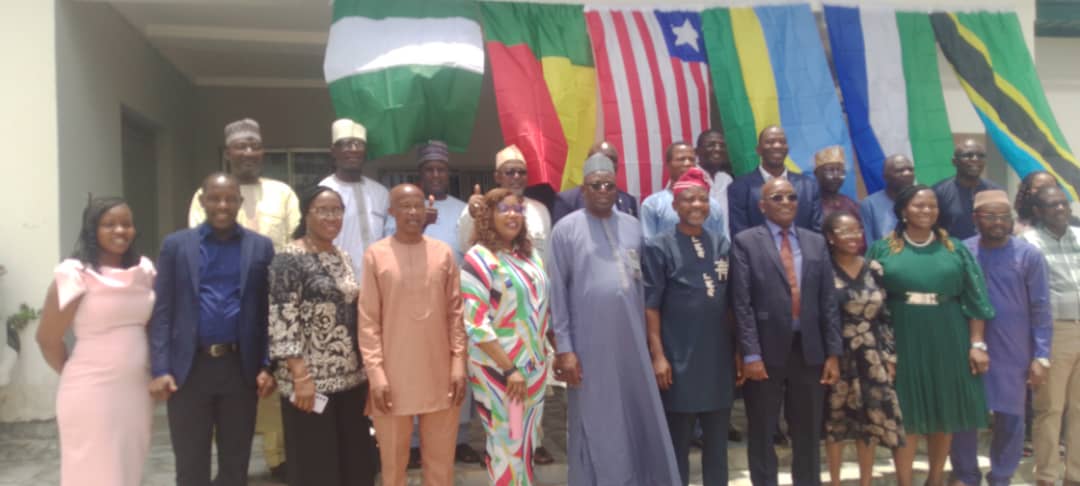
The acting Director General, NASC, Dr Khalid Ishiaku, stated this on the NASC’s hosting of the five African country delegations of seed regulatory agencies of Benin, Liberia, Sierra Leone, Rwanda, and Tanzania on a study tour to Nigeria.
Ishiaku speaking on the sidelines of the tour in Abuja, explained that the essence of the tour is to see how African countries harmonize their regulatory policies in the seed industry because they have common problems in seed issues as it affects agriculture in the continent, therefore they are to work tighter and ensure seeds are developed and traded within the continent instead of going outside to access seeds from other parts of the world.
Earlier in his address of welcome, he asserted that Nigeria is indeed positioned to positively influence other African countries to realize their potential.
Meanwhile, according to him, digitalization has been a strong point for Nigeria in the seed subsector, whereby some processes are digitalized including field inspection with the use of seed tracker and the seed codex for electronic authentication and traceability of seed, which was supported by the International Institute for Tropical Agriculture, IITA, also in the inclusion of diagnostic certification for vegetatively propagated crops.
He said: “Africa has a common problem and that is food insecurity, and it is an opportunity, based on those in attendance at the conference are equivalents of the National Agricultural Seed Council, NASC, from all those countries.
“So agriculture is now very important, we are not only looking at food security but also nutritional security, that is having somebody to feed on a balanced diet, and that is very fundamental for them, which is human development.
“So there is a need for us to sometimes come together. We are also involved in trading, and trading is very important to us. How do we smoothen the barriers, how do we make it easy for someone to sell his seed in Ghana and any other part of the world?
“So we need to brainstorm and try to come out with a common position. One of the common challenges as a continent is the farm-herder clash, therefore, we need to think of developing seed systems that would be able to reduce the competition today between human beings and livestock.
“Then we also need to encourage our research systems to come out with climate-smart varieties that will meet the test of time and present challenges.
“Nigeria seems to be on a very fast lane, there are requests from Nigeria to go and support our sister countries, and we also make sure we bring them up to developmental stages where we are today.”
Meanwhile, according to the acting NASC boss, the current tonnage of seed production in Nigeria stands at 451 metric tonnes, “As of this year, 2022-2023 production, we had a production of not less than 451 metric tonnes of assorted seeds, and the seeds are available to farmers because we even have dry season production that has been done, and even though some are used we still have replacements that is why our Minister is on his toe, he is monitoring it per minute per second.”
The Director General, Tanzania Official Seed Certification Institute, TOSCI, Patrick Ngwediagi, pointed out that it is now imperative for African countries to harmonize their seed systems.
“We are here to discuss issues that will finally allow us to harmonize seed sectors in Africa. We want to be speaking the same language so that when we do trade, we can trade with the same understanding of quality as the aspect of seed.
“If you don’t harmonize everyone has their own quality aspects of seed in their own country or their own region and therefore when you trade with others it becomes very difficult but if you agree on quality standards, for example, procedures for seed certification then finally it will be very easy to trade and we need to trade among African countries. We don’t have to buy seeds or receive seeds from outside Africa and we have all the potential to produce all types of seeds. So the only reason why we’re not trading is because we have not harmonized”, he added.
Meanwhile, the Seed System Specialist, IITA, Dr Mercy Diebiru-Ojo, also expressed optimism that with seed sector regulators coming together it will open a new vista for food production in Africa.
“As we can see from this conference, we have seed regulators from other African countries coming together and this is a giant stride to form harmonized African seed system, and this is going to be a very good one that will the continent as a whole and in terms of impact eventually this impact is going to be seen with demonstrated in the livelihoods of farmers as their yields will improve, and they will have access to good and healthy quality seed that is free from pests and diseases, and they can also make an income from it by turning them to business”, Diebiru-Ojo said.
Also speaking was the Executive Director Nigeria Stored Products Research Institute, Ilorin and Project Manager BASIC II, Prof Lateef Sani, who stressed that based on the African Continental Free Trade Area, AfCFTA, policies, the seed systems in Africa also need to be harmonized.
“Specifically, we are interacting with the Director Generals and Executive Directors of National Seed Councils from Tanzania, Nigeria, Rwanda, Benin Republic, Sierra Leon and Liberia. So it has a purpose. These are the leaders, they are the decision-makers. Based on our interactions, we have seen the need for harmonization.
“Our own understanding of the classification of seeds in Nigeria is different from the way they have it in Tanzania, whereas they are saying the same thing. So that is the reason why they have to harmonize the seed system, their terminology, and how do you promote the trade as to impact, and whether we are going to achieve it, is achievable because now the African trade issue, African Continental Free Trade Area, AfCFTA, that is on board now is harmonizing all products and creating space for all of us to sell, so you must be forced to actually harmonize.
“ECOWAS is also trying to integrate the regional house to be able to have a kind of quality approach to our food systems and so you must definitely harmonize”, Sani added.
Disclaimer
Comments expressed here do not reflect the opinions of Vanguard newspapers or any employee thereof.