By Evelyn Usman
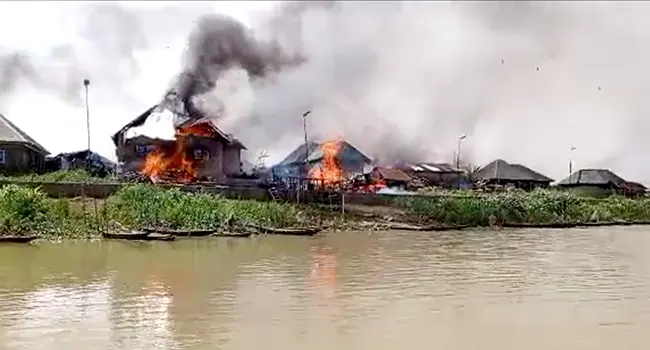
Emotions are still running high over the massacre of 17 personnel of the Nigerian Army, who were on a peace mission in Okuama community, Ugheli South Local Government Area of Delta State, last Thursday, March 14, 2024.
Residents of the community, the majority of whom have deserted their abodes for fear of being caught in the web of any likely Military invasion, claimed that tension escalated when the move by the Military to whisk away Okuama’s community chairman and some leaders, for further questioning, after the peace talk was resisted.
Residents claimed that during the resistance, the Military opened fire inside the town hall where the peace meeting was held, killing over two scores of villagers.
Though the Nigerian Army in a swift reaction, described the claim as propaganda, questions on the identities and corpses of the dead as well as how and where they were buried were raised by some Nigerians.
There are also doubts that what transpired on that fateful day has not been well explained. For instance, questions such as why would the attempt to arrest some of the community leaders by the Army personnel lead to their being mutilated with brazen disregard for constituted authority and how the re-enforcement team was overpowered, beat the imagination of reasoning. Other posers are: Were the personnel from 181 Amphibious Battalion that visited the community armed? If yes, how were they overpowered? If the reinforcement team intended to rescue its colleagues, how were they attacked? Was it necessary for the Commanding Officer to have been present in person? Did members of the community attend the peace talk meeting with arms?
Reactions
Reactions from different quarters have continued to trail the barbaric act, with the Executive Director, of Rule of Law and Accountability Advocacy Centre, Mr Okechukwu Nwanguma, calling on the need to unearth the remote cause of what he described as an indiscriminate action.
According to him, : “RULAAC commiserates with the families of the fallen gallant officers, and the Nigerian Military. It also welcomes the resolve of the military authorities to investigate and bring the culprits to book.
“The Delta State government must, as well, go beyond condemnation of this tragedy and ensure a thorough investigation of the root causes of the communal dispute and clashes that necessitated military intervention and unfortunately culminated in the ambush and deadly attacks and killing of the soldiers.
“.Military reprisals that result in the killing of civilians are not an acceptable practice under the rules of engagement. The rules of engagement are designed to ensure that military operations are conducted in a manner that upholds human rights principles and respects the lives and dignity of all individuals.
“Military reprisals are often regarded as an act of revenge, which brings into question the legality of the action. The use of force must always be proportional and limited to what is necessary to achieve a legitimate military objective. The indiscriminate use of force that results in the killing of civilians is a violation of international humanitarian law and human rights law.
“Therefore, it is important for the military to ensure that it does not descend to the level of criminals. It must ensure that its operations are conducted in compliance with the rules of engagement, which require that the use of force be proportional, necessary, and discriminatory. The military must uphold its duty to protect civilians, and not take part in acts of reprisal or any other form of violence against innocent civilians”.
Also, on her part, Convener, #Prayer & Support for the Nigerian Armed Forces, other Security Agencies, Amb. Mary Abayomi-Fatile, also condemned the killing of the Military personnel, insisting that the perpetrators must be brought to book.
Abayomi-Fatile noted that despite over two decades of democratic rule, peace and freedom remained elusive for Nigerians. She said, “During military rule, dialogue was often employed to resolve issues. Yet, under democratic governance, members of the military are being brutally murdered in settlements within the country. This occurrence is particularly alarming given that Nigeria is not at war”.
Military overstretched
The tragedy, however, brings to the fore the overburdened tasks of the Nigerian Army, especially in the face of the current state of insecurity. Ordinarily, the Police which is the lead security agency in Nigeria, would have been expected to carry out the peace talk between the warring communities, while the Army is expected to show up and restore any untoward situation when called upon, as stipulated in chapter 6, section 217 of the Nigerian Constitution.
Like some Nigerians argued, the presence of Army personnel as a mediator in a lingering land tussle between two communities underscores the need to enhance the capacity of the Nigeria Police and other paramilitary agencies to discharge their primary responsibility on internal security.
There have also been appeals by well-meaning Nigerians to the military to end reprisals on communities. This is apparently to avoid a repeat of the sad events in Odi, Bayelsa state, in the same Niger Delta region, in November 1999
Many are of the view that innocent civilians must not be made to suffer for the atrocities of a few deviants in the community, with a reminder that indiscriminate use of force that results in the killing of civilians is a violation of international humanitarian law and human rights law.
On the other hand, the majority of Nigerians insist that investigation should be intensified to arrest the real perpetrators and make them have their day in court.
Disclaimer
Comments expressed here do not reflect the opinions of Vanguard newspapers or any employee thereof.