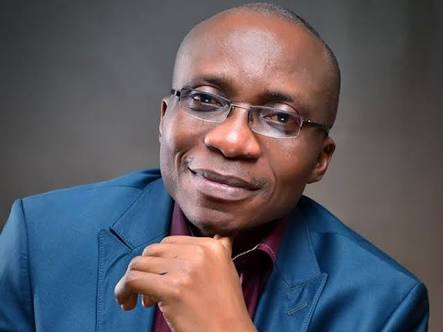
Ebiseni
By Sola Ebiseni
This piece was already posted before the unfortunate demise of the former Governor of Ondo State, Arakunrin Oluwarotimi Odunayo Akeredolu. In its tribute, the Afenifere described him as a “federalist and patriot” noting especially the establishment, in conjunction with his colleagues South West Southern Governors, of the Amotekun Security Corps for the security of the region and the constituent states as it ought to be in a true federation contrary to the most unacceptable monopoly of security by the Federal Government a caricature of federalism under the imposed military constitution”.
Aketi’s death was a great loss to the State and all who insist that Nigeria should be administered in line with the foundational principles of true federalism. God bless his memory.
The two personalities whose lives and times motivated this column are political and religious personalities because of the mix of both politics and religion during their times. One is Nehemiah, a Jewish leader who, by the biblical book of that name, came to limelight in the 20th year (445 BC) of King Artaxerxes in whose palace Nehemiah, a Jewish exile, was a servant, indeed the King’s cup-bearer.
Nehemiah who by serving in the King’s Court could be said to stand above his Jewish kinsmen in foreign land, did not allow his palace privileges to affect his passion for Judah, his fatherland. While most Jewish leaders in the bible were called and even compelled by God for leadership, including strong personalities like Abraham, the father, founder and patriarch; Moses, the generalissimo of the Movement of Jah people across the sea and wilderness pathfinder; Joshua, also a war commander yet a calm and astute leader of men and righteous administrator of land; David the avatar of the Jewish political authority whose star is even today the symbol of Jewish national identity embossed in its flag and its Judaism, Nehemiah was not recorded to have had divine calls to leadership.
Born away from his place of nativity and being told that it was not well with the remnant of Jews in Judah and particularly that the walls of Jerusalem were broken down, Nehemiah could not hide his feelings by which, contrary to conventional practices and injunctions, he appeared before the King sad. It was when the king noticed and drew his attention to the unacceptable sad countenance that he realised his grievous but involuntary error saying “ Then I was very much afraid”.
But overpowered by love for his nation he summoned the courage and declared before the King saying “Let the king live for ever! Why should not my face be sad, when the city, the place of my father’s grave lies in ruins, and its gates have been destroyed by fire” When the King surprisingly asked for his requests, Nehemiah sought divine guidance and prayed first “to the God of heaven” before asking that it may please the king “that you send me to Judah, to the city of my father’s graves that I may rebuild it”. His request was granted by the king who you might say had no business with the security of a territory under his conquest.
Nehemiah rebuilt Jerusalem walls and became the Governor of Judah for 12 years.
The other historic personality in our leadership studies is Oba Orhogbua of Benin who, by Benin’s historical accounts, was the 18th Oba of Benin (1550-1578 AD)
I have written several times about Oba Orhogbua particularly against the false historical narrative that Lagos or its monarchy was established by the Bini tracing it to his era. We have posited based on undeniable historical evidence that the founding of Lagos is inexorably traceable to the aboriginal Ilaje, the most riverine Yoruba tribe and the Awori Yoruba.
Our position was recently given vent by no less a personality than Professor Banji Akintoye when he recently wrote in his contribution to the debate that “the earliest non-Awori people to come trading with the Awori on the Awori coastal islands of Lagos, even long before the Awori had created any kingdom, were the Ilaje. According to traditions, of all the coastal Yoruba sub-groups, the Ilajes were the earliest pioneers of trade along the Yoruba coast… This coastal trade existed long before the coming of the earliest European explorers and traders to the coast of West Africa in about 1470s A.D”.
The only point in controversy between us and the authoritative professor is reference to what he called the “Awori coastal Islands of Lagos”. If as agreed, the Ilaje had existed in the coastal area “long before the Awori had created any kingdom” there could not have been and really no Awori political order or state with identifiable territory which had any coastal portion. In other words, the coastal island of Lagos was not of Awori but one in which the Ilaje and Awori were predominant with the former preceding.
Notwithstanding, it stands to reason that Lagos could not have been founded by the middle of the 16th century when Orhogbua reigned, when even Europeans had already then established flourishing trading relationships with Lagos and its aboriginal Ilaje and Awori Yoruba tribes who were the dominant population and ruling class.
We have reasoned that “rulership of the Lagos Island was on kindred, community or tribal basis among the original Yoruba groups, particularly the Ilaje and Awori and that the scenario was of the survival of the fittest. Stability, in terms of an organised monarchical order, was enacted at the ascendancy, during and after the reign of Oba AKINSEMOYIN who was of mixed Ilaje and Awori ancestry. His father was Ilaje while the mother was Awori of Apa, now in the Badagry area, where he also married. Subsequent Obas were of a mixture of Ilaje, Awori.
The same Akinsemoyin or Ilaje blood is traceable in many Lagos royal and notable families including Olumegbon, Oniru, Asogbon, Agoro, Ikudehinbu whose royal Court (Iga Oba Ikudehinbu) is still part of the royal territory of Lagos Island around the palace of the Oba of Lagos. As a natter of fact the Oniru family proudly referred to itself as the Oniru of Imahin land.
Oba Orhogbua who succeeded his father, Esigie is said to be the most formally educated Oba of Benin prior to Akenzua II. He was trained as a Catholic Priest before taking up the throne. However, like Nehemiah as earlier discussed, he abandoned those privileges and led Benin in war westwards Lagos. He was the first Oba of Benin to venture on the Lagos mission and notwithstanding the resistance of the Ilaje who occupied the coast exclusively and contiguously Orhogbua pressed on. He lost so much that only a Benin ragtag army invariably got to Lagos.
The above account was confirmed even by Benin historians including Jacob Egharevba and Oba Erediuwa, in a lecture on ‘The Evolution of Traditional Rulership in Nigeria’ which he delivered at the Conference of Traditional Rulers in the Governance of Nigeria held at the University of Ibadan on the 11th September, 1984 and which essentially later formed part of his book and memoirs. Orhogbua’s son and successor, Oba Ehengbuda, with the support of Itsekiri mercenaries, was not so lucky as he met his Waterloo in the hands of the Ilaje army at Eluju-Ibila and Ehengbuda himself chased to Langbasa lagoon where he was killed ending Benin’s ambitious expedition.
In all, the debate over Lagos history for which Benin name is now prominent would have been impossible but for the courage, determination and exploits of Orhogbua in spite of the risks involved in traversing such a long distance of complex riverine environment of over 300 kilometres between Benin and Lagos through the hostile Ilaje territory.
The same courage exhibited by Nehemiah in asserting himself, even as a slave, to ask that the King grant him favour to rebuild the walls of Jerusalem was similar to the determination of Orhogbua to make Benin now part of Lagos history. While Orhogbua met stiff resistance in the Ilaje army, Nehemiah met his own Sanballat, Tobiah and others. They both stood for history and are part of history today.
I don’t know why my grandmother who was not really a church person decided to name me Nehemiah. I was born outside my Ilaje Ondo state hometown, just like Nehemiah. He was Governor of Judah.
My grandmother is long gone but the prophesy behind her choice of Nehemiah is for an appointment time now at the verge of fulfilment.
Nigeria, we hail thee.
•Sola Ebiseni is the Secretary General, Afenifere.
Disclaimer
Comments expressed here do not reflect the opinions of Vanguard newspapers or any employee thereof.