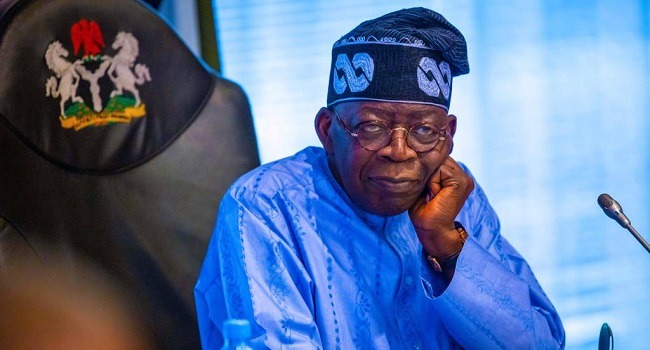
AS PART of his economic reforms for which he demands a mention in the Guinness World Records, GWR, as of right, President Bola Tinubu promised in October 2023 to bequeath Nigeria with a $1 trillion economy by 2026.
That sounds rather ambitious considering that 2026 is only two years away. But as many Nigerians have come to realise, in Tinubu’s dictionary, the word impossibility seems not to exist. Yet, the hurdle is a steep climb. Right now, Nigeria which is classified as a developing/emerging lower-middle income economy with an estimated population of about 220 million has a Nominal Gross Domestic Product (Nominal GDP) of $489.80 billion.
The implication is that as at the time in 2023 President Tinubu dreamt about the $1 trillion economy, the total market value of all goods and services produced in Nigeria stood at less than half a trillion dollars although the GDP per capita based on purchasing power parity, PPP, was $1.275 trillion.
But for those who think that doubling Nigeria’s GDP in two years is way too ambitious, President Tinubu upped the ante with the talk about a $3 trillion economy within the decade.
Of course, those records if achieved are enough for any president to earn, deservedly, a place of honour in the pantheon of world leaders. But the problem is that as lofty as the ambition is, Tinubu can only dream about it. Realisation of the dream will largely depend on what the banks decide to do.
Which explains the Central Bank Governor, Olayemi Cardoso’s hint in November last year, that the country’s apex bank would direct deposit money banks in the country to increase their capital base in order to make the projected $1 trillion economy plan a reality.
Cardoso, who made government’s intention known while delivering his keynote address at the 58th annual dinner of the Chartered Institute of Bankers of Nigeria, CIBN, in Lagos explained that Nigerian banks do not have sufficient capital relative to the financial system’s needs in servicing a $1 trillion economy unless action was taken.
Even as he buttressed the stability of the extant financial system, the CBN boss doubts the capacity of the banking industry to serve the projected economic growth and envisioned larger economy.
“We need to ask ourselves: Will Nigerian banks have sufficient capital relative to the financial system’s needs in servicing a $1.0 trillion economy in the near future? In my opinion, the answer is ‘No!’ unless we take action. Therefore, we must make difficult decisions regarding capital adequacy. As a first step, we will be directing banks to increase their capital,” Cardoso said.
To be sure, this is not the first time Nigeria will be travelling on this route. Faced with similar circumstances that the Tinubu administration is facing now, President Olusegun Obasanjo, in 2004, embarked on elaborate banking reform which focused on consolidation through the mechanisms of merger and acquisition resulting in the raising of the capital base from N2 billion to a minimum of N25 billion.
The consolidation programme, which ultimately reduced the number of banks from 89 to 25 in 2005, and later to 24, was necessitated by the need to strengthen the banks and position them to play pivotal roles in driving development across the sectors of the economy.
Addressing the Special meeting of the Bankers’ Committee in Abuja on July 6, 2004, Prof Chukwuma Soludo under whose watch the consolidation project was executed as the then CBN governor noted that: “In Nigeria, we have 89 banks with many banks having capital base of less than US$ 10 million, and about 3,300 branches. Compare this to eight banks in South Korea with about 4,500 branches or the one bank in South Africa with larger assets than all our 89 banks. The truth is that the Nigerian banking system remains very marginal relative to its potentials and in comparison to other countries – even in Africa.”
Soludo’s successor, Sanusi Lamido Sanusi, in a lecture he delivered at the University of Warwick’s Economic Summit on February 17, 2012 reemphasised that the need for an effective and efficient banking system is underscored by the critical role they play in national economic development.
“Banks, for instance, mobilise savings for investment purposes which further generates growth and employment. The real sector, which is the productive sector of the economy, relies heavily on the banking sector for credit. Government also raises funds through the banking system to finance its developmental programmes and strategic objectives,” he said.
Sadly, while the 2004 consolidation achieved the goal enhancing the capital base of the banks, they failed on the critical goal of stimulating the economy by guaranteeing access to capital in spite of their boosted financial portfolio.
One of the biggest problems inhibiting the growth of the Nigerian economy is the fact that most entrepreneurs don’t have access to capital because the banks don’t give them loans. Without increased flow of credit to Small and Medium Scale Enterprises, SMEs, especially the productive sector, an economy tanks.
Essentially, Nigerian banks have become transactional, the reason why they continue to declare mouth-watering profits even as the economy bleeds and many Nigerians are hauled into the poverty dungeon.
Not only that, considering the level of inflation and gross erosion in the value of the Naira, the N25 billion capital base which was considered adequate 20 years ago has become pittance, hence the need to recapitalise.
So, it is déjà vu because we have been here before. Yet, the seeming lack of seriousness by the CBN to follow through is enervating. Apart from making the pronouncement on the intended policy, the government has not rolled out any plan to drive the recapitalisation exercise.
That is where Jeff & O’Brien UK, an international professional knowledge development firm that has pioneered financial, corporate and deep content knowledge development in Africa, steps in.
As a critical player and knowledge advisor in the sector, Jeff & O’Brien assisted in capacity building as well as sensitising operators and banking professionals with the necessary applicable expertise that enabled them take positions when the financial system passed through the consolidation route in 2004.
And recognising that the banking sector is at the cusp of yet another crucial phase in its evolution with the prospects of a recapitalisation exercise as a critical ingredient of CBN’s tool to ensure stability of the financial system and to enable it drive the proposed $1 trillion economy, as it was the case 20 years ago, Jeff & O’Brien has elected to organise a one-day colloquium and technical workshop in Lagos on “Bank recapitalisation and value creation strategies” with Prof Kingsley Moghalu, former Deputy Governor of the CBN, as the keynote speaker and Mr Mark Andrews, Jeff & O’Brien faculty and subject matter expert as the speaker.
Mr Pascal Odibo, Group Country Director at Jeff & O’Brien, and host of the colloquium, says it “offers a rare opportunity for key stakeholders in the sector to understand the various moving parts for a bank recapitalisation both at technical and strategic levels in order to be able to make informed decisions that will enable the executive team and the board build stronger and virile financial institutions.”
It is not enough for the Tinubu administration to thump its chest on a $1 trillion economy without taking steps to make it a reality. While it is achievable since the potential has always been there, deliberate steps must be taken if we are to reach the Promised Land. But beyond recapitalisation, the banks must perform their core duty of providing loans to businesses and consumers, which help finance new investments and stimulate the economy. That is the only way an enhanced capital base of banks can add value to Nigeria’s economy and impact on living standards of the citizenry.
Disclaimer
Comments expressed here do not reflect the opinions of Vanguard newspapers or any employee thereof.