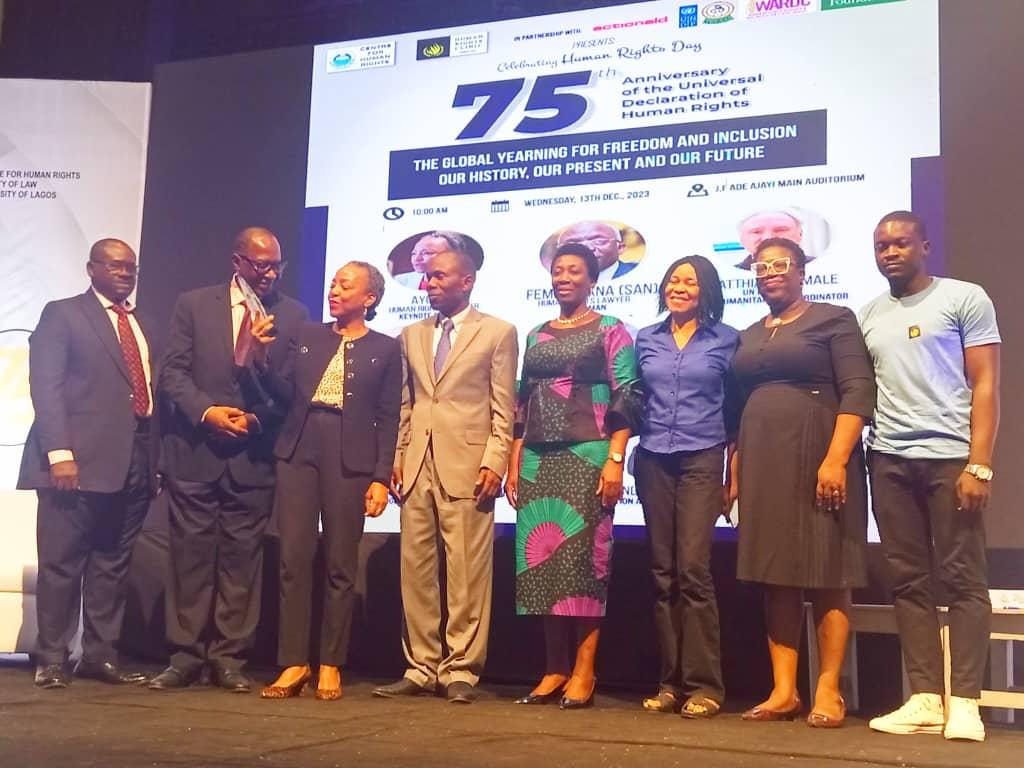
…as UNILAG Centre for Human Rights marks Int’l Human Rights Day
By Josephine Agbonkhese
The Federal Government has been advised by experts in the human rights community to ensure the adoption of a more student-centred approach in its plan to develop a Standard Operating Procedures, SOPs, towards the creation of a legal pathway for the prosecution of school-related gender-based violence.
Giving this advice Wednesday in Lagos, at an event organised by the Center for Human Rights, Faculty of Law, University of Lagos, UNILAG, to commemorate this year’s International Human Rights Day, the experts also decried the prevalence of sexual and gender-based violence in academic institutions across the country.
At the event which also marked the 75th anniversary of the Universal Declaration of Human Rights, UDHR, Dr. Abiola Akiyode-Afolabi, Director, Centre for Human Rights, UNILAG, said that in spite of ongoing efforts, there is a recognised need for a more inclusive and student-centered approach to the development of SOPs for the eradication of SGBV.
“Change begins with conversations, and today marks a significant step towards fostering a safer, more inclusive educational environment. Students’ voices will shape the path towards eradicating SGBV and promoting a campus culture rooted in respect, equality and empowerment,” she said.
Also speaking, the Country Director, ActionAid Nigeria, Andrew Mamedu, who was represented by Anawyat Yakubu, said the global theme for this year’s International Human Rights Day ‘Freedom, Equality, and Justice for All’ is a call to action urging societies to unite in safeguarding the inherent rights of every individual.
“With the world facing a climate emergency, the cost-of-living crisis, and multiple conflicts, the Declaration of Human Rights is more relevant than ever, yet the promise of dignity and equality in rights for everyone remains unfulfilled. As we in ActionAid Nigeria plan towards the development of our new Country Strategy Paper, we hold on to our Human Right-Based Approach to programming, contributing our quota towards furthering human rights to defeat poverty in Nigeria,” Mamedu said.
He further called on the Nigerian government and all relevant stakeholders to be intentional in taking all necessary steps required to ensure Nigerian citizens enjoy their human rights by adhering to the provisions of the constitution, acts, laws, polices and international instruments signed unto, that protect the rights of its people.
On her part, Indian human rights advocate/Diplomat, Shweta Shalini, decried the lack of respect for human rights that has permeated the global society.
“Having legislation and implementation of legislation are two different things. I am here to urge each and everyone of you to respect human rights. It is important to respect human rights and protect human rights everywhere for everyone. It is important to mobilise the political parties to have gender sensitive, human rights sensitive policies and laws in every country concerned.”
Others who spoke at the event chaired by Femi Falana SAN were the Dean, Faculty of Law, UNILAG, Professor Ige Bolodeoku;
Dr. Joe Okei-Odumakin, President, Women Arise; Ayo Obe, renowned activist and lawyer; Damilola Olaluwoye-Tunde, President, Human Rights Clinic, University of Lagos; Prof. Ayo Atsenuwa, Deputy Vice Chancellor, University of Lagos; and Prof. Oyelowo Oyewo SAN among other distinguished industry personalities.
The event, which hosted over 1,000 students, also featured an inter-faculty debate with a N200,000 cash prize; a panel discussion on the National Gender Policy, and the conferment of Human Rights Lifetime Award to legal luminary and Professor of Public Law and Criminology, Prof.Gbenga Akingbehin.
Held in collaboration with the Human Rights Clinic—a pioneering endeavour by the University of Lagos aimed at cultivating the next generation of human rights practitioners, the event was funded by ActionAid; Women’s Rights Advancement & Protection Alternative, WRAPA; MacArthur Foundation; and the UNWomen with support from the Women Advocates Research & Documentation Centre, WARDC.
Disclaimer
Comments expressed here do not reflect the opinions of Vanguard newspapers or any employee thereof.