By Prof Tayo Oloruntoba-Oju
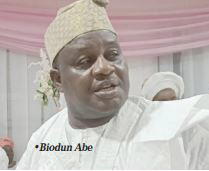
I have known Biodun Abe, whom I will interchangeably refer to as Biodun or Abe, and occasionally, Kester, for close to four decades, and it is with great enthusiasm and utmost admiration that I put this tribute together in his honour. On December 26, Biodun turns 60 and takes a retirement bow of honour and distinction from the National Theatre where he has worked for over three decades.
I have, in my title, referred to him as ‘boulder builder’ because the description best captures the strength, resilience, irrepressibility, and solidity that our most distinguished theatre scenographer, accomplished administrator, and technical director of over three decades, Mr. Biodun Abe, is so readily associated with.
“Boulder” in its ordinary meaning refers to a rock. It is also “a metaphor used to describe the scope of a product or feature,” and to “represent the largest, most complex tasks that require the most effort and resources to complete.” The boulder builder metaphor also comes from my recollection of how, in 1995 he built an awe-inspiring rocky landscape for the set in the stage production of Wale Ogunyemi’s Langbodo at the University of Lagos.
Biodun has a pedigree that is impressive. Upon his completion of his youth service way back in 1988, he got a blank check for automatic employment, under the government of General Ibrahim Babangida, anywhere of his choice in the country. He had distinguished himself as a Corper, and had earned a national merit award that carried automatic employment. Most others would have opted for a white-collar job in some high-flying government parastatal; not Biodun. He promptly chose the National Theatre, which he saw as a training ground for a career in technical theatre, in furtherance of his irrepressible love for the theatre.
I go back in time!
I go back to the mid 8os when I encountered Biodun as a co-student in the Department of the Performing Arts. Biodun was every student’s delight. His carriage was that of confidence, his mien amiable and his voice, when he spoke, was mellifluous and had a teasing baritone around it. He bubbled over with energy and charisma and didn’t need to have met you before to tease you in the most disarming and enchanting way the very first time your paths crossed. Biodun made conversations easily, yet never in any intrusive way, nor with any condescension. He was also widely read, and engaged with issues of local and international politics and economics with perception, persuasion, and compelling intellection. He was not one to put another down, not even when he disagreed sharply orradically with you. Once, we contested the same departmental association position together. Before the election, Biodun sought me out and said one of the most profound things I ever heard: “hello sis, the position we are vying for is one and we are two. It has no life, knows no one, yet has been known to tear the closest of kith and kin asunder. Only one of us will get it. I pledge my utmost loyalty and support in the event that you get it.” He got it, yet did not allow the victory to intoxicate him; no, he reached out to me for support and repeatedly reminded me that providence it was that got him there, and that I well could have been the occupier of the seat. That singular act of his marked the beginning of a friendship that has notwithered over time.
Unusual choice
Abe tirelessly worked and grew through the ranks at the National Theatre where he chose to build and establish himself as a theatre practitioner, over and above ‘juicy’ placements in choice places like the Central Bank of Nigeria, the NNPC, etc., any of which he could have had, had he as much as showed interest. This hard, uncommon and unusual choice speaks loud of Biodun’s irrepressible passion for and unalloyed commitment to the theatre. As a student in the Performing Arts Department in the 80s, he had shown this unwavering interest by having a formidable presence in the department through his involvement with and participation in most departmental productions. He was also a most visible member of the ‘Courtyard’, our Courtyard, that ritual space that housed our social collective and gave being to our foggy dreams and desires of a then fantasised future. For us, as students of the Performing Arts, the Courtyard was not just a random space in the department, nor was it merely an alternative to “Africa Hall’ where major productions held. No. The Courtyard was an awe-inspiring enclosure where we daily gathered, bantered, perspired, fought and made up, dreamt big and small dreams, cried and laughed, simmered and mellowed, and most importantly, engaged in a daily ’purification’ and ‘purgation’ of emotions. Such was its evocative power that no one ever left the Courtyard ‘unreconciled’ or ‘untransformed’. There, we sought and found catharsis, that feeling of being made whole and purified.
Situated right in the bellyof the departmental complex, with classrooms, props, costumes and makeup rooms adjoining it, as well as a technical theatre workshop space, it was a magical space of unending possibilities for us all. It was home, yet it was the epicentre of our workspace.
It was where we held long rehearsals, even for productions major enough to make the ‘Africa Hall’ that served as our major theatre venue at the time.
The Courtyard
Biodun’s heavy presence on this sacred ground, the Courtyard, is what makes me go this far down memory lane. He brought vivaciousness and vibrancy to the space with his enchanting voice and disarming humour. Yes, his sense of humour is both legendary and potent and would melt the hardest of hearts.
He had, still has, this unassuming way of telling jokes and ‘pulling legs’ in ways that would elicit laughter and douse the thickest of tensions. There are natural storytellers, endowed to engage and enthuse their audience through a perfect blend of patience, charisma, and good timing. Our dear Kester is one, adept at telling stories through large gestures and compelling delivery that have the power to transport his listeners to the place and time of his stories.
He also knew when to stop. I do not recall any of his jokes turning sour or leaving a bad taste in the mouth, nor do I recall him not knowing when to stop. In fact, Biodun would often ‘disappear’ almost as soon as the tickling began. And it didn’t take long to know where he disappeared to and what his interest was. As mentioned earlier, rooms adjoined the courtyard, including a theatre carpentry workshop where Mr. Awogbami taught us some of the practical components of stage construction. If you saw Biodun one moment cracking jokes in the Courtyard, rest assured you’dfind him the next moment in Mr. Awogbami’s workshop where he developed his artistic interest in drawing, painting, as well as visual and decorative arts. In no time, Biodun built his own stage models for specific productions and almost always assisted with stage lighting for enhanced visual effects. His choice of a humble beginning at the National Theatre was, therefore, not a random choice but a well-thought-out one to give full reign to an ambition he had been sure of and had nursed for so many years. I was later to know that Biodun indeed had a strong background in Fine Arts. His choice of theatre as a profession had, therefore, very strong roots and was quite intentional.
I set the above as the much I know about Biodun Abe’s background and his venture into, nay, adventure in,the theatre. For Biodun, the theatre has been one long, pleasurable, and fulfilling adventure, rather than a job; a vocation to which he is well-suited and of which he is well-trained and most highly qualified. Today, Biodun stands indomitable as one of Nigeria’s most visible and successful, theatre technicians and accomplished stage and set designers, with well over fifty major productions, ranging from such very difficult-to-produce ones as Wole Soyinka’s The Bacchae of Euripides and Alapata Apata, to Wale Ogunyemi’s Langbodo and Ola Rotimi’s Kurunmi – to his credit. He is a Fellow of Theatre Arts and member of many professional bodies both locally and internationally. I have often marveled at the seeming parallel between Biodun’s exuberant and cheerful nature and his extravagant commitment to lighting and brightening up the stage, giving the stage a captivating and mesmerizing decor, forging an ambience of life and living, creating and recreating mood and atmosphere, speaking loud and clear through frames and flannels even before a word is uttered on stage, experimenting with colours to generate contrast, and breaking boldly through the boulder to chart a path for the playwright whose work is temporarily seized by the director and blown open by conspiring actors. Like Ogun, Abe emerges as the ‘first darer and explorer’ that is symbolically and metaphorically entwined, engraved, entrenched and embodied in the production. We see him not but feel him first; the fiery man on the ‘hilltop hut’ that houses those gadgets that switch from light to darkness, the ‘protector of orphans’ and provider of ‘roof over the homeless.’ Yes, Abe not only builds the stage that houses the actors, he also gives shape, sound, sense and sight to these actors; he gives them being. Armed with metal and wood, like Ogun, he ‘bridges the abyss’ that separates the living (the audience) from the ‘dead’/’ancestor’ (the stage and its world of make-belief) serving, here, as that first and singular ’actor’ who took the plunge, embraced the chthonic realm, and paved the way for other participants (actors, crew and spectators alike) to journey together in the search ofmeaning and harmony.
Master of devices
Bidoun is a master of devices, gadgets and tools through which stage illumination, visibility and multiple dimensionality are achieved. The actor speaks to and of spatial agency and relations, Abe builds the very bounds and boundaries of this spatial agency and gives content and contour to the spatial practice and artistic relations amongst the actors on stage and between the actors and the audience. Within this context, Abe is a creator and influencer, in the theatre, of the actual production of space and spatial relations, and the distinct actualisation of both as a social site for cultural continuity.
Biodun Abe has stood tall, like a colossus. He has organized and led teams that have represented, in flying colours, the National Theatre in competitions, festivals, carnivals, etc., across the length and breath of Nigeria. More impressively, he has led performing troupes that have represented Nigeria at numerous African and international film festivals. It is to Biodun’s credit that he served as the Director of a project jointly put together by the Development Agenda for Western Nigeria (DAWN) and Legendary Productions to institute the very first Yoruba museum of war history. Deploying his skills, training and resourcefulness, he directed a stage performance ‘detailing Kiriji, the epic Yoruba war experiences in the 19th century and listed as one of the longest civil wars in human history.’
Abe’s work ethic and sheer devotion to the theatre isextraordinary. He runs two distinct families, and both with equal devotion, attention and love. The one is his family consisting of a devoted wife and loving children who have given as much support to him as he has lavished love and devotion upon them. For a man so actively and deeply involved in the theatre, it has taken years of enormous sacrifice and undiluted love to build the strong home that Biodun has, and I would love to pay a short tribute at this juncture to his beautiful and dependable wife of several years for reciprocating my dear brother’s love for family with a commensurate love and devotion, plus patience, perseverance, and commitment to family values. Mojisola Abehas, without doubt, done well in keeping the home front duringBiodun’smany ‘on-location-induced’ absences from home. It, indeed, takes only a good and strong partner to ‘survive’ marriage to a full-time theatre practitioner and administrator, no matter the amount of amelioration offered for the long and frequent absences. I am particularly happy that Biodun found a friend and sister in Mojiand seize this opportunity of his 60th birthday and retirement to also wish them many more seasons of rain, dew, and sunshine together.
The other family that Biodun shares his time, love and devotion with is his theatre family. The theatre is his second home, that other space where, as with his wife and children, he walks and runs, laughs and cries, eats and drinks, naps and snaps, and breaks yet remains whole. It is the place where, more than anywhere else, he gives free reign to his creativity. The theatre is of course home to many. It offers peace and tranquility, it gives fulfilment from days and nights of work and sweat; that fulfilment that comes from being first drained and totally purged, and then refilled, refreshed and renewed again. Working with Biodun, and I have worked with him some bit, takes one through this cathartic journey in a way that is at once humbling and satisfying.
Team leader
Our Kester, Biodun, is a team leader, with excellent communication and collaboration skills and strategies, and has the capability and capacity to combine teaching with mentoring. His team is an assemblage of artisans and young but vibrant graduates. The ease with which Biodun bridged the age gap between him and his ‘boys’, as well as the extent to which he would go to humanize them, was amazing. Even though he held the key to the technical skills and was clear-headed about the design and template he wanted, he involved them in decision making and taking. It was incredible how he seamlessly navigated being the boss and being one of the ‘boys’ as they all exchanged banters in-between work that was evenly distributed and jointly discharged. The sensitivity he paid to their needs was also striking. They practically ate from the same plate and he obviously knew the strength and capacity of every single one of them and was on top of who to put in charge of what and when to tell the one who needed a break to catch one. Like him, every single one of them exuded a seeming inexhaustible energy that was both impressive and compelling.
Years after our undergraduate days, I had the privilege of working closely with Biodun Abe at a professional level in my capacity then as the foundation head of department of the Performing Arts Department of the Adekunle Ajasin University, Akungba-Akoko in Ondo State. We got approval for our lights and sound equipment and installation only the weekend before the Monday of the verification exercise to be conducted by the National Universities Commission (NUC). When I called to inform Biodun Abe of this sudden requirement , it was only to ‘fulfil all righteousness’, as I was near certain that thiswas a ‘mission impossible.’ But then, thiswas Biodun Abe, whose motto seems to resonate with Eugene Lee’s dictum that “Nothing makes me happier than an impossible space and an impossible project.”
It was a Friday. Biodun assembled every single equipment required, hired a truck, assembled his team, and hit the road from Lagos to Akungba so early the following morning that, by 2pm that Saturday, work had commenced on the installation at the Obasanjo Multipurpose (OBJ) Hall that was our ‘Africa Hall’ equivalent in Akungba. He rented a generator and, with his dedicated and hardworking team, worked all through to the very early hours of Monday morning, only pausing to take short breaks to eat and to take short naps. Okay, let me say this in very clear terms. From about 2pm, when Biodun and his team arrived the OBJ hall, work commenced all through to 6 a.m. of Sunday when they retired to the University Guest House where they were lodged to freshen up and take a short nap. By 10am on Sunday, they were back, full of renewed energy and in very high spirits. Like the day before, they worked right through to around 6am the following day (Monday). The level of professionalism and impressive work ethic displayed remain highly remarkable and commendable till date. Two things struck me: one, Biodun took on every challenge in his stride and solved every single problem that surfaced. Upon getting into the ceiling of the hall to lay wires and cables for the heavy lighting and sound equipment to be installed, the decay and depreciation of the very old electrical wiring in the hall stared them in the face. It was so bad that many others would have been deterred and may in fact had insisted on some major upgrading and, or renovation. ButBiodun took the situation In his strides and headed straight for Ikare, the nearest major town, from where he returned with a welder and newly procured electrical wires and fittings. Two, after completing the lights and sound installation, Biodun resumed a conversation we had had previously. We had talked about the need for a lighting booth and I had informed him that the university was phasing our needs and that, hopefully, in another financial year it would be in a position to release money for the booth. Tapping me lightly on the shoulder, Biodun said, “Please let me have a word with you,” and we stepped aside. “My sister,” he said, “I’ve thought through this booth stuff and decided to donate it as a gesture of solidarity with you for the good work you’re doing here. It really isn’t nice that this much equipment should beleft unused until the many months away that the university would be in a position to mount one.” And that was how Biodun returned to Lagos to work out the logistics of making good his pledge. In no time, he was back with his team to install the lighting booth he pledged and fully funded.
This part of my tribute to Biodun Abe would be incomplete without mention of two other related phenomenal things with respect to his brief but impactful involvement with Adekunle Ajasin University, where I lecture, specifically its Department of Performing Arts at that critical stage of its conception and birth. As head of department, I was able to persuade Biodun to agree to give lectures on lighting to our students as an adjunct member of our teaching team. During the verification exercise required for the full takeoff of academic programmes by the NUC, the team of theatre professors on the NUC team were particularly happy and impressed that we were able to attract Abe to our programme and they expressed this to us in the presence of the then Dean of Arts, though they also expressed scepticism that we would be able to retain him for long given his tight schedules. Unfortunately, although Biodun magnanimously gave a couple of lectures to the students as soon as the programme took off fully, it became difficult to retain himon the staff list due tologistic reasons,and as feared by the NUC team.. Another historic contribution of Abe’sis that he also delivered the very first public lecture in the department to an audience that also includedstudents of English Studies and Performing Arts, withthe Dean of Arts as chief host, and myself and the Ag. Head of the Department of English Studies as co-hosts.
Supportive friend
In all of this, Abe has been a supportive friend and professional colleague who places friendship over and above personal interest. At a very critical point in my career in AAUA, he stood by me and was prepared to lose a major project that would have earned him good money. I found this singular act of his most humbling, endearing and honourable.
I end this tribute by proposing a toast to a man of inexhaustible energy and very large creativity; a dogged worker and problem solver, one who builds from the inside to the outside; from abstract to reality. I pay tribute to a man whose first love is the theatre and whose entire career has been unrelentingly dedicated to building and crafting stage (set and light) designs and models, and squaring up to challenges of traversing difficult spaces and landscapes. I salute and celebrate a man whose passion, patience, panache, perseverance, and painstaking proactiveness have cut him out as a colossus in his field of technical theatre. As he turns sixty today and takes a bow from the National Theatre after a most meritorious service, I join family and friends to speak more strength to his bones, and good health too, as he commits to even greater service to humanity, most likely through the very theatre that has been his ‘home and abode’ for almost an entire lifetime.
Disclaimer
Comments expressed here do not reflect the opinions of Vanguard newspapers or any employee thereof.