By Chris Onuoha
With what started in the Republic of Benin on Oct 27, as a kick off of the 2023 LagosPhoto Festival, the annual art fiesta organised by African Artists’ Foundation (AAF) moved the grand opening to Lagos, Nigeria on November 3, at Alliance Française, Mike Adenuga Center, Ikoyi and unveiled a colourful exhibition that will run till November, with a convergence of art lovers, curators and art critics in attendance.
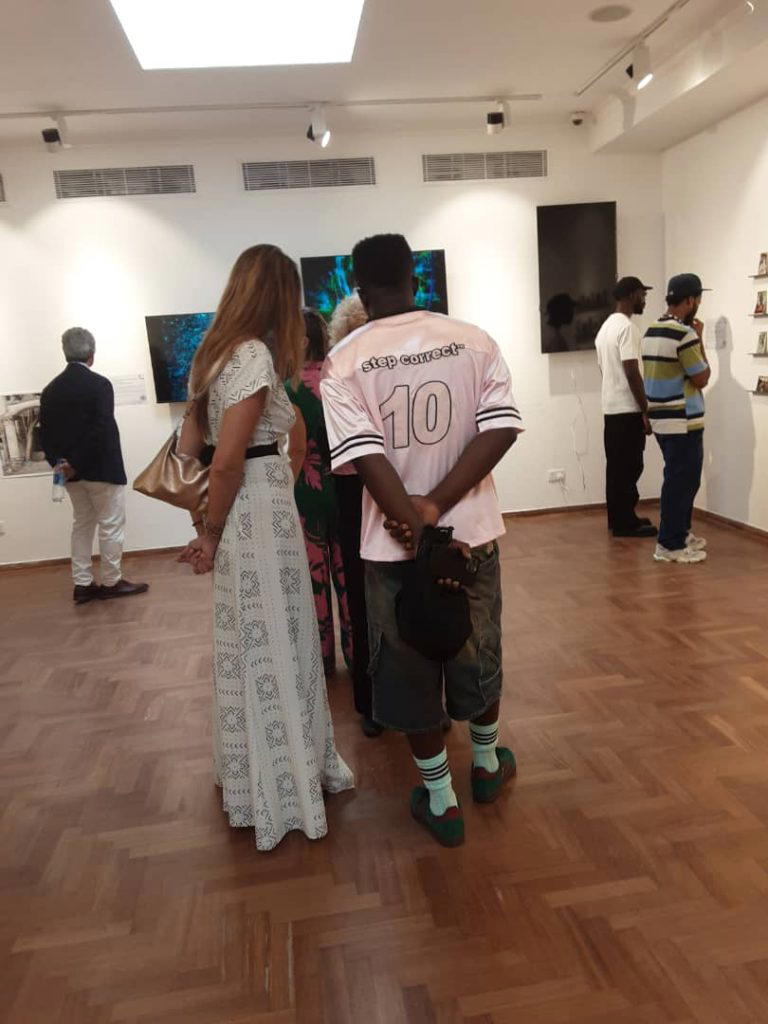
The LagosPhoto exhibition themed; “Ground State-Fellowship within the Uncanny” is a collection of photographs by international photographers who, through their lens, explored and exposed the uncanny nature of the ecosystem and its surmounting challenges to mankind.
In the words of the curator, Paula Anta, ‘listening to the deepness’ as the title goes, serves as a converging topic that incorporates different themes and concerns related to the observation and understanding of the outside with the unique vision of the artists, such as their involvement with experiences, cultural phenomena, environmental issues, myths, or the social features of others.
“The female platform Cómo ser Fotógrafa (How to be a woman photographer) presents an exhibition project featuring the work of four artists. Beyond the different backgrounds and themes, the four projects shown have an important thing in common. All of them stem from a place of listening, avoiding direct conceptualization, and adopting an attitude initially based on respect and observation of the outside, which makes it possible to think more deeply later on.”
She noted that contradiction is a part of all realities, no matter how painful or beautiful they are. It is also a part of all inherited attitude, whether they are hopeful or helpless, adding that in order to find coherence, you have to have feelings and positions that are at odds with each other. “This creates a paradox. So, we should take the time to listen and try to understand the depth of the situation, no matter how contradictory it seems,” remarked Paula Anta.
Explaining further, she stressed, “We might get closer to a better understanding or, at the very least, a sense of sisterhood by listening. One thing that can save us in the end is our ability to understand how other people feel, even if we see things differently. The projects address these questions from sociological, cultural, visual, and archival perspectives, using different themes and languages. It includes the use of portraiture, landscapes, document on, and in sum, all the possible resources that can bring us closer to these questions and move us to listen to the outside world with a higher level of consciousness.”
Furthermore, x-raying the featured four artists at the Lagos side of the photo exhibition, they all had different stories to tell from different perspectives. In Lagos, ‘The History of Quietude’ by Chris Iduma offers a fresh perspective on the vibrant yet chaotic city of Lagos. Having lived there for three decades, he re-imagines this bustling metropolis through a lens-based project. Contrary to the common portrayal of Lagos as a high-octane commercial hub, the project delves into the city’s quieter and more isolated moments. It seeks to find serenity in a city that seemingly never sleeps, capturing the essence of Lagos beyond its bustling surface.
Through this project, Iduma explores the interplay of personal and collective memories, presenting an introspective reflection on Lagos as an urban phenomenon. Each image candidly frames the negotiation of space and time by its subjects, unveiling uncanny moments of reflection in this dynamic city. Lagos: The History of Quietude invites viewers to discover a different side of Lagos, one that embraces silence amidst its constant activity.
Chris Iduma, is a self-taught photojournalist and visual artist with a keen focus on exploring themes of identity, women, history, and socio-political issues. With a BSc in Mass Communication from the University of Lagos, Nigeria, Iduma transitioned to photography after graduation. His work serves as a protest against the constraints of time and societal constructs, examining how the context of his photography influences the viewer’s connection to their social and cultural identity. Chris Iduma in the span of his career has garnered international recognitions that include a nomination for the Leica Oskar Barnack Newcomer Awards in 2021, and has exhibited at the British Journal of Photography Open Walls Arles exhibition in Arles, France. His photographs are part of the collection at the Museum of Fine Arts Houston, and he earned a 2023 MacDowell Residency Scholarship in the United States.
The next in the feature is M’hammed Kilito, a Moroccan visual artist. His ongoing project, “Before it’s gone,” documents the challenges faced by Moroccan oases, which are crucial ecological buffers against desertification. Climate change and human intervention have threatened these ecosystems, leading to a significant loss of palm trees and increased droughts.
Kilito’s work aims to raise awareness about these underreported issues and their impact on the oases’ residents. He has explored the effects of climate change, including desertification and fires, while also delving into local practices and conservation efforts. Ultimately, this project showcases the resilience of inhabitants, farmers, scientists, and citizen associations working to protect these green oases in the desert, ending with a message of hope.
M’hammed Kilito, a documentary photographer based in Casablanca, explores the dynamic between people and their environments, unraveling narratives that deepen our understanding of this connection. His work delves into cultural identity, the sociology of labour, and climate change. He has earned recognition as a National Geographic Explorer, a recipient of the Magnum Foundation grant, a World Press Photo award, and a grantee of the Prince Claus Fund and AFAC. His work has been displayed at esteemed international venues and festivals and featured in prominent publications. Additionally, Kilito co-founded KOZ, a collective dedicated to impactful storytelling alongside fellow Moroccan visual artists.
Next in line is Jon Henry. He featured with a theme, ‘Stranger Fruit.’ The African-American Brooklyn based from Queens, New York in response to the senseless murders of black men at the hands of police, embarked on his project, titled; “Stranger Fruit.” According to him, “Despite the prevalence of smartphones and dash cams recording these incidents, lives continue to be cut short by unnecessary violence. The project raises a pressing question: Who will be the next victim – Jon, his brother, or his friends? How can these men be protected?
Within the chaos of media coverage, lawsuits, and protests, the plight of mothers often goes unnoticed. Regardless of the legal outcomes, they must carry the profound burden of losing their children. Through photography, Jon captures mothers with their sons, evoking the emotional weight of such pain. These mothers haven’t experienced the loss, but they understand the grim reality that it could happen to their families. Moreover, the project portrays these mothers in isolation, highlighting the profound absence they face. After the trials end, the protesters disperse, and the news cameras depart, it’s the mothers who are left behind to mourn and survive.
The project’s title, “Stranger Fruit,” draws a poignant parallel to the song “Strange Fruit.” Rather than black bodies hanging from trees, it underscores the tragic reality of our families and communities losing their members to street violence. His work reflects on family, socio-political issues, grief, trauma and healing within the African American community. His work has been published both nationally and internationally and exhibited in numerous galleries including Aperture Foundation, Smack Mellon, and BRIC among others. Known foremost for the cultural activism in his work, his projects include studies of athletes from different sports and their representations. He was recently named one of The 30 New and Emerging Photographers for 2022, TIME Magazine NEXT100 for 2021 included in the Inaugural 2021 Silver List.
Lastly, we have Zora J. Murff featuring “True Colors” or “Affirmations in a Crisis.” True Colors is a chronicle of survival by trailblazing artist Zora J. Murff. He constructs a manual for coming to terms with the historical and contemporary realities of America’s divisive structures of privilege and caste. Since leaving social work to pursue photography over a decade ago, Murff’s work has consistently grappled with the complicated entanglement of the medium in the histories of spectacle, commodification, and race. True Colors continues that work, expanding to address the act of remembering and the politics of self, which Murff identifies as “the duality of Black patriotism and the challenges of finding belonging in places not made for me—of creating an affirmation in a moment of crisis as I learn to remake myself in my own image.”
Zora J Murff is an artist and educator living in Rhode Island, USA. He is interested in the American social conception of race and the role of visual culture inside of that system. He has created multiple books of his work including his latest monograph, True Colors (Or, Affirmations in a Crisis. His work has been exhibited and collected widely by institutions like the Museum of Modern Art, LACMA, Studio Museum in Harlem, and the V&A Museum. In 2023, Murff was named an International Center for Photography Infinity Award winner.
Speaking with the founder, LagosPhoto Festival, Azu Nwagbogu, he said, “Lagos Photo show is about hosting ideas. It is not about showing lights, but about putting out dialogues in the global conversation of art. We don’t want to create an art conversation that is going on globally. If you look at the works of Henry, you can see challenges like violence going on daily. Here in Nigeria and Africa, men are killed for different reasons and women have to deal with the situation. We tried to create that conversation around issues that relate to our common challenges.”
He noted that for this year’s theme, “fellowship within the uncanny” that people are dealing with the global recess. “After the pandemic, there is global shift of events. Every community looks within themselves to solve their problems instead of looking to the outside world for solutions. The integration is all about guiding the people who are where they are not meant to be,” he said.
He also mentioned that the spirit behind a continuous successful journey of LagosPhoto projects is teamwork. “We had a great team that worked with us for over 12 years. We also have a support system that is working and we believe that we have a great passion for the art.
“If you check our website, you will notice that we have featuring local and international artists. Last time, we had artists from over 40 different countries. Nothing has changed from the way we operate. Perhaps, the only thing that looks different in this particular exhibition is that we create a different space for each exhibition,” Nwagbogu said.
In conclusion, the curator of the project, Paula Anta, a Berlin based artistic director with over 20 years working experience said, “This is my first time here in Nigeria. This year’ project holding in Lagos for the grand finale is opening at a stage that the world are grappling with many challenges and the ecosystem taking a lot from it. “The questions we wanted the artist to address is that if we have seen a lot taken away from the earth, and gotten to a point where we cannot stop it, how do we find help within our community so that we can continue to thrive and exist?”
Paula noted that “in terms of solutions, we don’t get more answers, other than dialogue as regards to what is important to us. The engagement will help us share energy together and empower how we live together.”
Disclaimer
Comments expressed here do not reflect the opinions of Vanguard newspapers or any employee thereof.