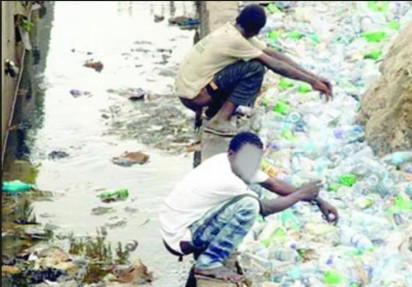
File: Open-Defecation
By Charly Agwam & Femi Bolaji
The menace of open defecation in the Katagum local government area of Bauchi State, headquartered in Azare, one of northern Nigeria’s most prominent cities was defeated after the council was assessed and declared Open Defecation Free (ODF) by the Minister of Water Resources, Mr Joseph Utsev in September.
This success story, according to the Bauchi Ministry of Water Resources and Rural Water Supply and Sanitation Agency (RUWASSA), in partnership with UNICEF, was achieved through a multi-stakeholder approach and the introduction of affordable modern pit latrines.
The modernized toilet, in the form of a plastic toilet seat, is constructed to block out foul air and gas from escaping from the pit after being set in a concrete slab, making it safe to use for women and children, including people living with a disability.
As part of the government’s effort to ensure the sustainability of the initiative, government-trained Toilet Business Owners (TBOs) are linked with micro-finance institutions where they access funds on a revolving basis for business expansion.
Speaking with Vanguard, a Water Sanitation and Hygiene (WASH) member in the Katagum local government area, Ado Bala said that the adoption of a modern toilet, Sato pan contributed greatly to Katagum’s new open defecation-free status.
“For long, we have been battling with the issue of open defecation. But we recently found out that with new technology, we could build toilets everywhere in our locality for a very affordable cost. We were trained on how to mobilize and construct in households and public places like markets and motor parks.
“The interesting thing about this new toilet is that apart from the fact that it is safe for use, it doesn’t require much water to flush down faecal matter. With a kettle of water, one can conveniently use the toilet,” he said. “There are no issues of smell or house flies around the toilet area. It also doesn’t cost much, with about N3,000, one can conveniently have a decent toilet.”
A user of the toilet, Ummi Abubakar told Vanguard that since the construction of the new toilet, she stopped having reoccurrence of toilet infection like she used to when she used the pit toilet.
She said: “The toilet is very safe to use. When we had a pit toilet, I used to have toilet infections but since we adopted this safe method, I and my girls have not had an incident of toilet infection. Apart from that, we don’t have to worry about not having a lot of water for flushing because, with a kettle of water, you can flush and clean up.”
Another user, an eleven-year-old physically challenged boy, Hassan Khalid said that he finds the toilet easy to use because he wouldn’t “need to carry a big bucket of water to flush after using the toilet”.
Reacting to the open defecation-free status of the council, Commissioner of Water Resources, Nuhu Zaki said the government, in its quest to rid the State of diseases, identified and trained private entrepreneurs on sanitation marketing for improved latrine construction in households and public places like markets and motor parks.
According to him, 194 toilet business owners, (TBOs), 582 masons and 116 toilet investors have been trained on improved latrine construction both for households and public places across the state.
“About 5,934 communities have been declared ODF while two other LGAs are at different levels of becoming ODF; that is Bauchi and Zaki LGAS. One of the sustainability processes is the training of private entrepreneurs on sanitation marketing for improved latrine construction in households and public places like markets and motor parks.
“Awareness was created through promotional activities by the government and toilet business owners on the need for improved latrine uptake, and there is high demand for improved latrines by households. Toilets are important because access to a safe functional toilet has a positive impact on public health, human dignity and personal safety.
“Sanitation systems that are not safely managed, allow the spread of diseases like soil-transmitted diseases and water-related diseases such as cholera, diarrhoea, typhoid fever, dysentery, and neglected tropical diseases among others,” he noted.
Katagum joins Dass, Warji, Shira, Gamawa, Bogoro, Ganjuwa, and Toro local government areas as open defecation-free zones in Bauchi State.
The United Nations Children’s Fund (UNICEF) has commended Katagum local area of Bauchi State for attaining open defecation-free status after being declared open defecation-free.
Officer-in-Charge/Chief of Field Office, UNICEF Nigeria Bauchi, Dr Clement Adams, commended the council during a Media Dialogue on World Toilet Day 2023 in Azare.
“Let me start by congratulating the people and government of Katagum LGA on the attainment of open-defecation-free status. It is a testament that when we work together, we can achieve great strides.
“I celebrate this achievement with the people of Katagum while championing the call for increased action to promote healthy, clean, and safe communities by enhancing access to sanitation facilities.
“This year, the WTD is themed ‘Accelerating Change’ to highlight the journey towards achieving “SDG 6- Clean Water and Sanitation. We are about seven years away from 2030 – the global target for the SDGs. We must therefore reinvigorate our efforts if we must meet the sanitation target of SDG 6 – safe toilets and water for all by 2030.
“The access to safe and clean toilets prevents the spread of diseases; the access to safe toilets means children, especially girls, and women are protected from the risks of attacks and abuse if they had to go into bushes to defecate; access to basic WASH services is integral to school enrolment, attendance, retention, and completion – the benefits are numerous,” he said.
He noted that in Nigeria, about 48 million people still defecate in the open – mostly in the rural areas, saying that it bears severe socio-economic losses for the country.
“The achievement in Katagum LGA needs to be replicated across the country. Out of 774 LGAs in the country, only 105 have been validated ODF.
The availability of improved toilets in schools, public spaces, homes, and health facilities is critical to discouraging open defecation.
“Economically incentivizing sanitation through the approach of toilet business owners, creates jobs and improves income generation while leading us to our goal to become open defecation free.
“The ODF status is not an end. It is a means to an end. This means we must sustain the actions attained for us, ODF in Katagum LGA and other LGAs in Bauchi state. Because if we do not, the achievement we celebrate today may be lost,” he added.
Disclaimer
Comments expressed here do not reflect the opinions of Vanguard newspapers or any employee thereof.