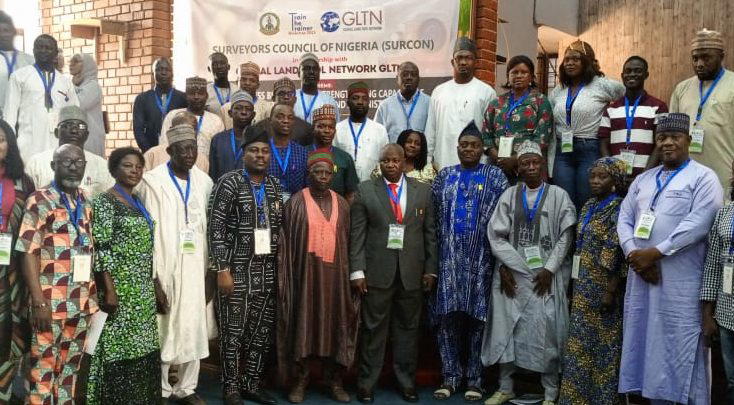
Some of the participants in the workshop
By Marie-Therese Nanlong
Jos – The Surveyors Council of Nigeria, SURCON has decried the numerous challenges that hinder the effective delivery of land administrative services to Nigerians and advocates effective land reform, good land governance, inclusive land administration, sustainable land management, and effective coordination within the land sector.
SURCON which collaborated with the Global Land Tool Network, GLTN to organize a weeklong train the trainers workshop on awareness building and capacity strengthening of communities on fit-for-purpose land administration, insisted that land and land issues are key factors in economic development and the need to give the needed attention to land matters.
In a keynote address at the event held at the National Institute for Policy and Strategic Studies, NIPSS for surveyors, traditional rulers, women and youth groups, and other stakeholders in the land sector from Katsina, and Plateau States, a SURCON consultant, Professor Ibrahim Choji stated that implementing the fit-for-purpose land administration in States in the federation would bring solutions to the menace facing land matters in the country.
His words, “This is an event organized by the Surveyors Council of Nigeria (SURCON) in partnership with the Global Land Tool Network (GLTN). The GLTN is an active and diverse alliance of international partners dedicated to increasing access to land and ensuring secure tenure for all, with particular focus on marginalized groups such as the poor, women and youth.
“Its main objectives are to develop, disseminate, and implement land tools and approaches that are pro-poor and gender-responsive. These efforts contribute to land reform, good land governance, inclusive land administration, sustainable land management, and effective co-ordination within the land sector. The ultimate aim is to uphold human rights, reduce poverty, promote economic prosperity, and achieve sustainable development, thus aligning with the Sustainable Development Goals, the New Urban Agenda, and other regional and national policy initiatives.
“The Fit-For-Purpose, FFP land administration approach provides an overall, enabling framework (spatial, legal and institutional) for implementing the GLTN Phase 2 Project at the country level to deliver security of tenure at scale. The adoption of an FFP land administration solution can be considered a prerequisite for effectively implementing the GLTN tools at the country level… This workshop which is a build-up on previous ones has the following objectives.
“To upscale the sources of Fit-For-Purpose awareness campaigns carried out recently; to advocate for the security of tenure over customary rights of communities, individuals, landholders and women; to promote recognition and protection of rights of informal settlers, minorities and the landless. Various studies conducted in Nigeria revolving around land administration and governance have revealed that institutions charged with land administration are faced with a range of challenges and constraints that hamper the effective delivery of land administrative services to the citizenry.
“These challenges range from hierarchical and outdated organizational structures, excessive bureaucratic processes, to the high cost of fees for service delivery, leading to frustrations culminating into poor land governance. Thus, it is no surprise that about 30% globally and 3% of lands in Nigeria have no property titles. There are also systematic inequalities (lack of inclusion) in the form of women’s limited
access/control over land, compounded with the fact that issues of youth and People Living with Disabilities being minimally addressed.”
He added “The plights of minorities, informal settlers, and the landless are more often than not protected, nor recognized. We have problems of rapid urbanization and pressure on land. All these challenges have called for a change in paradigm with the need for the adoption of the FFP Land Administration System developed by GLTN, as facilitated by the UN-Habitat.
“The term FFP is not new, what is new is relating the term to building sustainable land administration systems, particularly in less developed countries like Nigeria where the system is expected to be flexible, and focused, on citizens’ needs such as providing security of tenure and control of land-use rather than focusing on top-end technical solutions and high accuracy surveys.
“An FFP approach includes flexibility in the spatial data capture approaches to provide for varying use and occupation; inclusive in scope to cover all tenure and all land; participatory in approach to data capture and use to ensure community support; affordable for the government and society to use; establish and operate, and reliable in terms of information that is authoritative and up-to-date. Upgradeable is about incremental upgrading and improvement over time in response to social and legal needs and emerging opportunities.
“The FFP approach has been successfully implemented in a number of developing countries like Rwanda, Ethiopia, Kenya, Kyrgyzstan etc. and the results have served as excellent best practice for other countries to use. FFP solutions thus provide opportunities for land administration systems to deliver benefits to a wide range of stakeholders far better than conventional approaches…”
Earlier, the Registrar of SURCON, Surveyor Kunle Olugbemiro noted that the workshop is aimed at equipping relevant stakeholders with knowledge of FFP and strengthening their capacity to deal with land matters as he tasked the participants to step down the training to others in their communities.
Goodwill messages were received from Surveyor Mohammed Kabir, Dr. Isah Funtua, Abigail Banga, Mariam Ashiru and the Acting Gwom Rwei Kuru, Da Pius Jugu, among others as participants promised to contribute their quota for an effective land administration in Nigeria.
Disclaimer
Comments expressed here do not reflect the opinions of Vanguard newspapers or any employee thereof.