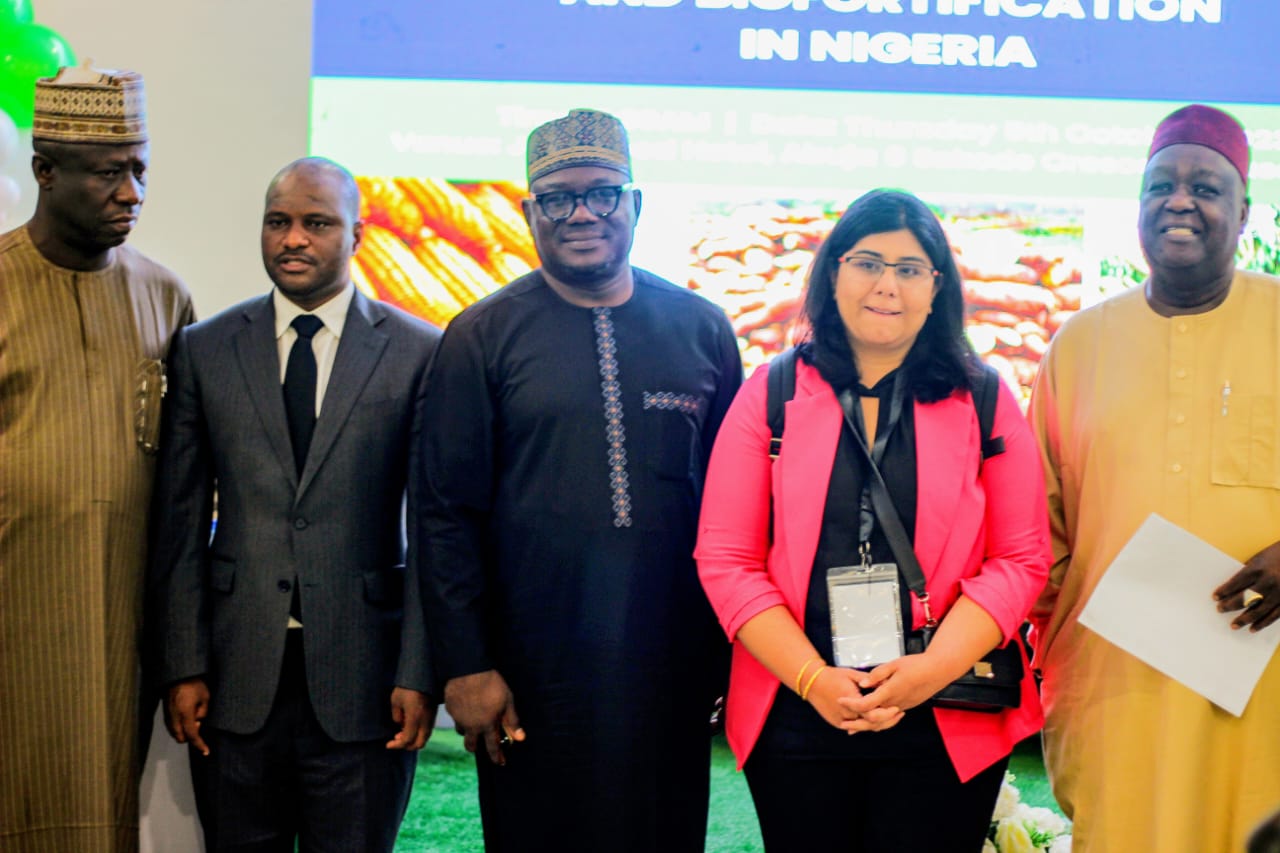
National Project Coordinator,Agro-Climatic Resilience in Semi-Arid Landscapes(ACRESAL), Abdulhamid Umar(left); Assistant representative,Food and Agriculture Organisation (FAO), Abubakar Suleiman; Country Director, HarvestPlus Nigeria,Dr.Yusuf Dollah; Head, National Policy and Innovative Financing, HarvestPlus Washington DC,Rewa Misra and Senior Programme Manager-Agriculture, Bill and Millanda Gates Foundation (BMGF) Nigeria,Dr.Audu Grema during the Consultative Policy Workshop on Climate Smart Agriculture and Biofortification in Nigeria. Held in Abuja 05/10/23
By Gabriel Ewepu
ABUJA – As more Nigerians go down with nutrition-related diseases and increasing cases of poor brain development among children, the Federal Government, HarvestPlus, and the International Food Policy Research Institute, IFPRI, joined forces on Thursday to conquer malnutrition with biofortified crops.
The Country Manager of HavestPlus, Dr Yusuf Dollah, explained that there is the need to get all state governors informed about the development going on in food-related issues, including biofortification.
Dollah stated this during a presentation at a ‘Consultative Policy Workshop on Climate Smart Agriculture and Biofortification’ in collaboration with the Federal Ministry of Agriculture and Food Security and the International Food Policy Research Institute, IFPRI, in Abuja.
According to him, HavestPlus is basically out to complement existing nutrition initiatives using biofortified staple crops that give the body a high level of micronutrients and vitamins; therefore, encourage farmers to grow them and consume them for healthy living and the development of children in order to conquer micronutrient malnutrition.
Climate change is a major threat to food security and nutrition in Nigeria. Accelerated changes in climate are expected to lead to potentially significant impacts on crop yields, micronutrient content, and food prices and make it more difficult for farmers to produce food.
Biofortification, a process involving the breeding of staple crops to include high levels of micronutrients such as iron, zinc, and vitamin A, offers a promising solution to address the dual challenges of climate change and malnutrition, which are major challenges in Nigeria.
For example, iron deficiency anemia affects an estimated 69 percent of Nigerian children under the age of five. Nutrition Smart Agriculture, NSA, and Climate-Smart Agriculture, CSA, represent an approach to farming that not only reduces greenhouse gas emissions but also enhances resilience to climate change, ultimately leading to increased productivity and food security.
He said: “In Nigeria, when we eat food and fill our stomachs, we are satisfied and we are happy, but from this presentation, I will like to make it known that satisfaction is when you eat this food and the food is able to deliver essential micronutrients and vitamins that your body requires for you to live a healthy life, and now if you eat food that is deficient in these micronutrients and vitamins, you come up with a situation known as hidden hunger or micronutrient malnutrition.
“And in some instances, if it happens, it is irreversible, and we also know that in the first 1,000 days of a child, if the child misses some of these essential micronutrients, it also impairs the development of the child’s brain, and if it happens that way, that child will grow and not be able to compete with his peers. They will grow up and become leaders who cannot take key decisions for our development.
“So this is what Harvestplus is trying to contribute, but we know that there are existing nutrition initiatives, so biofortification is one of those initiatives, and now to complement what we already have.
“Hidden hunger is not just a Nigerian problem but a global problem, but Nigeria falls within those countries with severe incidents. We are also told that more than 2 billion people in the world are affected by this.
“Also, there is a nexus between security and nutrition at the same time. We have the iron and zinc-enriched millets, Vitamin A-enriched potato, Vitamin A-enriched cassava, and the vitamin A-enriched beans.”
According to him, their operations start with research, and that is from the research institutes where the varieties are developed, ensuring that early-generation seeds of those varieties get to the conventional seed companies.
Therefore, the conventional seed companies that convert the seeds into certified seeds link them with the agro-dealers who get the seeds to the farmers in the communities.
However, he (Dollah) disclosed that women in the communities are not really carried along in the initiatives; hence, Harvestplus rolled out an initiative called the Women-Led Extension Activity, which led to commercial activities that were integrated into the school feeding program.
He also made it known that Oyo State is one of the states that have introduced biofortified crops into the school feeding programme, which is the combination of biofortified maize and biofortified cowpea for feeding school children, and he added that Harvestplus provides technical support to cooks and aggregators for the school feeding.
Meanwhile, on the sidelines of the workshop, the Head of National Policy HavestPlus, Washington DC, United States of America, USA, Reva Misra, explained that the workshop is about facilitating the needed policy reforms to enable scaling up access to climate-smart agriculture and biofortified input so that farmers can have access to nutrition and also be more resilient to climate change challenges.
Misra said: “It is about facilitating policy reforms to really scale up climate-smart agriculture inputs, biofortified inputs, as farmers can have access to nutrition but are also resilient to climate change, and in that context, this is a multi-stakeholder workshop we are bringing, and it is co-hosted with the Federal Ministry of Agriculture and Food Security, and we are bringing together the Federal Ministries of Agriculture, Environment, and Health, representatives of development partners, to talk about this important issue.
“There is a lot of knowledge in both the government and private sector; the mean thing is a coordinated roadmap that can really help in these reforms and make them practical.
Another positive aspect is to shift the National Agricultural Technology and Innovative Policy, NATIP, and climate change policy; how can we bring these policies into a joint reform roadmap?”
Also, the Assistant Country Representative of Programme, Food and Agriculture Organisation, FAO, Nigeria, Abubakar Suleiman, said the essence of the workshop is basically to “promote the catalytic effect in malnutrition, especially micronutrient deficiency, which is the key thing.”
He further stated that “And climate smart agriculture is an approach to producing food or engaging in agriculture in a way that ensures sustainability in the use of the earth’s natural resources, which means investing in technologies and innovations that improve productivity.
“Secondly, it means the practices of agriculture prevent harmful effects in the organic way agriculture does to the environment and or planet, and also changes in our approach and practices in the way that we produce, process, consume, and dispose of food.
“We recommend to the Nigerian Government to adopt climate-smart agriculture, and no country can afford to be left behind in sustainable agriculture practices because it is beneficial to profit, food safety, and mitigating food losses and waste angles.”
Disclaimer
Comments expressed here do not reflect the opinions of Vanguard newspapers or any employee thereof.