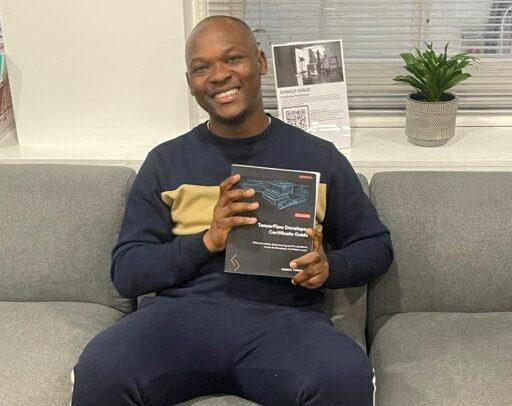
TensorFlow Developer Certificate Guide, a comprehensive expedition that bridges gaps, inspires careers and shapes the Future of AI Education
In the developing landscape of artificial intelligence (AI) and machine learning, Oluwole Fagbohun’s magnum opus, the “TensorFlow Developer Certificate Guide,” emerges as a beacon of knowledge. His interview reveals the motivations behind this influential work, discovers its impact on AI education, and manifests the future of AI and machine learning.
His journey’s driving force is a tale of addressing a void since he noticed the absence of practical and hands-on for burgeoning TensorFlow developers. The guide, therefore, is not only restricted to the preparation manual for TensorFlow certification; it practically honed readers with a solid foundation in the applications of AI and machine learning utilizing TensorFlow. Fagbohun visualizes his work acts as a bridge, connecting advanced AI concepts to real-world problem-solving.
The guide unveils a comprehensive compendium, encompassing an array of topics vital for mastering TensorFlow and machine learning. The interview reveals Fagbohun’s aim behind the selection of key areas, including an introduction to machine learning concepts, TensorFlow fundamentals, neural network construction and training, and specialized domains like image and text processing, and time series analysis. The intent is clear – to effectively equip readers with both theoretical insights and practical skills compulsory to navigate diverse AI challenges and ace the certification exam.
One of the critical areas in designing educational material lies in ensuring accessibility for a diverse audience. Fagbohun successfully solved this complexity by providing a step-by-step approach that initiates from fundamental concepts and gradually develops into more intricate topics. The guide incorporates practical examples and exercises to give hands-on experience to effective learning. Precise explanations of technical terms and concepts act as signposts, making sure that even beginners can traverse the journey, an educational path sculpted based on real-time feedback from a diverse readership.

Fagbohun’s interview reveals the intricacies of presenting complex AI and TensorFlow concepts in a way that is both explanatory and comprehensible. He adds that striking a delicate balance between technical depth and readability becomes a consistent challenge, one that requires continuous revision and simplification. Additionally, his guide is founded on meticulous research and regular updates to retain the guide’s relevance.
Moving towards the AI and machine learning community, the guide is a kick-start for those who are preparing for the TensorFlow certification, acknowledged for providing a structured and detailed learning path. However, professionals in the field looking for continuous upskilling also find benefits in the guide.
The soul of Fagbohun’s work comes alive through impactful responses from readers in the interview he told successful stories of how a reader transitions from a non-tech background to AI, reflecting this triumph to the guide’s approachability and efficacy. Not only this, an educator, too, validates the guide as a go-to resource for students, simplifying complex concepts. This feedback displays the guide’s role in emboldening individuals with diverse backgrounds to initiate the AI journey.
Moreover, the guide makes a tangible mark on AI education and TensorFlow certification training in Nigeria as it is adopted in educational institutions, becoming a fundamental part of the curriculum. Bridging the AI knowledge gap in developing countries becomes a defining chapter in the guide’s narrative. Fagbohun expresses the guide’s role in demystifying AI and machine learning, making these fields less intimidating and more accessible.
Furthermore, the interview takes a visionary turn as Fagbohun talks about the future evolution of TensorFlow. He guarantees that it will become more user-friendly, and accessible to a broader audience, with advancements in automated machine learning (AutoML). Not only this, but it would also integrate other technologies, such as IoT and edge computing, promising to open new frontiers in AI applications and setting the platform for an exciting era for professionals in the field.
More importantly, Fagbohun cleared out the misconceptions about TensorFlow embedded in his guide. One prevalent misunderstanding is dispelled – TensorFlow is not exclusive to large-scale, complex AI projects. Its versatility makes it appropriate for a spectrum of applications, from the simple to the intricate. Another myth is the perception that extensive programming knowledge is a requirement, but Fagbohun articulates that TensorFlow’s accessibility through high-level APIs and comprehensive documentation makes it approachable even for those with basic programming skills.
In this comprehensive interview, Fagbohun shares invaluable advice for those who are starting the journey in AI and machine learning. He recommends a strong foundation in mathematics and programming, citing statistics, algebra, and calculus as essential components. Additionally, he stresses the significance of hands-on experience and recommends readers start participating in online competitions and contribute to open-source projects to reinforce theoretical knowledge.
Formal certification, portrayed by the TensorFlow Developer Certificate, takes centre stage in the discussion as Fagbohun highlights its function in providing a structured learning path, validating skills, and encouraging career prospects. He reinforces the blended importance of practical experience and a deep conceptual understanding, positioning certifications as a source for guiding professionals on a path of continuous learning. Furthermore, Fagbohun recommends learners make portfolios displaying their skills, while educators are highly recommended to integrate project-based learning and industry-relevant tools into educational materials.
Looking toward the future, Fagbohun shifts his focus to AI for environmental sustainability, constructing models to predict and mitigate climate change’s effects on agriculture. Moreover, he said that this aspect would be reflected in an upcoming TensorFlow guide that surely promises a deeper exploration of advanced topics, closing the gap between intermediate to advanced practitioners.
Books and educational materials are considered crucial in AI and ML, with a vision of blending traditional books with dynamic digital resources for a more effective learning experience. Fagbohun concludes with a powerful message from the TensorFlow guide, encouraging aspiring professionals to view AI mastery as an experience of continuous learning and practical application. Moreover, he reinforces the spirit of embracing challenges and using the right approach is particularly important for navigating the complex world of AI with purpose and resilience.
Disclaimer
Comments expressed here do not reflect the opinions of Vanguard newspapers or any employee thereof.