By Charles Kumolu, Deputy Editor
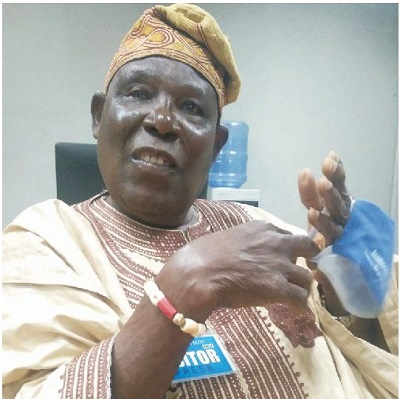
Otunba Dipo Onabanjo spent a substantial part of his career as an ace photojournalist with Daily Times of Nigeria, DTN.
In this interview, the Ijebu-Ode-born chief, who clocks 80, next week, shares some interesting and daring exploits that marked his career.
His coverage of the 1972 coup in Benin Republic, Jerry Rawlings Revolution in Ghana and arrest on the orders of the then Emir of Kano, Alhaji Ado Bayero, and Dr. Nnamdi Azikiwe, give a clear picture of the adventures that characterised his working life
Background:
I was born at Mercy Hospital, Lagos, in 1943. I grew up in Lagos in Idumagbo area. I started primary school in that area. I was later taken to Ijebu Ode. I started primary school again in Ijebu Ode. I attended secondary school in Ijebu Ode. I started working with International News Agency. From there, I joined Daily Times Nigeria, DTN, where I spent a substantial part of my life. I loved photography from my early years. I started practising it while I was in school. I bought a camera at Kingsway in Marina at the time.
I was using the camera to take a picture of anything that took my fancy. During that period, when some reporters were going for assignments, they asked me to accompany them so that I could take pictures. I usually went with them to cover night events. I was also at Daily Sketch.
When I joined Daily Times, I was employed by Chief Segun Osoba, who was the Editor of the Sunday Times. He later became Editor of Daily Times. I also worked with Ogunsawo, Tunji Oseni and other editors.
Despite your experiences, you attained 80 years, which is a milestone…
To survive in life you must have faith in God. You mustn’t be anxious. You have to be satisfied with whatever you have. Contentment gives you the opportunity of having a peaceful life. It is the absence of contentment that leads to worries and other things that do not make some grow old. I never nursed any fear that I would not get to 80. I said earlier that I am a contented person. I do not disturb myself about things I do not have. I am not jealous of anyone. I do not gossip and I don’t hold grudges. When someone offends me, I tell the person how I feel and move on thereafter. I love my neigbours as I love myself. I socialise a lot. That is why I am a member of many elite clubs in Lagos.
Between the time you grew up in Lagos and Ijebu Ode, what were the major events that marked the period?
As a young boy, I was so much of a rascal. In school, I was known as a rascal. I used to listen to elders. I was following good elders because I learnt a lot from them. I saw how those who were bad died prematurely. For that reason, I avoided bad people.
While going through the manuscript of your book, I discovered that irrespective of the prominent people you had relationships with, your grandmother was the first to be acknowledged and appreciated…
My grandmother took much more care of me than my mother. My mother was also nice but my grandmother loved me so much. Before I was born, my mother had many children who died in infancy. I was the first to survive before two others survived. My mother had seven children before me who didn’t live. Being that I was the first to survive, my grandmother took me and loved me so much. When I was in trouble, she stood by me.
You worked with leading newspapers of your time and covered the activities of eight Nigerian presidents. What was it like working with them ?
I want to start with Tafawa Balewa, who was a simple man. Covering him was easy. There was a day I saw Balewa driving on the road. I followed him until he entered the State House in Marina to see the then President, Dr, Nnamdi Azikiwe. As he alighted from the car and was standing with Azikiwe, I took a picture of both of them. Azikiwe saw me and said I should be arrested. I was detained and charged to court for trespassing. At the magistrate court, I was discharged because the law didn’t recognise the State House as a restricted area. Balewa was surrounded by the Hausa people.
You know he was nominated by the then Sardauna of Sokoto, Alhaji Ahmadu Bello. When Aguiyi Ironsi took over, the coverage wasn’t like Tafewa Balewa. He didn’t surround himself with Igbo soldiers. He was surrounded by Hausa soldiers. They were even the ones guarding him. Covering Obasanjo when he was Head of State was the most challenging. I followed Obasanjo to monitor the 1979 election in Lagos. I was at the State House, Dodan Barrack, early in the morning on Election Day. Obasanjo drove a Peugeot 504 to monitor the election. I drove behind him to the Federal Electoral Commission, FEDECO, office at Onikan. When he entered, I entered with him. When he saw that I was inside with him, he sent me out. Obasanjo drove himself around while I followed him.
When Murtala Mohammed was killed, I was with Obasanjo at Obalende praying ground when they brought Murtala’s remains. His body was taken from Military Hospital, Awolowo Road, to Obalende Praying Ground. From there it was taken to the airport en route to Kano. I knew Obasanjo before he became Head of State. He knew me as a photojournalist. Yoruba don’t like Obasanjo because he didn’t hand over to Awolowo, but they didn’t know that it was beyond him. I, Obasanjo and Gowon had done a race on Ijora Bridge. It was when they were commissioning the bridge. Obasanjo and Gowon decided to do a race on the bridge. I was there as a photojournalist. I did the race with them. Gowon was the friendliest to journalists.
On his birthdays, he invited us to Dodan Barracks and gave us champagne. He was a religious man even as President. Do you know that at some point during Gowon’s regime, some top soldiers would approach us with some questions to ask Gowon so that they could know his position on some things? For instance, that famous remark by Gowon that the 1976 handover wasn’t realistic was a result of a question given to journalists by one of the top soldiers. They had their meeting but the senior officer couldn’t get a commitment from Gowon on handover. They now wrote questions for journalists as they did at the time to ask Gowon.
The fact that I had a passion for my job ensured that I covered Azikiwe, Gowon, Obasanjo, Shagari, Babangida, Shonekan and Abacha. I had an interest in my job and was not looking for money. I was just working to make a name for myself. I didn’t care about death. I didn’t entertain fears that I may die in the course of the job. Whenever my colleagues said some jobs were impossible, I made them realise it was possible by doing the jobs.
Among the challenging assignments you covered, the coup that brought in Mathew Kerekou of Benin Republic in 1972 and the Jerry Rawlings coup of 1979 in Ghana stood out. Tell us the story…
When Kerekou took over, Segun Osoba was the Editor of Daily Times. My boss, who was the Photo Editor, was asked to go. He said he wasn’t ready to go. He asked if was willing to go, and I obliged. At that point, it was decided that I would go with our dispatch rider.
That was how we left Lagos at 8pm. When we got to Idiroko, the border was closed. Fortunately, I met a friend who was a customs officer. He said he wasn’t going to allow me to go because it was a dangerous journey. He gave me a lot of alcohol to drink so that I could get drunk and decide not to proceed. Rather than make me terrified, the alcohol emboldened me to continue with the journey.
At midnight, I decided to continue with the journey to cover the coup. I saw a footpath beside the border and continued on our motorcycle. When I got to Cotonou, we went to the Presidential Palace, which was destroyed during the coup.
Meanwhile, Kerokou had sent for French journalists to come and interview him. My task was to take pictures of the place, but I wasn’t allowed in. I saw bricklayers working at the entrance. They were going in and coming out. I disguised myself as a bricklayer. I joined in carrying blocks into the palace and hid my camera inside my shirt, which I had removed. I followed the bricklayers inside. When I got inside, I put the block down and brought out my camera. I saw some gun-wielding soldiers and spoke the little French I knew. I took his picture. They were so happy and called some of their colleagues, whose pictures I also took. As I was doing that, I saw some journalists with a television crew.
I joined them as if I came with them. When the coup leader, Kerekou, came out, I joined in taking his pictures. I saw one Nigerian journalist, Odafe, from Observer. I was shocked because I didn’t know how he got there. The leader of the coup thought I was among the French journalists he invited. I took pictures of the palace that was destroyed by the coup plotters.
After taking all the exclusive pictures of the destruction at the Presidential Palace, I went outside and gave the film to the dispatch rider who was waiting for me outside. Osoba,who was Daily Times Editor at the time, used the picture well on the front page. The caption of the picture was ‘’our man at the hot spot.’’
Execution of former Ghanaian leaders
The day I was given the assignment, I witnessed the plunging of a fully-loaded molue , long commercial buses formerly used in Lagos, into the Lagoon. I was told there was a coup in Ghana and I had to proceed to Ghana. At the time, I was using a Peugeot 504. At the time, there was a Daily Times journalist who was around in Nigeria because the then Head of State, Gen Ignatius Acheampong, wanted to kill him. He ran back to Nigeria. Some people at the office tried to discourage me from going to Ghana. They said JJ Rawlings was going to kill me. I said it was impossible. I told the journalist that ran back from Ghana to accompany me to Ghana. He said he could not go and that he would be arrested by Acheampong. I told him Acheampong had been arrested and detained by Rawlings. Daily Times gave me N3000 at the time to go to Ghana.
When I got to Aflawo border in Togo, the border was closed. I told some people I met at the border that I was going to Ghana, they said they could facilitate my passage if I gave them money. I did so and they facilitated my passage. When Ghanaian soldiers accosted me, I told them I was coming from the border. I claimed I wanted to go back to Nigeria, but the border was closed.
I told them I could no longer continue my journey to Nigeria. I claimed I was going back to Accra. They didn’t know I deceived them. When we got to Accra, I decided to lodge close to the Presidential Palace, Flag House. I lodged at Penthouse Hotel located a few metres from the Presidential Palace. After filling out my form at the hotel, the form was taken to their state security service.
In the morning, my form landed on Rawlings’ hand. Rawlings asked his best friend, a medical doctor, to monitor my movements in Ghana. During that period, Obasanjo was our Head of State. Any time I covered Rawlings’ assignments, I sent the pictures to Lagos.
My colleague, Akindele, who accompanied me, was also sending his reports. Rawlings was reading the stories and seeing the pictures we were sending to Nigeria. I was there for a week. Every night, Rawlings’ friend came to discuss Rawlings’ coup with me. Whenever he raised the issue, I told him we needed someone like Rawlings to carry out such a revolution in Nigeria. He didn’t know I was aware he was spying on me. He went back to Rawlings and told him my views, but I knew what I was doing.
Close shave
I can’t remember the number of times I was beaten and detained by the police in the course of my job. One of the close-shave experiences I have had was when I went to cover an assignment in Kano in 1969. I escaped the BOAC plane crash. When I got to Kano, the Emir of Kano was in front of his palace and I was wearing a pair of shoes. He saw me with the shoes and asked them to take me to prison.
I didn’t know it was taboo to wear shoes at the place I was. I was to go back to Lagos with the BOAC plane that was coming from London.
It was scheduled to stop over in Kano and pick up Lagos-bound passengers. I was one of the passengers scheduled to board the plane in Kano. Because the Emir ordered my detention, I missed my flight and survived. If I wasn’t detained, I would have died alongside other passengers who died when the plane crashed. I was with Daily Times at the time. Daily Times office was at France Road in Kano. I was released when the information about my detention got to my office. My editor was always around to rescue me whenever I was detained.
Execution
When Rawlings knew I wasn’t opposed to his coup, he sent his men to bring me to him. When they came at night and said the Head of State, Rawlings, wanted to see me, I refused to go. I said I could only go in the morning. What if they killed me? I said they should tell Rawlings I wasn’t coming that night. In the morning, I informed the hotel that should anything happen to me, Rawlings should be held responsible because I was going to see him. I went to the presidential palace alongside Akindele.
Rawlings received me warmly. I took many pictures of him. I was commanding him with my camera. He granted us a four-hour interview, which we sent to Daily Times. There was a day he held a press conference. He invited the detained ousted Head of State to the press briefing. Before the press conference, he told Acheampong to tell Ghanaians at the press conference that he was returning all the state funds he had looted.
Acheampong agreed but decided to say something else at the conference. I was at the press conference when Acheampong started saying something else. He didn’t say that he looted money. That got Rawlings annoyed. I was later informed by Rawlings that he was going to execute Acheampong in the morning. That was why I was the only journalist in Africa who got the picture of the execution.
I got the picture of him being tied to the stake alongside another top military officer. He was pleading for leniency up to the point they were executed. The execution made Obasanjo annoyed. He wanted to execute other heads of state but stopped following public outcry. He shelved execution and now started giving lashes of the cane to all who had stolen.
At some point, you left Nigeria for the UK for further studies and returned. Why didn’t you ‘japa’ as is the case now?
I have passion for my job. My love for my job made me come back from the UK after my studies. I could have stayed back. Whatever I could have achieved in the UK, home is home. When I got to London, I enjoyed the period I schooled there. In my fourth month, I bought a car. I had already secured a mortgage. I was living well in London. I belonged to many clubs in London.
I came out with flying colours in school. But why should I stay back in another man’s country? Those who are there and do not want to come back are not successful. If you are successful, home should be your destination. Nigerians should be patient. Our country is good. Some Nigerians do not have a conscience.
I have no cause to regret my life at 87. In my next life, I would be a photojournalist because it made me have relationships with prominent people. I dined with presidents, governors, kings and other important people in the country.
Disclaimer
Comments expressed here do not reflect the opinions of Vanguard newspapers or any employee thereof.