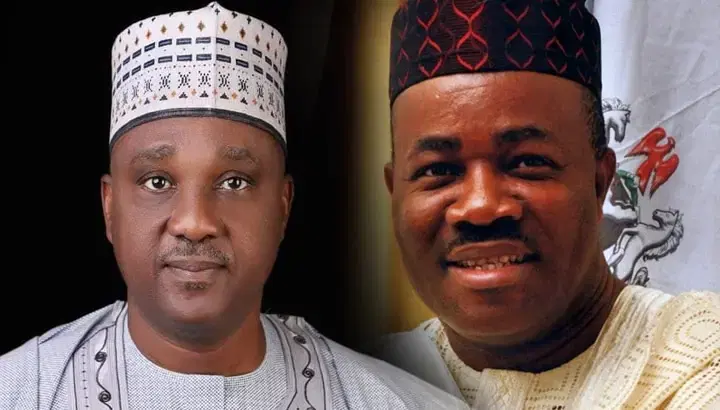
By Ise-Oluwa Ige; Henry Umoru; Luminous Jannamike; Dayo Johnson; Dapo Akinrefon; Rotimi Ojomoyela; Shina Abubakar; Steve Oko; Deola Badru & James Ogunnaike
This is scandalous. It is nothing but sheer insensitivity that as Nigerians are groaning under the weight of the current economic realities, a presiding officer of the National Assembly could appoint 400 aides to himself alone who are being paid for virtually doing nothing by the Nigerian tax payers.
The number of aides to be engaged by Presiding Officers in the nation’s National Assembly is open ended as the President of the Senate and the Deputy Senate President can each engage over three hundred persons.
Each federal lawmaker is entitled to five aides who are paid by the National Assembly Service Commission. But the number of aides to be engaged by Presiding Officers is left to their discretion, which invariably is exploited by those who want to use the office , appointing aides for political reasons especially in election years.
A source told Vanguard that in the just concluded 9th Senate under the leadership of Senator Ahmad Lawan, the two presiding officers, the eight Principal Officers and other Senators engaged more than 4, 000 aides put together.
The Presiding officers of the Senate are the President of the Senate and his Deputy, while the Principal officers are the Majority leader; the Chief Whip; the Deputy Majority Leader; and the Deputy Majority Whip. Others are the Minority Leader; Minority Whip; Deputy Minority Leader and Deputy Minority Whip.
These officers are entitled to appoint aides to be paid by the Management of the National Assembly and the National Assembly Service Commission as they get up to 10 slots from Management and five to be paid by the Commission. Other Senators who are not Principal Officers are entitled to five aides who are paid by the Commission, but they can get other staff to be paid from their pockets.
Vanguard gathered that in the 6th and 7th Senate when Senator David Mark was the President of the Senate, he had about 350 aides who were here in Abuja as well as in his Makurdi and Otukpo offices in Benue state. David Mark was the President of the Senate from 2007 to 2015.
According to another source, during Senator Bukola Saraki’s tenure as the President of the Senate from 2015 to 2019, he enjoyed the services of close to 380 aides, but he later reduced their allowances.
As the President of the Senate from 2019 to 2023, Senator Ahmad Lawan had almost 400 aides and they were mostly in Yobe state, especially his Senatorial District of Yobe North.
A source said, “In the just concluded 9th Senate, the immediate past Deputy Senate President, Senator Ovie Omo-Agege had close to 500 aides because of his governorship. Appointment of aides by the Presiding Officers is an open-ended thing.
“Omo-Agege and the former Speaker, House of Representatives, Femi Gbajiabiamila took advantage of it and had many aides as well as Lawan and Omo- Agege. Even up till January and February this year and less than four months to the end of their tenure, letters were still being given out on the appointment of aides. The Presiding Officers of the present 10th Senate have from now till January 2027 to issue such letters.”
In a country grappling with economic challenges, the National Assembly’s recent allocation of N70bn for its members as palliative for the withdrawal of oil subsidy and N45bn for the purchase of cars for its members has sparked concerns about the cost of governance.
These figures, coupled with the lawmakers’ exorbitant pay packages, have led to concerns about the sustainability and fairness of such expenditures. With a reputation for bestowing generous allowances upon themselves, lawmakers in Nigeria enjoy one of the highest pay packages in the world.
In Nigeria’s political landscape, it has become customary for lawmakers to allocate substantial allowances to themselves, irrespective of the state of the economy.
Furthermore, the public is disheartened by the apparent disconnect between the lawmakers and the ordinary citizens they represent. While many Nigerians struggle to make ends meet, the indulgence of the National Assembly in allocating funds for luxury items and personal benefits strikes a chord of discontent. This growing disparity in wealth and priorities begs the question of whether the bicameral legislature truly serves the best interests of the Nigerian people.
Costly National Assembly
Critics argue that maintaining this dual system comes at a significant cost to the nation. The duplication of efforts, administrative expenses, and the need for separate offices and staff for both chambers all contribute to the hefty price tag of governance.
Moreover, the efficiency and effectiveness of decision-making processes within the bicameral system have been called into question.
Some argue that the legislative process is often slowed down due to the need for harmonization between the two chambers, resulting in delays in passing critical legislation. This sluggishness can hinder progress and impede the government’s ability to address pressing issues promptly.
To gain further insights into this matter, prominent lawyers, statesmen, activists, religious leaders, and community leaders have expressed their opinions on whether Nigeria would benefit economically from a unicameral legislature instead of a bicameral one.
Unicameral N’Assembly will streamline governance costs – Ozekhome, SAN
“I have said it several times that Nigeria does not need a bicameral legislature: a red chamber, the Senate; and a green chamber, the House of Representatives.
“What, for God’s sake, are we doing with 109 senators and 360 federal representatives? Who are they representing? Is it the suffering and impoverished masses of Nigeria? It’s a case of ‘monkey working, baboon eating’.
“There’s no fairness in that. The Nigerian legislature is the most expensive in the whole world. We only need a unicameral legislature.
“Let three senators per state give us our laws. Their duty under Section IV of the 1999 Constitution (as amended) is simply to make laws for the peace, order, and good governance of Nigeria. It did not say ‘to make law for themselves’.
“If you look at the 1999 Constitution (as amended), any lawmaker that sits for six months in a year has performed his constitutional duty. That is why I have always called for a unicameral legislature or, if we must retain the bicameral legislature, then the compensations of the lawmakers should be determined based on sitting allowance.
“We better make it a full-blown part-time role so that any day you sit, you get paid. Any day you do not sit, you are not paid.
“With that, only worthy Nigerians will go to the centre to look for these positions. It is because governance has been made so attractive that everyone is dying to go to Abuja because we are practicing a ‘unitary system of government’ and not a federal system of government.
“In a federation, powers will devolve more to the component units than to the central government. The Nigerian federal government today is so powerful that politicians kill themselves to get there. You will have a senator or minister with a long chain of aides and assistants.
“At the end of the day, we use 80 – 85% of our national income for recurrent expenditures rather than capital projects. No country can grow and develop in that manner.”
Bicameral system exacerbates nation’s economic woes – Sowore
Echoing the sentiments of Ozekhome, activist Omoyele Sowore stated that it’s high time the nation considered a unicameral legislature—a more economically pragmatic solution.
“The U.S. is a multi-trillion dollar economy and has only 100 senators, but Nigeria, which is not as rich as some states in the U.S., has 109 senators and 360 House of Representatives members,” he argued.
Ambassador Yemi Farounmbi
“It is obvious to everybody that the cost of governance in Nigeria is outrageously high, that the present American fashioned Presidential system we are running is, perhaps, beyond the financial capability of Nigeria.
“We run a Senate of 109 people with associated Special Advisers, Special Assistants and so on. We run the House of Representatives of about 360 with all of that too. We run an Executive that sometimes have a limitless number of special advisers and assistants and so on, so the cost of governance is high.
“In the 1979 constitution, I remember, a governor could have only three special advisers and the president could have seven special advisers.
“But Today, you have governors having over 20 special advisers, 109 special assistants, so the cost of governance is beyond the financial capacity of Nigeria today.
“We know we think we are rich but indeed and in truth we are not rich, we have potential to be rich but we are not yet rich, so we ought to take a look at our cost of governance, and part of which might be to streamline the National Assembly, consider the possibility of merging both into having a single tier National Assembly.
“It is something worth considering. I know of course the reason we have a two-tier is to have representation and equality.
“We have to be able to work it out, it is either we reduce the number of senators that we have or number of representatives that we have or we will have a single one in which we have half of them based on representation and half of them based on equality of state, but certainly, there is need for us to look at the excessively high cost of governance in Nigeria.”
Bicameralism not sustainable in Nigeria – CLO President, Akeregha
The President of the Civil Liberties Organization (CLO) and another proponent of a unicameral legislature, added that a single legislative body would not only be sustainable but also foster a more coherent and unified policy-making process.
He explained that, “the cost of governance has been the subject of intensive conversation, it is not sustainable, it is oppressive and draining the resources of the country. It is crucial that it be reviewed.
“For us in the CLO, we believe that a unicameral legislature is what Nigeria needs, rather than the current bicameral legislature with a large number of lawmakers who themselves appoint special aides and assistants, further draining the resources at the expense of the toiling masses of Nigeria.”
Bicameral legislature comes with huge opportunity cost – Olugbade, Deekor
Titilayo Olugbade, a human rights activist, said “the exorbitant salaries and allowances awarded to lawmakers contribute to the diversion of resources that could be better utilized for developmental projects and improving the lives of ordinary citizens. The humongous pay package of our lawmakers is a severe burden on the Nigerian economy.
“Nigeria will benefit from discarding the bicameral legislature, particularly in terms of freeing up funds for impactful infrastructural projects and critical sectors that propel development and enhance the well-being of citizens such as education and health.”
Those advocating unicameral legislature ill-advised – Senator Ajibola Basiru
Meanwhile, former Senate Spokesperson, Senator Ajibola Basiru, has argued that those advocating the scrapping of one of the two chambers of the National Assembly are ill-advised regarding the real cause of the exorbitant cost of governance in the country.
According to him, “The argument that a unicameral legislature would save costs and protect the Nigerian economy is false. Advocates of unicameral legislature fail to understand the real cause of Nigeria’s high cost of governance.
“The current bicameral legislature costs less than three percent of the national budget annually. Therefore, eliminating an entire chamber of the National Assembly would not result in significant savings to benefit the Nigerian economy.”
His Eminence Elder Israel Akinadewo, the President of the Organization of African Instituted Churches (OAIC) and Prelate of Motailatu Cherubim and Seraphim Church Worldwide, strikes a neutral chord and suggests a more balanced perspective.
According to him, both systems have their merits and pitfalls. Therefore, the key is to find a model that ensures effective governance while considering our economic realities.
He said, “the truth of the matter is that the kind of democracy we practice is linked to the one that America practices, and because of that, the law recognizes the House of Representatives and the Senate. These are the people who actually represent us and create laws that will benefit the nation.
“I don’t have the statistics with me, but the reality is that the cost of governance, in comparison to the standard of living of our people, is just too wide.”
We need part-time legislature – Chima Nnaji
Lagos-based lawyer and Good Governance Advocate, Chima Nnaji said: “Not only should there be a mono-cameral legislature in Nigeria but those who perform the function should be on part-time basis.
“The character we recruit there in the recent times, is a gangster situation. So, they corner and blackmail the Executive who themselves are not unblemished in terms of character and content. They just go in cahoots. And recently, they have recruited the judiciary into the clique. So, the whole situation in Nigeria is a mess. We do not need these characters.
“They don’t even know what law making is all about. When you interview some of them one on one, you see they lack content. For you to make laws, you must understand the jurisprudential basis for law making because that was the basis upon which the Greek philosophers of old recommended democracy.
“Even Montesquieu in the characterisation of the separation of powers, did so on a philosophical basis. Tell me any political party in Nigeria today that is based on any philosophy? Look at their manifestoes during campaigns: they’re essays written for them by somebody.
“There is no manifesto that is characterized by deep thinking. It’s all copy and paste. They write what people want to hear and not what they will do.”
Similarly, Comrade Nnanna Nwafor, Civil Right Activist and the Executive Director of Foundation for Environmental Rights Advocacy and Development, FENRAD, said: “it is such a disgrace that the so-called Tenth Assembly could be anti-poor and callously insensitive to the plight of ordinary Nigerians in the current subsidy-free regime.
“Allocating N110bn billion of the N819bn supplementary budget – as subsidy package and vehicle allowance to its members, is criminal, and must be called what it is. Why are they telling Nigerians to make sacrifice, or endure the pains of subsidy, and yet are not cutting back on cost of governance?
“Where are the stimulus packages that will stimulate economic growth, the palliatives that ought to come in the form of mass transit scheme and reasonable intervention programmes, the increase in workers’ salaries and the rest? What do you call a reward system that pays such amount of money to only 469 members – both Reps and Senate – and leave the poor to starve, if not anti-people? It is even hard to imagine that this is happening at a time the nation fell on hard times and household finances shrank.”
Bicameral Legislature not problem but recklessness—Lawson, CD scribe
In his remarks, National Secretary, Campaign for Democracy CD, Olufemi Lawson said: “The Bicameral Legislative structure in my opinion, is not the major problem, but rather the recklessness in the management of national resources by Public officials in Nigeria.
“We must remember that the Bicameral Legislative structure is synonymous to the Presidential system of government being practiced by Nigeria, and this has been successfully operated in several other climes, without the kind of financial excessiveness like we witness here.
“There is generally a culture of financial recklessness across virtually every institution of government in Nigeria, and this must be reviewed, in a holistic manner, rather than narrowing our focus on the National Assembly alone.”
It’s about corruption, not the number—Ajulo
Also speaking, a legal practitioner, Dr Kayode Ajulo said: “I don’t want to believe that we have a bloated legislature in all ramifications. The legislators in Nigeria are not up to 1,500 if you add up others in the state Houses of Assembly and they are representing over 200 million people.
“The constitution we operate is taken from both the United States of America and the United Kingdom. When you look at both the UK and the USA, both countries operate bicameral. In the USA, they have the Senate and Congress while in the UK, they have the House of Lords and House of Commons. If you look at the National Assembly, the issue here is not about having a bloated legislature but it is about the corruption. The truth is, when you can take corruption away, every other thing will be in place.
The Social Democratic Party chairman in Ondo state, Hon Stephen Adewale said that “Ordinarily, a multi-ethnic nation like Nigeria benefits most from a bicameral legislative structure. It enhances representative capacity and assures due process.
“The lack of a mechanism to control the financial excesses of our legislature, in my opinion, is the real issue, not whether we have a unicameral or bilateral legislative structure. We must implement a system that prevents the legislators who represent the people from taking large sums of money home each month, which harms our economy.”
Former South-West Zonal Publicity Secretary of the People Democratic Party, PDP, Mr. Ayo Fadaka , said,”Truly bicameral legislature is a mandatory feature of federalism, but we are at a period when compliance to situations dictate the rules, therefore Nigeria should begin to think of having a unicameral legislature.
“This is particularly instructive in view of the limited productivity of that arm of government, coupled with its entrenched gulping of billions of Naira primarily directed at the personal comfort of it’s members and not the system itself.
“Nigeria needs to think deeply and atune itself to current realities, therefore if we are going unicameral, the Senate must give way and take a dip into history while the House of Representatives, being more representative of the people should remain the National Assembly.
The President, Yoruba Council Worldwide, Aare Oladotun Hassan said: “The clamour for a unicameral system with just one branch of the legislative system is best for a country like ours not only to save cost of maintaining the lawmakers but also reduce the length of time usually taken for bills that are of urgent importance to become law.
“The country has also consistently wasted huge amount of money in purchasing bullet proof cars every four years to assuage the thirsts of the political class at the detriment of the poor masses. The need for a review of our current legislative structure, has not only become an imperative, but a compelling necessity.”
The Founder, Oyo Si Maa Dun, OSMD Network, Dr Abisoye Fagade said: “The need for a bicameral legislature in Nigeria or any country is a matter of political and constitutional considerations.
“In the face of a crashing economy, some may argue that having two chambers can lead to more robust debates and discussions, allowing for a more comprehensive and well-thought-out decision-making process.
“However, others might argue that a unicameral legislature (one chamber) could be more cost-effective and streamlined during challenging economic times.In my opinion, I don’t think it should be based on economic considerations alone.
“We need to consider various other factors like governance efficiency, representation, and the specific needs of the nation. To even scrap the bicameral legislature will need a process which can easily take our focus away from fixing our current economical situation.”
A Public Analyst,Mr. Adedunle Adeniyi, said bicameral legislature is a waste of the national resources. “In Nigeria of today, we don’t need Bi-Camera legislature. This is one way that we waste money in our democracy. Imagine, Nigeria with 36 states, having 469 legislators with ‘nothing’ to show for their performances even at the end of the legislative calendar year.
“But taking a cursory look at the realities of the present economic situation in the country, running a bicameral legislature is of course, a waste of resources and the country should cut down costs by fusing the two Chambers of the National Assembly; both the Senate and House of Representatives.
“This will definitely, go a long way in reducing the cost of governance. In my opinion, Nigeria does not need both chambers now. We have to do away with one of them.”
The Chairman, Trade Union Congress (TUC), Ekiti State Chapter, Comrade Sola Adigun: ”I don’t think bi-camera legislature is sustainable considering the present reality. I have spoken against it on several fora, if indeed the economy of this country is dwindling as we are made to know and as we can see, there is no need for bi-camera legislature.
“The President and every democratic leader must look inward, take every step to cut down the cost of governance and one of the ways to do this is to start with the legislature and reduce it to a single one. There is a lot of duplication of duty, if the federal government is genuinely interested in its plan to reduce or merge ministries and departments, then they should start with our legislature, let the Senate and House of Representatives be one.”
Comrade Alagoa Morris, an environmentalist said: “What we practice is too expensive and just prodigal, maybe because of petrodollars. Just as we have State House of Assembly, it should be like that at national level. When the Okilos and Shagaris were in the National Assembly, though parliamentary system; it was better.
“This duplication is wasteful, juxtaposed with whatever outcomes. Some just go to the House of Representatives or Senate and the only thing they do is get constituency project funds and share a fraction of it with loyalists in their constituencies in the name of empowerment. That is not what we expected from legislators.”
The National Coordinator of Human Rights Writers Association of Nigeria (HURIWA), Comrade Emmanuel Onwubiko said “The allocation of the humongous amount of money to themselves as palliative for cushioning the effects of the withdrawal of fuel subsidy by the President is an aberration and is absolutely illegal and should never be allowed to happen.
“This actually brings us to the continuous question of the relevance of having a big national legislature amidst the dwindling of national resources. It will be necessary for Nigerians to critically analyse the possibility of running a single chamber national assembly just like what obtains in Senegal.
“We in HURIWA endorse the call for the abolition of the bicameral legislative institution and will suggest that we try to work with a very lean national assembly of a single chamber.”
Disclaimer
Comments expressed here do not reflect the opinions of Vanguard newspapers or any employee thereof.