By Obaro Obru-Egboro
The opinion of others no matter how preposterous should be respected —Major (A character in the film “They call me Trinity-1970, Directed by Enzo Barboni)
THE above statement made in that film as directed by Enzo Barboni is apt for our nation of today because those who voice their opinion contrary to the position of government no matter how relevant are branded as naysayers and busy bodies. Yet our know-it-all governments at various levels have emboldened incompetence as a virtue, as reflected recently by former Emir of Kano Sanusi Lamido Sanusi who described our present gang of leaders as unprepared persons taking to governance. The UN declares 2021-2030 the decade of ecosystem restoration. How prepared are we as a country with existential fundamentals? Before 1960 Nigeria had 35 per cent forest cover but today we have less than three per cent due to over-logging without commensurate tree planting and exacerbated by endemic system corruption. Cameroon built Lagdo Dam in 1982, 50 kilometers south of the city of Garoua on the Benue River to act as flood shock absorber among other functions. Nigeria, on her own part, was expected to build a dam along the Benue river corridor since 40 years ago, yet no action because of insufficient political will and abracadabra leadership. This trend reflects the nature of our degeneration and how we have allowed problems to fester without due leadership. This generational leadership deficit has been explained by the words of Saul Bellow who said “there is a pleasure in being mad which none but mad men know”.
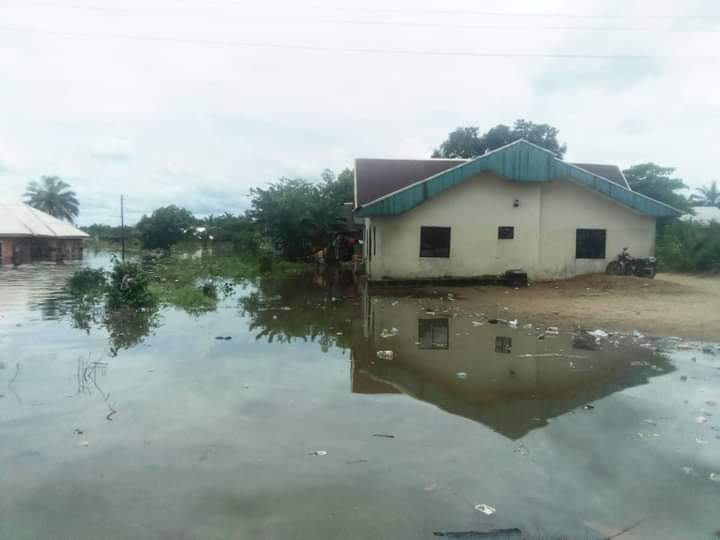
The Nigerian Meteorological Agency, NIMET, has predicted flooding in 2023 like they did in 2022, linking it to an early start of rainfall this year which may cause flooding in many parts of the country. The predicted rainfall could exceed 1900 mm in the riparian states of Lagos and others in similar geographical locations. And what has been our response so far? The usual routine warnings of do not build on water channels, don’t dispose solid waste into drains, residents in lower plains should relocate to higher grounds.
Similarly, on the part of government agencies such as National Emergency Management Agency, NEMA, and State Emergency Management Agency, SEMA, theirs could also be in the domain of earmarking or budgeting billions of Naira to purchase relief materials to be distributed to victims of flood disasters and in the process a lot of the purveyors of such relief materials, annual rituals, smile to the bank with swollen bank account figures while victims weep on graves and homelessness occasioned by the loss of properties swept into the belly of rivers and lagoons. This is the situation annually with government on high horse perfidiously announcing dividends of democracy.
This typifies the shameful nature of our policies without recourse to advice from seasoned professionals on environmental issues, as recently pronounced freely by the National Chairman of the Nigerian Institute of Environmental Engineers, Sesan Odukoya. While speaking on the topic: “Dredging Rivers to Avert Flooding”, he urged the Federal Government to protect the shorelines by dredging river Niger and Benue, and construct some dams on the corridor, build protection barriers and drains among others to prevent a repeat of the flood disaster that ravaged many parts of the country in 2022.
He encouraged the Federal Government to implement recommendations submitted by experts and appealed to states to adopt measures that would support efforts to safeguard lives and properties. Instead of going along with expert opinions as enunciated, some states in the South-West are busy training officers on the early warning signs as part of efforts to combat flooding in their states. This approach can be likened to closing the gates of a horse stable after the horses have escaped.
A school of thought reasoned that officials of some relief agencies could be going round collecting list of prizes for relief materials and encouraging manufacturers to increase their stock in consonance with an impending 2023 flood Armageddon as predicted by NIMET. What is required today is long-term solution. Since the last devastating flooding back in 2012, what efforts have governments put in place at all levels in preparation to mitigate perennial flooding and save the lives and properties of our people, apart from the relief materials policy and the fall outs for the boys?
Where are the dams to counter Lagdo dam yearly harassment from Cameroon and the embankments and channelisation of our drainage channels? Where are the mitigation measures from the Federal Ministry of Environment and its junior brothers at the state levels called State Ministry of Environment, to bring these yearly deaths and losses of properties to an end with the global warnings on climate change that cannot be wished away by our garrulous politicians and venal civil servants at policy tables across the country?
As much as one is in agreement with the suggestions of the Nigerian Institute of Environmental Engineers and such other concerned stakeholders, one is of the opinion that we also need to put whatever approaches on the short or long run into an Environmental Master Plan, EMP, for a holistic solution since such a plan will provide a more robust approach to dealing with the issue of flooding and other environmental challenges such as erosion, deforestation, solid waste management, aggressive mining and such other poor human developmental habits putting stress on the environment. In other words, the EMP will present a template to arrest further degradation of the environment suffering from poor environmental regulations and inadequate adherence.
Put differently, there is an urgent need to prepare Environmental Master Plans, EMPs, as guides to tell our policy drivers what to do, how to do it and why it should be done. It is the environmental oxygen needed today at all strata of policy making to save our environment from environmental poaching by thoughtless aggressive development from the society that hardly observe building standards. It is the control and roadmap for a healthy environment because violations have prescribed severe consequences.
It should be noted that the absence of environmental master plans at various levels of government, have made mitigation efforts on flooding, erosion control and solid waste management a political gyration in Nigeria. The EMP will help to articulate or put in proper perspective all government-formulated strategies for all environmental disasters. It is not enough to demolish structures on waterways and open up blocked drainage channels because these are mere cosmetic and adhoc solutions that can be likened to a doctor giving a patient amnesia that will wear off, bringing back consciousness.
If governments want to be taken seriously on solving the issue of flooding, specifically they must put their hands on the drawing table to fashion out an EMP in a given level to drive the processes of combating flooding because only then will they be able to understand the causes, effects and solutions through painstaking studies involving experts on environmental engineering.
An Environmental Master Plan therefore is a policy instrument designed with smart robust proposals to regulate all environmental activities that could create one stress or the other, affecting living standards in a most atrocious way. It creates the necessary synergy on the effective application of environmental control mechanisms for sustainable environmental performance in terms of balanced development and growth.
It is primarily focused on multiple actions government and stakeholders can apply to protect and improve the environment, maintaining applicable standards. In other words, EMP is simply based on background research, interviews and environmental attitude surveys and it brings into focus a myriad of environmental programmes, policies and initiatives across professional lines to strengthen environmental performance. It puts forward a procedure of management theories as enunciated by Henri Fayol, a French Mining Engineer regarded as the father of modern management science with gauging valves for evaluation and monitoring. Hence, it is a guiding document that streamlines environmental behaviour, liken to an environmental constitution that prescribes various environmental restraints with dire consequences if flouted.
It is programmed upon the principle which reflects an overall sensitivity to the environment with the needed stop-gaps to avoid endangering the environment.
Therefore, the EMP may be viewed simply as a document to translate our environmental behavior into attitude and lifestyle which encourages an understanding and respect for the natural environment.
In the absence of a single comprehensive meaningful environmental policy at the Federal level,environmentalprograms at the state, regional and local level must attempt to incorporate existing social, environmental, and economic policies while achieving specific program objectives. Since policy conflicts are resolved by trade-offs and balancing priorities, the EMP has a responsibility to provide decision-makers with a policy trust which gives strong consideration to environmental components, especially environmental sensitive policies.
In a nutshell, for successful mitigation of flooding in Nigeria we need EMP as a total package or comprehensive approach since the deliverables of an EMP will help to tackle land use issues, solid waste menace, degradation by haphazard mining activities, shoreline destruction by coastal communities and other such environmental activities that instigates flooding. Tackling flooding alone without dealing with the various contributors and tributaries, will encourage handlers to focus more on annual budgets for relief materials neglecting efforts to minimize perennial flooding.
Our inactions as indirect collaborators in the yearly flooding bonanza business will persuade the handlers to consult voodoo witch doctorswho will persuade them to appease the gods with sacrifice for us to look the other way for their flooding enterprise to thrive. There are too many graves and losses of properties in our country today due to perennial flooding, and complacency in this issue is not worthy of any applause in a country where we have humongous security votes, ecological funds and such other disaster management funds that could be swallowed by snakes and eaten by rats if not properly channeled to get rid of this flooding vampire in this 21st century with so much knowledge available to us.
It is time for our governments to take full responsibility for our collective existence or else our inaction will encourage leaders to think recklessly like Louis XIV, 1638-1715, King of France who imperiously declared “I am the State”.Suggesting anything worthwhile to our Leaders is like telling an Inuit about the good, the bad and ugly of the formation of ice. For according to Walter Lipmann 1899-1974), It requires wisdom to understand wisdom, for the music is nothing if the audience is deaf.
Obru-Egboro, a town planner, environmental management consultant, wrote from Asaba, Delta State
Disclaimer
Comments expressed here do not reflect the opinions of Vanguard newspapers or any employee thereof.