By Ebri Kowaki
Fall into Lagos’ long reign carving caches of visual artists to serve its muse. The contemporary roundtable is broad, populated by every conceivable shade of conceptual extremes. Of Margaret Abgaje, Yinka Babalola to Chinwendu Oreluwakitan Chidi, photographers who narrate alloyed Lagos share rough similarities. The gravitation to monochrome, texturized background expressions, striking faces or faces facing something striking. There exists an undying photo-semiotic debate around what representation of the face of Lagos is/should be, the authentic face, the true face, Truth. Chinwendu’s association with the city-muse stops on the line before last. Her prints project a maze of melancholic reflection, remote preoccupations. She has made a stylistic habit of withdrawing faces, and several cases on 2023 Night Time in Ikeja exhibition are perfectly without subjects. The closest she comes is a protruding ear.
Not even Chinwe Chidi tries to keep the noise out, what a unifying symbol of cosmopolitan culture. Watch from any junction on Lagos mainland, on a Friday afternoon, you do not have to listen to fill your ears, concerted voices of returning pupils knees striding from furniture store to Jumat dust-kicking boots of black clothes security guards queuing for petrol behind running Molue engines. If you live here, you are longing for something. Maybe that is why everyone is outside, the nights marked by air horns of fire trucks congesting half the vehicle-pedestrian road. Maybe that is why street side parties are loud and deluge Asake heavily, why – as in Godiva Omoruyi’s go-slow series – imagery has to be dramatic.
Our souls are fires that have forgotten
how to burn,
– Emmanuel Esomnofu, Chanting Fire
Light enters Chinwe’s Longing from the upper left, building ridges across the face. Notice how quickly illumination decays across the shoulder. This creates the depth that pulls the figure from the dark, she emerges like relief sculpture. Object minimalism and an economy of shadow are Chidi’s signature, much like how the economy of faith is a cornerstone of her photography and general artistic philosophy. In this way, she marries technique to psychological weight.
Longing, indeed much of her photography, takes footing in the sense of the cryptic gained through tender depiction of human features, after a Sidibic tradition underlined by art critic Emmanuel Iduma. Like Chinwe, Malick Sidibe’s Vues de Dos subjects reject meeting the lens. Where he explored how absence of the face impacts perception of individuality, exterior realities, she ushers us to expanse interiority. Two-thirds expanse, actually.
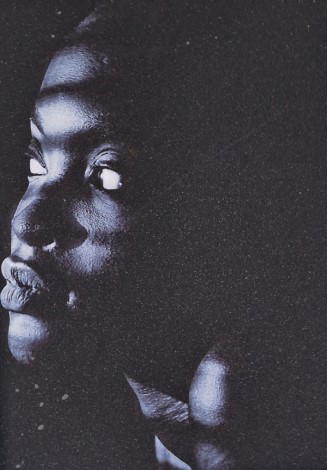
Two-thirds terrain is the deep black background. Light isolates emotion in several pockets, consistently vague as Andromeda observed past midnight. It is geological how her body juts out of the pressure, everything else – the tilt, the spareness, the whites of her eyes being the only visible part – seems to push our gaze inward and answer the follow up question, longing for what? The answer may have been in that otherworldly attraction, but seeing her cornerstone messaging comes from liberation from that abyss of emotion- and what lies beyond our sight is an abyss like the surrounding realm- the inward charge triumphs. It has consistently been Chinwe’s solution anyway.
III – In the Shadow
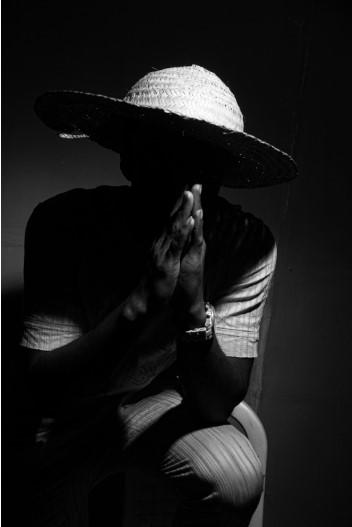
If you are wounded unconscious on the frontlines, medical corps would at least know what division you came from through your dog tag. Sometimes fatigues is the only thing left in the crater of an eruption, pieces of cloth, silver of arms, a straw hat. At least they can tell who you are/were. In the Shadow would have made a less ordinary cover for Sound Sultan’s 8th Wondah. The lockdown project was the last offering the music don who had backboned afropop for two decades made before his passing. He let an elite cast of colleagues and mentees provide the wonder, the irreverent coach humming to himself from the sidelines, confident he was about to watch his best game.
Strumming to Cedar Smith’s ‘music in corners of the dark’, she leaves us a faceless figure with clasped hands. She carries on her mythic ethos in the temporal suspension here, how there are no markers of setting or era. Again, we are to escape the box, look beyond the page to find what is pointed at. In place of sight she hints a different sensory receptor, prayer. What is not said transfigures this image from portrait to icon. And this consistent skill at writing metaphor in technique makes Chinwe an interesting emerging creative to watch out for.
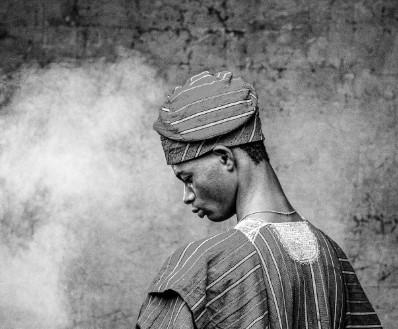
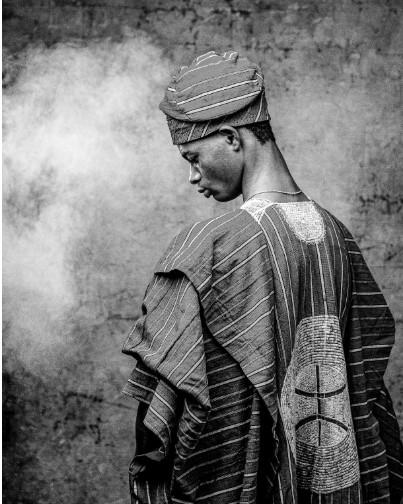
IV – The arc has moved from being seen to being sovereign. The downward tilt of the head continues the inward vector, this shot revels in social semiotics. The emotion is rather muddled by the absence of color, as the direction here veers not toward nostalgia but around a present assertion. This is a situation where the style of an artist handicaps vision. Two examples to defend this; his clothing directs the visual pulse, foregrounding where Chinwe ordinarily left spatial, and cosmic resonance may be read onto the patterns on the back. Because he refuses to offer a direct gaze, the viewer becomes witness to a private moment.
Exhilaration is ever a sacred moment, and at the denouement of this conceptual trifecta, he has attained bearing and legacy. He does not even need to read the parchment background, attracted, as every one else was, to music in dark corners. Lagos is an undying muse because of how random her roads are, in such diverse population, the most arbitrary things happen. In cyclones of dust raised by the 7:30am horde, shapes would be twisted. Existence would break. Only to reboot the next morning, or the moment before the woman treading in Chosen bulletproof, electric green a glint in concrete, looks away from sirenless fire trucks parked by a building that had been marked for demolition a week ago. Chinwe teaches the space and silence where stiffening wrists and charred khaki sleeves go. It embodies, this music, that slab of light falling across your thighs.
The depth of the message is reinforced by the deliberateness with which it is conveyed. Nuance rich portraiture that retains its groundedness through post production. Its presentation is grand, which is crucial. Her work claims its alcove in the aesthetic, accessible to varied levels of appreciation. Intensified observation would perceive the revolving door. Stored in the interior are personalities you wish to see. It is a trap door. Signed in ink holding an ode that begins, if you are sick and tired of being tired,
Ebri Kowaki is an arts and culture expert. His reviews and opinions have appeared in The Republic, UbuntuAfrica, Afrocritik, African Writer Magazine, and elsewhere.
Disclaimer
Comments expressed here do not reflect the opinions of Vanguard newspapers or any employee thereof.