By Chris Onuoha
With the recent wave of migration in Nigeria called “Japa,” many of the country’s young talents are embarking on new journeys abroad perhaps, for greener pastures or as a sort of escape from the economic reality on ground.
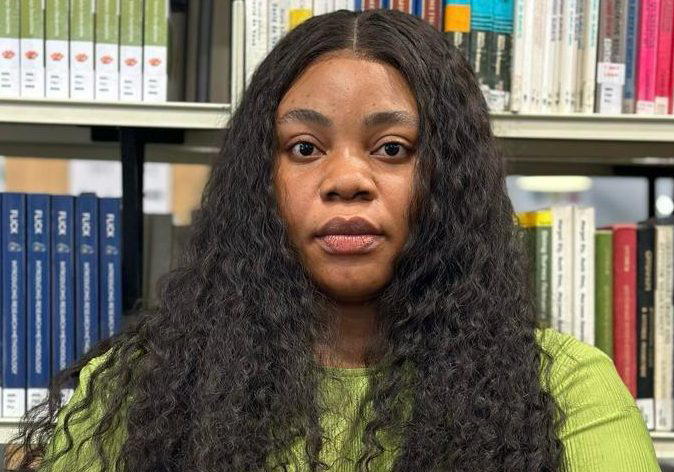
One of such young talents, Amaka Felly Obioji, a Nigerian writer and poet whose work has been featured in several journals and magazines across Nigeria, in a chat with Vanguard Correspondent, shared her story in a creative non-fiction piece. Amakais such artist who managed to nurture creative talents away from home, and despite adjusting to her new life in the United Kingdom, she continues to find solace and joy through her writing and poetry in this excerpt.
My flight had taken off from Lagos Airport. We duly arrived at Heathrow Airport. Disembarkation was followed by an unnerving sensation: the blast of freezing air.
I arrived in January. It was a freezing world. London teemed with multitudes, yet felt utterly uninhabited! It was populated by people rushing along in a frenzy. Their repellent odours remained after they had passed.
However, every new place has a feel – and a poem – that evokes it for me, rather like old friends reuniting. London for me feels like reading Mary Oliver’s Wild Geese on a cold, rainy night. This feeling stuck. Whenever I am minded to relive my first day in that city, the last paragraph of her poem springs to mind. Like a movie, it replays my first day at Heathrow, the glum immigration officers prying into my passport as though intent on uncovering the sinister, interrogating me over why I left home and why I made my way to England.
“Whoever you are, no matter how lonely,
the world offers itself to your imagination,
calls to you like the wild geese, harsh and exciting –
over and over announcing your place
in the family of things.”
New places – my new self fights my old self and both are left in limbo
I dragged along my three matching suitcases. I had purchased them after vigorous haggling with Igbo traders at Lagos’ Balogun market. Haggling is an art that demands special skills. Bargaining with Igbo traders and finally buying at your bidding price is almost a miracle, but I won. I would later deploy this skill at Camden market with Pakistani traders, negotiating sales of three vintage sweaters for the price of one, sweet-talking them into giving me a shawl for half its fixed price. To live well necessitates mastering skills which, although seemingly trivial, gets one through the next day. This conclusion impels recall of Bronislaw Maj’s poem, A leaf.
“A leaf, one of the last, parts from a maple branch:
it is spinning in the transparent air of October,
falls on a heap of others, stops, fades.
No one admired its entrancing struggle with the wind,
followed its flight, no one will distinguish it now as it lies
among other leaves, no one saw what I did. I am the only one.”
At the tiny flat I rented with a friend in East London, I found myself squeezing into cupboard-sized rooms. I compared my new abode with my large home in the heart of Igboland, the London kitchenette – really a cramped cubbyhole – with the capacious kitchen in Igboland which easily contained ten persons. In my tiny flat, everything was at arm’s reach, the microwave almost on the washing machine. I think the first thing my old self did was try to adjust to the situation, but I was disorientated by discomfort. My old and new selves seemed to war each other.
One evening, I rummaged piles of old books. I had obtained them from an indie bookshop about to shut down on account of lack of funding. In one of the books, I found a piece that was apt of my feelings, reminding me to simply pause and live in the moment. It was Rita Dove’s poem Pithos.
“Climb into a jar and live for a while.
Chill earth.
No stars in this stone sky.
You have ceased to ache.
Your spine is a flower.”
The new boots from Zara chafed my toes, making me wince as I limped to the back of the red bus bound for Hendon Central. A schoolgirl with a mouthful of food placed her dirty shoes on a seat. I glared at her, hoping she grasped that her action was disgusting. My glower had no effect; it appeared that she habitually sat with her dirty shoes on seats. I was becoming so aware of where I sat that my mind raced, imagining what numbers of people might have placed dirty things on the very seat on which I sat. My Google map jolted me with its vibration to remind me that I should get off at the next stop. The pain in my toes had ebbed, but I somehow feared a resurge as soon as I resumed walking.
However, I believe “the journey might hurt but we won’t dwell on its pains; we’d rather look forward to the gains that will exceed the strains.’ That resolution was the lesson drawn from my shoe experience on that cold morning in London.
She who wears the shoe knows where it pinches
The lady at the registration office gave me a sidelong look when I told her that I needed to complete my student registration, then attend a class in a few minutes’.
I sometimes shuffled my legs, seeking to diminish the pain in my toes which were trapped in the boots I wore. The lady mistook my moves as impatience, quickly adding that the registration process would take a while and I should be prepared to wait. I realized how people could misunderstand people’s body language, or assume the false. I was having a bad-shoe-day, but my body language had communicated impatience. How easy it is to judge others without knowing the truth.
My Body
I didn’t know how much weight I had added, probably because I had spent all winter and summer wearing oversized jackets and t-shirts from Zara and TK Max. I seldom looked at the mirror anymore. I had begun to fear the double chin I was developing. I have refused to admit that my once oval eyes are being misshapen by sagging eyelids.
The blood form results proved my fears. My body had betrayed me. It was not a misunderstanding. My body had simply become incapable of defending itself. The cause might have been the tea or coffee or canned foods from the corner shop. However, the blood form declared: PCOS detected. My heart sank down to my belly. On the district line train to Upminster, I dropped all inhibition and let the tears roll down my cheeks.
I pondered how our bodies developed minds of their own with no care, at the strangest times, even when we were at our lowest. I distilled my feelings into a poem.
“You wouldn’t know how
long you have lived
until you stare at the
mirror and see your once
slim jawline, heavy,
filled with hollows,
carrying grief from ages.
“Your neckbone sagged,
spilling flesh,
you are no longer
the girl with the silky hair
Your hair that imitates the colour of the
rain clouds at night have taken the
golden sheen of the moon.
Your bosom lays out flat
like drylands,
forgetting its fullness
that gave life.
“Your bed, empty,
filled with noises of
departing footsteps.”
It was on a Sunday that I finally found myself, or at least remembered every detail of myself! It was summertime, a Sunday simultaneously wet and sunny. A friend had invited me to a poetry evening with other migrant writers. We sat in a circle, discussing home and how easy it was to forget. We all declared that one could be so preoccupied with making a home in London, in new spaces, that past identities and dreams would be lost. We remarked the pervasive newness of our environment, the urge to be able to pronounce r and other sounds whilst concealing our indigenous accents.
We held our hands in wonder. We were emigrants or children of immigrants, in a busy street of flashy cars and blaring car horns in central London, crowds drifting about in apparent aimlessness in overcrowded shops and malls, and all we had were poetry and one another. We sat in an old library, writing poems, because that was the only way to remember, to preserve the memories of our fathers, our mothers and siblings, to preserve the places of our birth because whatever was not written could easily be forgotten.
“I’ve been praying,
and these are what my prayers look like;
dear God
I come from two countries
one is thirsty
the other is on fire
both need water.
“Later that night
I held an atlas in my lap
ran my fingers across the whole world
and whispered
where does it hurt?
it answered
everywhere
everywhere
everywhere.
The above poem was authored by the Somali-British writer, Warsan Shire.
That day after our writing, I was holding the hand of a Sudanese asylum seeker, who recently fled to London for refuge, battling the endless application processes and staying strong despite her precarious mental health… that night, before we parted, she cried in my arms and I stayed put, so defeated by the system, by the entire world, that I had never wanted so badly to change the world. However, all I could offer were tears and weakness.
Later, we would read another Warsan Shire poem: Home.
“no one leaves home unless
home is the mouth of a shark
you only run for the border
when you see the whole city running as well
your neighbors running faster than you
breath bloody in their throats
………………………………………….
“no one leaves home unless home chases you
fire under feet, the go-home blacks
refugees dirty immigrants
asylum seekers sucking our country dry
niggers with their hands out they smell strange
savages messed up their country and now they want
to mess ours up”
Now, I lie here again on my bed in January with the heating turned to 30 degrees because my body has not become acclimatized to cold habitations. In my tiny, poky flat in East London, the landlord had just increased the rent and his excuses were dressed with phrases like ‘cost of living’ and ‘mortgage tripled.’ I didn’t even try to negotiate with him; I was already exhausted and this winter has roused a lot of feelings and I was in a hurry to end the call. I opened my social media apps and news of war continued to trail my timeline. Sudan, Congo, Gaza, everywhere was burning, piles of corpses of children abounded. Filled with rage, I wrote a poem.
“I flipped through these TV channels
That have become pathways to horror.
Somewhere,
a home is burning,
a mother has lost a child
My cubicle becomes a magnet,
channelling the rage of the
world into my room.
“I stay rooted in anger.
“I want to offer my body to Earth,
to decay, to pay homage to the
5-year olds mowed down
on their way home.
“To spill my blood in appeasement,
to cleanse the earth,
to cure the world of rage
and my rage.”
Poetry is how I remember myself, poetry is how I live, how I survive, the prayers I offer to the universe, the faith I muster on my hard days, and the hope I give my friends. It’s still cold here in London, I hope winter ends soon, and the sun comes sooner. I hope we find only ease in our journey.
Disclaimer
Comments expressed here do not reflect the opinions of Vanguard newspapers or any employee thereof.