By Matilda Ikediobi
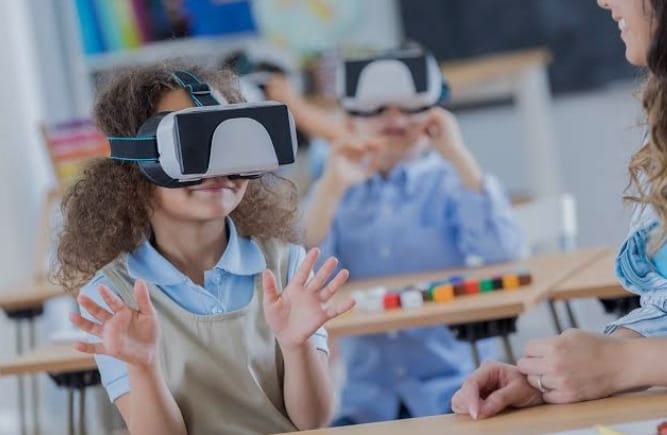
Nigerian education technology researcher, Rachel Israel, has called for the introduction of Mixed Reality, MR, technology into primary schools, especially in rural communities, saying it could transform how children learn science and secure the country’s future.
The education technologist noted that many public primary schools across Nigeria lack laboratories, libraries and basic instructional materials, forcing pupils to memorise scientific concepts without practical exposure.
According to her, this gap has continued to weaken interest and understanding of science among young learners.
She said: “Science is supposed to be seen, touched and experienced, not just memorised from textbooks. Mixed Reality has the power to bring science to life for children who may never see a real laboratory throughout their primary school years.”
On her research, Rachel said MR technology allows pupils to conduct virtual experiments, explore the solar system, observe chemical reactions safely and study plant and animal cells in three dimensions, all within the classroom environment.
She added that a child in a remote village could, through MR, simulate mixing chemicals, watch the water cycle in motion or travel through the human body virtually.
She said: “These are experiences that are simply impossible in most under-resourced rural schools today.”
According to her, biology lessons that rely heavily on flat diagrams could become interactive journeys through ecosystems and organs, helping pupils develop curiosity, critical thinking and a deeper appreciation for science at an early age.
However, she stressed that technology alone would not solve Nigeria’s education challenges, insisting that parents also have a major role to play in children’s development.
She said: “Parents must take responsibility by having only the number of children they can adequately care for and educate. Overcrowded families often struggle with school fees, learning materials and attention, and this limits children’s potential.”
She argued that when responsible parenting is combined with modern educational tools like MR, children are more likely to stay in school, perform better academically and aspire to scientific careers.
The researcher described the integration of MR into primary education as “a blueprint for national progress,” noting that children who learn science interactively are better prepared for higher education, skilled jobs and leadership positions.
Israel said: “Investing in Mixed Reality for schools and promoting responsible parenting are not luxuries. They are strategic steps to unlock Nigeria’s human capital. The children learning today are the scientists, engineers and innovators of tomorrow, and we must give them the tools they deserve.”
Disclaimer
Comments expressed here do not reflect the opinions of Vanguard newspapers or any employee thereof.