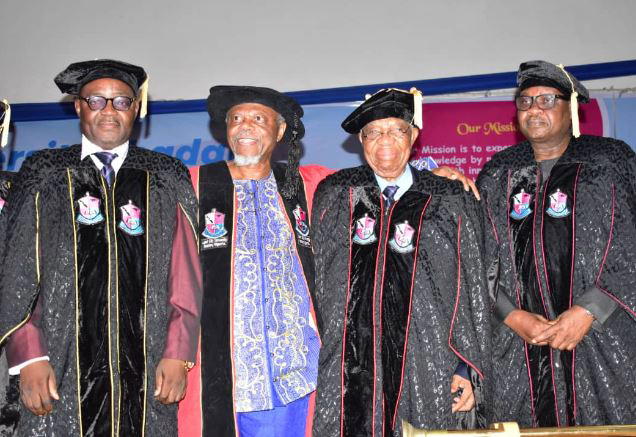
Leading scholar and African historian, Professor Toyin Falola, has been decorated by the Lead City University (LCU), Ibadan, with the highest honorary status for a distinguished academic with the rank of an emeritus professor in the humanities.
Falola, who is the Jacob and Frances Sanger Mossiker Chair in the Humanities at the University of Texas at Austin, has been described by many as a distinguished African historian whose track record of research and mentorship has been adjudged second to none.
Professor Falola’s appointment was announced at the Lead City University’s 15th Convocation Ceremonies which took place on Monday, December 12, 2022. Also appointed professor emeritus at the event was Professor Alaba Ogunsanwo, a political scientist and former ambassador to Belgium. Others who bagged honorary doctoral degrees at the ceremony were Mr. Ogie Alakija (Business Administration), Mr. Kola Daisi (Business Administration), Mr. Tunde Kelani (Doctor of Letters), and Professor Kayode Falade (Engineering Science).
In his lecture titled: ‘Interrogating ‘Japa’: Youth and Talent Exodus, National Development in Uncertain Times,’ Dr. Charles Akinola, noted that “As you know, Nigeria in recent times has been experiencing an unprecedented exodus of our young people to other parts of the world in search of the proverbial greener pastures.
“The reason advanced for this, in many instances, is the tenuous socio-political fabric of the nation and the particularly demanding economic realities which are increasingly making life challenging for many citizens.”
He, therefore, called on the government to arrest this trend, noting that if gone unchecked, the implications may be too dire. Pointing towards Professor Falola, the lecturer eulogized Professor Falola’s accomplishments in the global academe, saying that he remains a source of inspiration all over the world.
Earlier in his remarks, the Vice-Chancellor of the university, Professor Kabiru Adeyemo, called on the relevant stakeholders to address the frequent impasse between university lecturers in public universities and their employer, the Federal Government. He insisted that a conducive environment remains critical to the development which advanced countries have recorded. He, however, lauded the honorees at the event while singling out Professor Falola for his remarkable achievements in the academia.
Advancing reasons Professor Falola was penciled for the emeritus professor rank, the university’s orator, Dr. Donald Odeneye, told the audience that Professor Falola, in contributing to knowledge, “has opened access to information for various schools in impoverished countries by giving out periodicals, journals, books, and technology devices and offering free lectures and seminars. He is a liberal scholar who supports grants for the needy and establishes an annual award to help underprivileged people pay for their education. These actions have allowed many underserved people to pursue their ambitions and become a better version of themselves.
“Toyin Falola is an avatar whose contributions to academic activities cannot be fully explored in a brief discussion. His influence extends outside of the classroom. He is a mystery and a significant contributor to Nigeria’s political system and way of life.
Due to his journey of political soul-searching and his writings about the negative consequences of oppressive systems that result in excessive disdain for the rule of law, Falola has produced a sizable collection of writing that pioneer various fields. Though the political climate in the nation is hostile to dissenting viewpoints, Falola refuses to be intimidated by the hazards involved and speaks to the authorities with common reason, not caring whose ox gets gored as long as the masses are taken care of.
“Falola has written incisive works specifically discussing the nature of the Nigerian bureaucracy in an African democracy, which makes significant contributions to the political life of the Nigerian people. This speaks to his impact beyond the four walls of the classroom. Additionally, his studies and writings have aided in Africa’s political, social, and economic advancement.
“Falola is the extended arm of Africa, working for the continent, its diaspora, and international peace and justice. His pioneering works expanded the body of knowledge on Africa during the nineteenth and twentieth centuries. He also provided a vast array of fresh observational data to fill important gaps in African literature. His writings have reframed various subjects and fundamentally altered how we understand Africa in the nineteenth and twentieth centuries.
He has led admirable intellectual efforts on African history, with a special interest in West Africa, Nigeria, and the Yoruba-speaking people. His goal has always been to illuminate African studies, which mainstream media have purposefully obscured. His willingness to accept this risky mission has earned him acclaim and attention from around the world, necessitating his constant travel to fill in the world’s knowledge gaps surrounding Africa.
Falola has made the unwavering decision to restore the already damaged image of the African people, but he hasn’t let that stop him from pursuing a career as a teacher because he views teaching as the noblest way to serve humanity. He has also written works on Africa, examining the significant events that influenced African life and how they relate to the continent’s current agenda.”
Disclaimer
Comments expressed here do not reflect the opinions of Vanguard newspapers or any employee thereof.