By Gabriel Ewepu
ABUJA – AS food crisis looms across the country, ActionAid Nigeria, AAN, Small-scale Women Farmers Organisation in Nigeria, SWOFON, CAADP Non-State Actors Coalition, CNC, Monday, decried 1.11 per cent budgetary allocation to the Agricultural Sector by the Federal Government.
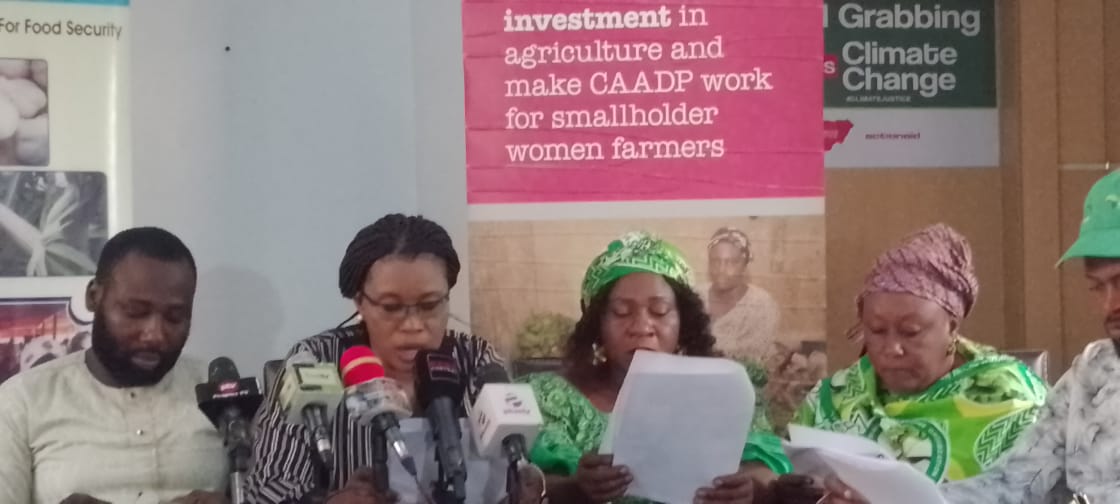
Their displeasure was made known at a media conference held in Abuja, where leaders of the groups took turn to read the joint address tagged ‘2023 Proposed Agriculture Budget’.
According to them, the analysis focused on the proposed 2023 agricultural sector’s budget to x-ray how Nigerian agricultural sector is funded and positioned for growth, employment generation, meet domestic food demand, generation of foreign exchange via exports on the perimeters of Comprehensive African Agriculture Development Programme, CAADP, framework, how the budget addresses smallholder farmers, women and youth, irrigation, climate resilience and sustainable agriculture, value chain development, access to credit, extension services, mechanization, post-harvest losses reduction, and others.
They said, “Out of the N20.5 trillion, the agricultural sector’s allocation is N228.4 billion (1.11%) which is rather low in terms of its proportion to the entire budget.
“In the last seven years or more, the budget for the agricultural sector has not exceeded two per cent of the total budget.
“Given that the agricultural sector is adjudged to as the sector with the potential to transform the entire economy and employ the teeming youth, adequate funding must be prioritised for it in the national budget.”
Pointing at the CAADP benchmark, they argued that if government is to allocate 10 per cent of N20,507,942,180.704 (the budget amount) , it, therefore, means that the expected amount should be N2,050,794,218,070.4, which with the current amount allocated to the sector indicates a shortfall and a huge gap of N1,822,365,529,668.4.
It would be recalled that in 2022, the Federal Ministry of Agriculture and Rural Development Headquarters got an allocation of N185 billion while its Departments and Agencies received N106.3 billion, and in 2023, the Federal Ministry of Agriculture and Rural Development Headquarters received an allocation of N131.7 billion while its 45 Agencies including Universities of Agriculture received N97.7 billion, which stakeholders in the sector condemned the sharing formula and said it is unfair and should be adjusted in order for implementing agencies to have a larger chunk from the total budgetary allocation to execute expected projects, programmes and policies.
According to them, some of the weaknesses in the agricultural budget include; amount too low to achieve the National Agricultural Technology and Innovation Policy, NATIP; unclear support for smallholder agriculture; poor funding for climate change mitigation and adaptation, and others.
Meanwhile, they pointed that threats to implementation of 2023 agricultural budget include; preparation towards 2023 general elections; late release of funds, main Ministry’s domination over implementing Departments and Agencies.
However, some of the recommendations made include; Creation of a Separate Agriculture Emergency Fund outside 2023 Agriculture Budget to avert looming food crisis which is going to be occasioned by the ongoing Russia-Ukraine War, Flood disaster, insurgency, banditry, farmer-herder clashes, post-harvest losses of N3.5 trillion annually, “The President needs to urgently create a separate Agriculture Emergency Fund.
“Government should quickly mop up agricultural produce excesses across the country in areas that dis not experience flooding this year.
“The Federal and State Governments should complete ongoing construction of dams, construct new dams, water catchment, desilt existing dams to function at full capacity, dredge the rivers and put our ecological funds to adequate and articulate use for irrigation for all year-round farming got our food and nutrition security.”
They also called for recapitalization of Bank of Agriculture, BoA; Monitoring of agricultural projects, programmes and policies in the budget by stakeholders; the budget should be more gender responsive; Reintroduction of GES; Reduction of huge budgetary allocation to Federal Ministry of Agriculture and Rural Development Headquarters; Early and timely release of funds for implementation of policies, programmes and projects. On this Manager, Governance Programme, ActionAid Nigeria, Celestine Okwudili, assured that the group will explore options including lobbying and reaching out to relevant Ministers and other heads for release of funds.
Others who also spoke include, Food and Agriculture Programme, ActionAid Nigeria, Azubike Nwokoye; Manager, Policy and Advocacy, ONE Campaign, Razaq Fatai; Chairperson, CAADP Non State Actors CNC, Rosemary Effiong; Federal Capital Territory, FCT, Secretariat, SWOFON, Nnanna Mercy Chukwuma; National Auditor, SWOFON, Safiya Yahaya; and FCT Budgit Committee, Chris Kaka.
The Country Director, ActionAid Nigeria, Ene Obi, represented by Director, Resource Mobilisation and Innovation, Andrew Mamedu, stressed that it is no longer acceptable for paltry 1.11 per cent allocation to agric sector.
Obi also said, if Government adequately support smallholder farmers, they will faithfully pay taxes to the government which they are willing and ready to do as it would generate huge revenue for the country.
She said: “We just got an emergency. Just some weeks back, thousands of farmers were affected by flood, and we think it is business as usual? That calls for an extra emergency fund for agriculture. If we are not getting the message definitely it will wait for us.
“Food is critical. So even if we are borrowing money, we are to borrow money to invest. We should invest in agric sector, 1.11 per cent budgetary allocation to Agriculture is not acceptable.”
Disclaimer
Comments expressed here do not reflect the opinions of Vanguard newspapers or any employee thereof.