.
-Marks first year of operation in Nigeria
By Ibrahim Hassan-Wuyo
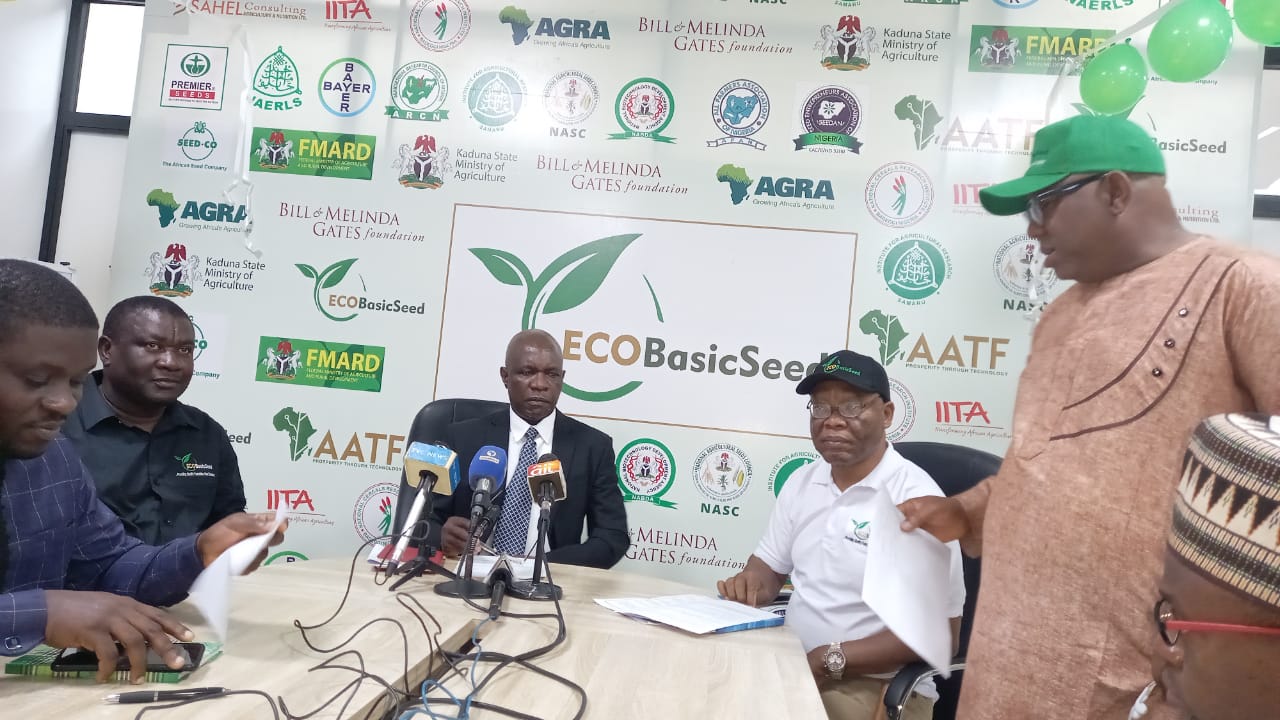
The Managing Director of ECOBasic Seed, Brighton Karume, a company providing quality foundation seed solutions to Nigeria’s agricultural sector, has urged Nigerian farmers to reduce their concentration on Open Pollinated Varieties (OPV) and embrace Hybrid Varieties for better yield.
He said at a press briefing in Kaduna on Saturday, that they were convinced that with sustained investment and the needed cooperation from farmers and other stakeholders, Nigeria would be able to meet its annual maize deficit which currently stands at eight million metric tons.
“It is my pleasure to address you today as we mark the first year of operation in Nigeria. A year ago, we debut with the promise of bridging the wide gap between the foundation and certified seed production in the country as a way of giving our farmers the opportunity to maximize profit, and expand their production with the availability of quality and 100% seed purity.”
He said that promise had remained their watchword and guided their operations in the last 12 months.
“With just 6 personnel and an office building, we have been able to transform into an exciting organization working with Out growers to cultivate over 50 hectarages of maize and cowpeas (beans) foundation seed across Nigeria,” he said.
Speaking on their demo establishment; the Managing Director said they have prolific germination of about 60 different demo sites across Kaduna, Niger and Kano state with about 10 different varieties of hybrid maize including Sammaz 62, Sammaz 63 and Sammaz 68 of drought tolerant and high yield.
He said they give emphasis on international training of their team, adding that “we believe that all our individual actions contribute to the bigger picture, one team moving in the same direction hence the World Class Training organized abroad for the team to provide an added dimension to both our awareness, skills and professionalism.
“Our business model is a B2B thus our direct customers have registered seed companies in Nigeria. To date -seed companies have committed to work by placing foundation seed orders of various hybrids including the new cowpea seed on the market against next year.”
“Although our operations are still far from our overall target, we are convinced that with sustained investment, Nigeria will be able to meet its annual maize deficit which currently stands at eight million metric tons,” he said.
The company promised the seeds market “quality and genetic purity,on-time delivery, standard and professionalism, value addition at minimum cost and strict confidentiality.”
According to him; “it is important that our farmers reduce their concentration on Open Pollinated Varieties (OPV) and embrace Hybrid Varieties which yield better and has the capacity of leapfrogging Nigeria to the attainment of Self-sufficiency in maize production.”
” In Africa today, Nigeria is not leading in maize production but grows the largest maize hectarage on the continent and this is hugely due to its inability to utilize the opportunities provided by the introduction of hybrid varieties which enable the farmer to produce more from the same old piece of land.”
“Technology now plays a very crucial role in agricultural productivity and hybrid technology brings about improved varieties which is helping farmers in other countries in their quest for food and nutritional security, Nigeria cannot afford to miss out.”
“As a new entrant to the seed sector in Nigeria we also get a lot of support from our local and international stakeholders and partners..,” he said
Vice Chairman of ECOBasic Seed, Prof. Johnson Onyibe in his remarks; said though he works for Ahmadu Bello University, he was there to provide technical support for the seeds industry.
According to him, it is imperative that they succeed in ECOBasic so that Nigeria’s agricultural sector will continue to grow.
” It’s one enterprise that must not fail. We want every hand on deck to help us make it a success. One would’ve imagined this kind of establishment if we would’ve established it before this time. But we are just marking the first year of its establishment,” he said.
He said the MD and other staff of the company would work round the clock to ensure that high-quality hybrid seeds are made available in Nigeria.
He explained that because the quality of seeds earlier used was poor, seed companies came together and said ” because we don’t have the capacity to produce these foundation seeds, breeder seeds and in fact, the foundation components cost so much to produce and to maintain, we need help.” ECOBasic Seed, he said, has come to provide that help.
The company later took journalists on an inspection tour of the ECOBasic Seed demonstration farm near Kwana Farakwai along Zaria Road; where varieties of hybrid seeds were being produced which had already, elicited a lot of interest among the local farmers.
Disclaimer
Comments expressed here do not reflect the opinions of Vanguard newspapers or any employee thereof.