.
By Ebunoluwa Sessou
People Living With Disabilities, PWLDs, both women and girls are at the risk of discrimination, extensive rights violations, neglect, and stigmatization, and they suffer physical, sexual and economic abuse compared to women and girls living without disabilities.
This risk is further exacerbated by a lack of information and limited capacity of women living with disabilities to assert their sexual and reproductive rights and report rights. Infringements/violations and demand a more inclusive justice system that caters to their unique needs.
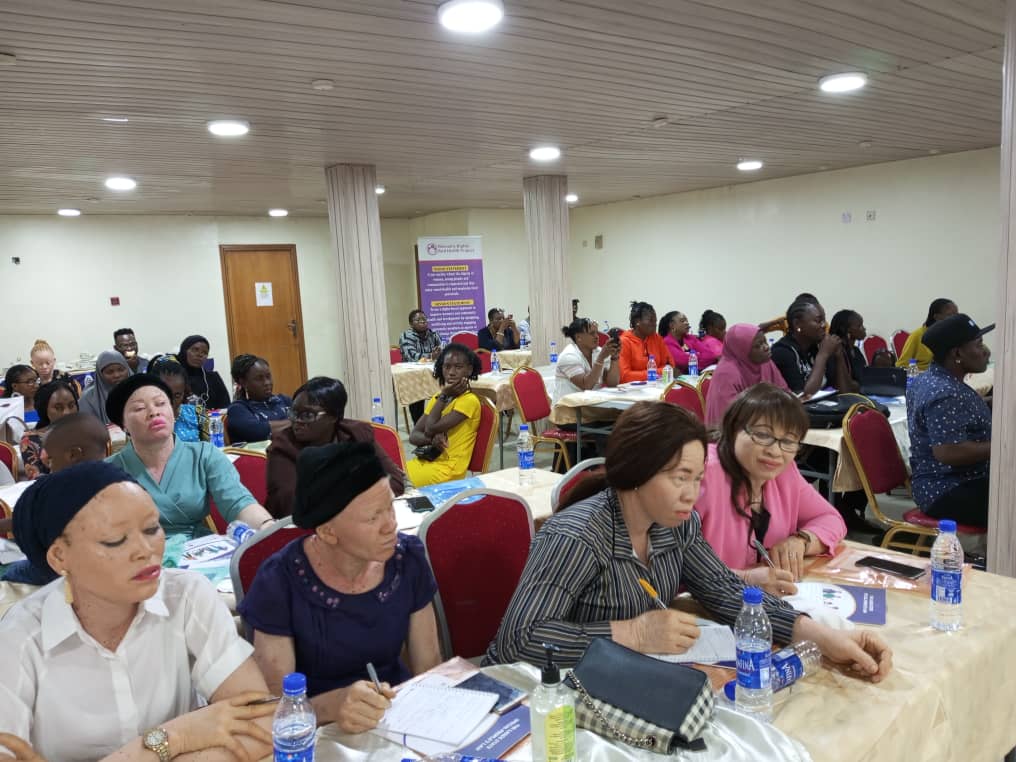
This was the essence of the three days training on Access to Justice for Women and Girls Living with Disabilities Survivors against Sexual and Gender Based Violence, SGBV, in Lagos State.
The project is being implemented by the African Women’s Development Fund, AWDF, in partnership with Women’s Rights and Health Project, WRAHP, with the theme, “Amplifying the Voices of Persons Living with Disabilities, PWLD, Survivors against SGBV in Ebonyi and Lagos States was part of the efforts of the Women’s Right and Health Project, WRAHP, to ensure that persons living with disabilities, especially women and girls, advocate their rights to be free from violence, right violations and demand a more inclusive justice system that caters for their unique needs.
Categories of PWLDs were albinism, virtually impaired, physically challenged, hearing impaired, and dwarfs among others.
Executive Director, WRAHP, Bose Ironsi in a chat with WO, explained that the organization will build the capacity of 40 Persons Living with Disabilities (PWDs) across Lagos State to effectively report issues of SGBV in their communities.
This project is being implemented by the African Women’s Development Fund (AWDF) in partnership with Women’s Rights and Health Project, WRAHP. And it is designed to build the capacity of PWDs to enable them to be credible and effective drivers of change for sustainable development in Nigeria.
“In this training, our focus will be centred on building the capacity of women and girls living with disabilities to advocate for their rights to be free from violence as enshrined in the Violence Against Persons (VAPP) Act and other existing laws; improve access to justice and Violence Against Women and Girls (VAWG) response services among women and girls with disabilities, and improve implementation of laws on VAWG within the justice sector.
“This is a follow-up workshop to the previous stakeholders meeting we had. That programme centred on the sexual and reproductive health of People Living With Disabilities, PLWD. This three day workshop is to train the representatives of different PLWDs.
“One of the things we find is that the majority of the PLWDs do not know there are Laws guiding their existence and they do not know how to go about the Law.
“They are supposed to go back to their communities and educate other people that are not informed on the relevant Laws guiding their existence. The training they are undergoing now is an opportunity to make them advocates in their own communities.
“There are lots of the PLWDs that are not speaking out when they are molested or harassed. But, when they see some of them engaged in an interactive session like this, they will be engineered to speak out.
“Within the 12months of the project, the trained PLWDs will be linked to directory of people who are working on Sexual and Gender Based Violence, SGBV, Lagos State to access help. We will follow up and provide technical support”, she said.
In his contribution, Head Legal Service Department, Lagos State Office for Disabilities Affairs, LASODA, Barrister Babatunde Safiu, disclosed that, there is an office created by Lagos State as Special People’s Law 2010 to implement the Law for Persons Living With Disabilities, PWLDs, adding that the Law provides certain rights such as rights to education, free health, driving especially for the hearing impaired persons, physical disability if the car is molded to suit their use for PWLDs which women with disabilities also enjoy.
Speaking on the relevant Laws as enacted by the Lagos State House of Assembly Safiu quoted some of the Laws including Sections 23 of the Law, Every public transport service must run in such a way that will allow persons with disability to use it.
“Section 24 of the Law, The convenience and safety of persons living with disability must be considered before seats are assigned in vehicles, trains, aircrafts or ships. This includes factors such as ease of access/exit and non-disturbance by the movement of other passengers.
“According to Section 25 of the Law, 5percent of the spaces in a car parking lot shall be reserved for people with disability whose vehicles have been identified with the necessary insignia.
“Any person or organisation in control of a parking lot without such a provision will be liable to a fine of N100, 000 (one hundred thousand naira) per day of default among others.
According to him, LASODA has been putting efforts to make sure that PWLDs have access to justice and medical care. We take violence against PWLDs seriously and follow it to its logical conclusion. We ensure that women get justice.
On her part, Vice Chairman 1, Lagos State Chapter, Joint National Association of Persons With Disabilities, JONAPWD, as well as Head, Lagos State Albino Clutter, Josephine Omolola, said, the organization at its various clutters has counseled women and introduce them to training organized by by other organizations on how to protect PWLDs.
“There is room for more training so that we can be better informed and educated on what we do not know relating to the relevant Laws, how to use the referral systems. There is no limit to training as it would trickle to our different clutters”, she said.
One of the participants, Sofia Azubuike, expressed gratitude to the orgainser for the development. “I have heard of cases of women being raped and intimidated. I have been looking forward to programmes such as would avail me all the necessary information on how to help such individuals.
“I am eager to know when PWLDs would be given attention in situations like this. I believe we will be able to create awareness in our various clusters to educate other PWLDs on appropriate Laws to access justice.
“This is an avenue for us not to feel that we are left out in the society and to see that we have a sense of belonging. No more room for intimidation, relegation and stigmatization. We must know that the Law and government are solidly behind us”, she said.
Disclaimer
Comments expressed here do not reflect the opinions of Vanguard newspapers or any employee thereof.