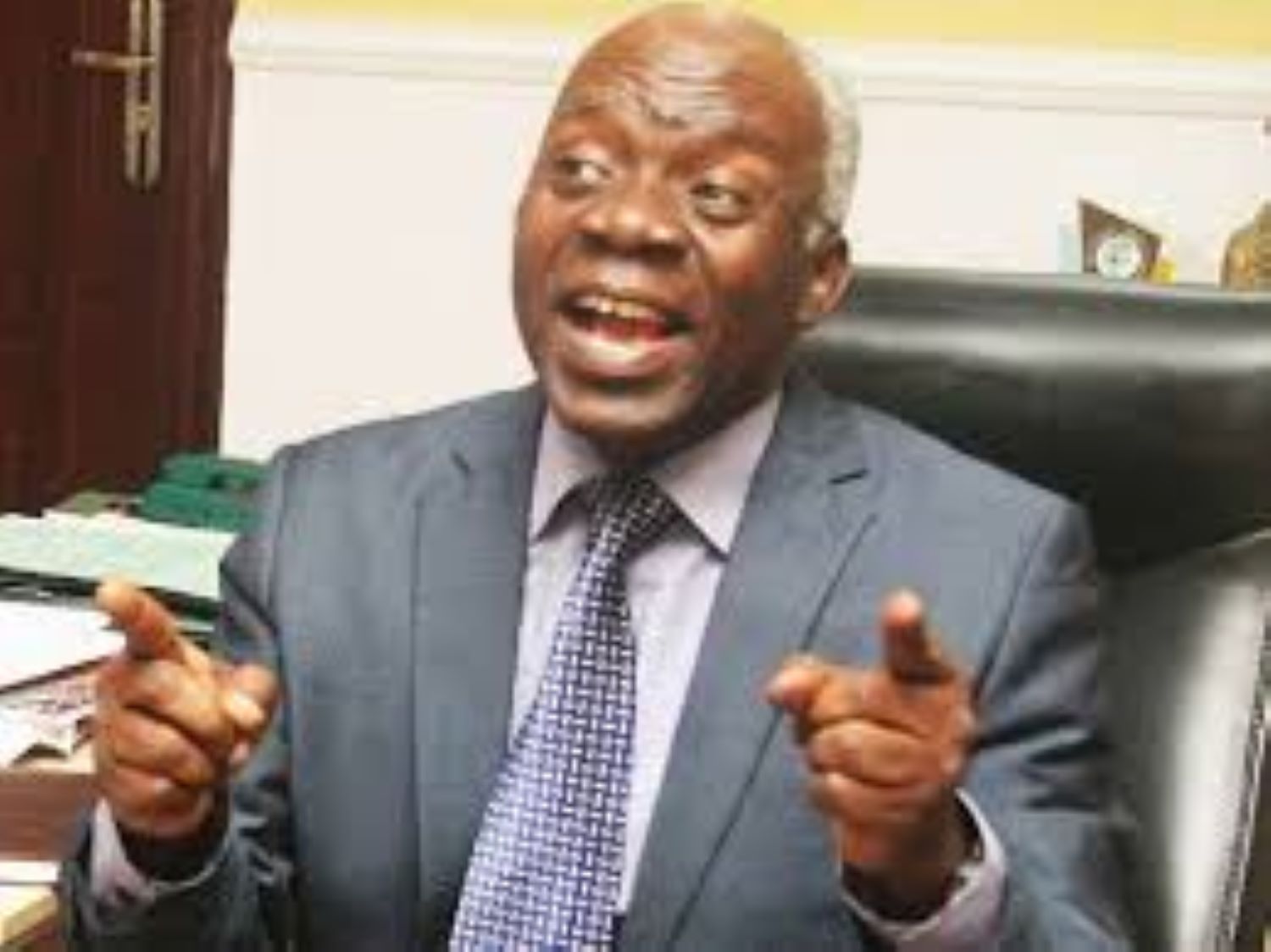
Femi Falana Femi has called on Nigerians to actively expose private individuals and public officials who contravene the provisions of the Anti-Torture Act 2017.
By Jide Ajani, General Editor
Arising from Vanguard’s lead story of Monday, July 25, 2022, where Festus Okoye Esq, National Commissioner and Chairman, Information and Voter Education Committee, of the Independent National Electoral Commission, INEC, said Resident Electoral Commissioners, RECs, are not recognised as members of the electoral commission, just as he explained the import of Section 115(d) of the Electoral Act 2022 as amended (the section criminalises double nomination), legal practitioner and human rights activists, Femi Falana, SAN, lampooned the idea that RECs are not members of the electoral commission. He says there are only two categories of public servants in INEC and they are the National Chairman, National Commissioners and RECs, on the one hand, while the staff of INEC appointed by INEC represent the other. Falana also debunked the notion that Section 115 (d) is not about aspirants but about candidates, saying, if it is not about aspirants, politicians would be at liberty to pick as many nomination forms as possible and block the process of a free, fair and participatory democracy, as might and deep purse would become the order of the day.
Excerpts:
On the floor of the House of Reps on Wednesday, some of the members suggested that there might be a revisit to the Electoral Act, BVAS and others, and they also looked at the interpretation of Section 115 of the Electoral Act. They even said RECs quoted it wrongly. 115(d), says, in respect of offences arising from nominations, that if someone signs a nomination paper, signs result form as a candidate in more than one constituency at the same time, or (k) signs a nomination paper, consenting to be a candidate at an election, knowing that he or she is ineligible to be a candidate at that election, commits an offence and is liable to conviction of a maximum term of two years?
Without an option of fine. That is, the court cannot say that instead of going to jail, pay N500,000.
In terms of an aspirant or a candidate?
Now, you have to understand that we are operating in an atmosphere of impunity of the ruling class.
On a regular basis, police commissioners in each of the states, parade criminal suspects in crimes involving terrorism, kidnapping and the likes. At the end of the parade, no attorney general contacts the police commissioner to request for the case file so they can be prosecuted. At the end of the day, the police, it’s been alleged, will release some of them, others are ‘wasted’. Criminality continues in society.
To stop impunity, that is what is being introduced now, because, before this law, we must know where we are coming from, the Supreme Court had ruled that you cannot have double nomination. It was in a case of Imo State, where a guy contested and lost in the APC governorship primary, and then moved to Accord, to also participate.
As a candidate or as an aspirant?
As a candidate. And the Supreme Court said NO, you cannot have a double nomination.
When you talk of an aspirant here, in the same election, and the Supreme Court said it is illegal – and that is in the same election.
The NASS members are now worried, because some of them are engaged in double nomination. What the law has done is to criminalise the practice of jumping from one party, after losing in the primary to another party or pursuing different offices at the same time. Now, when you talk of a candidate, for instance, a guy contested to be president of Nigeria, took part in the primary as an aspirant, but we are now told, even though the primary for the senatorial election has passed, his name is now submitted to INEC as a candidate. It is a criminal offence and what the law seeks to do is to stop impunity and political prostitution.
In this case now, we have the governor of Ebonyi State who contested in the presidential primary and now resorts to contest for the senate, where his brother who won the election is being replaced by him. Is that criminal? He was an aspirant in one and now a candidate in another.
You cannot debate that now because there is a judgment of a court which is valid and subsisting so, even if I have an opinion, there is a judgment which INEC must comply with and which is binding on the governor and all authorities and persons in Nigeria. That is the law today, so if an INEC official comes round to say we depend on our own report in Abuja, therefore, we are not bound by reports of INEC in the states, what are you talking about? There is only one INEC.
But when you consider Akwa Ibom and Yobe with Senator Akpabio and the Senate President, does your term political prostitution apply here?
Of course, it is known to the whole world that these people took part in the presidential primary, they lost. They then rushed to their states. And INEC now says you are a candidate in a senatorial election which has been held in your absence. Again, like I said, there is already a judgment in this case.
In the case of Akwa Ibom and Yobe, the matters are in court.
Without some of those judgments, let’s put them in context. If someone contests in a primary say, presidential, and that one is over, can’t the person go and contest for the senate?
No, you are required to choose one. It is about the 2023 election and that is just one election.
It’s not about what the lawyers say, it is what the law says. It is the same election.
You cannot say because you lost the presidential primary then you want to go for the senate primary.
Mind you, the primary to the senatorial seat is already over, so your name can only be smuggled in by the political party.
You have chosen to go for the presidential primary. Others have chosen to go for the senate or house of reps, if you lose that one, you cannot say ‘I push you aside, officials in INEC, put my name’.
Does the law frown at that? Is there any court or any part of the Electoral Act that frowns at that?
Yes, Section 84 says, there shall be a primary conducted by the party, monitored by INEC. In these cases, mind you, reports of INEC do not favour these guys. There shall be a primary monitored by INEC.
Section 29 sets out conditions and if you do not meet those conditions, it is a criminal offence to send your name.
But what of the case of death or withdrawal…
There are conditions to be met in those instances.
Even if that person withdraws, there is a procedure.
What the court had said is that if you had taken part in another primary, you are not qualified. It is in line with democratic principles. The Federal High Court in Ebonyi said so. And the judgment nullified the second primary. The court has not said that the governor should participate. What is happening is that if you are well connected with your party, you can smuggle in your name and you rubbish the person that emerged through a valid primary. The governor has taken part in another primary. That is the position of the court. Unless that decision is overruled, that is the law.
Would the law require an amendment now?
No! Those who are trying to amend the law are trying to shift the goal post in the middle of a game. They have discovered now that they are caught so they are trying to amend. It is all about the 2023 general election.
But Mr. Festus Okoye said there is a nomination form from INEC which the candidates and not aspirants will sign and that’s the context being spoken about.
With profound respect, it is not about what Mr. Okoye or anybody else said, I’m talking about the law. The law is clear. Nomination form is paid for by you. And we are not talking about the general election. We are talking about the primary of a political party and it is in the case of APC that we are talking about now and the presidential aspirants paid N100,000,000. They contested in that one. They cannot contest in another primary.
But an aspirant is one who just wants to participate in a primary while a candidate is the one who has emerged from the primary.
An aspirant took part in the presidential primary in Abuja. His name has now been sent to INEC as a senatorial candidate. And the law is saying, just take one and allow others to participate in the process but don’t use your position to make a mockery of the electoral process. You can participate in only one primary in an election year and that is in line with democratic principles.
Only one primary?
Yes! Otherwise I can do three or four primaries – I can do presidential, governorship and senate and house of reps. That will make a mockery of the spirit of the law.
But the emphasis is on the election.
What is important is that the primaries have all been held. And winners have emerged in the case of Akwa Ibom and Yobe but the APC now sent other names. What is required of INEC is to say that we have our reports from the monitored primaries and it is illegal under Section 29 of the Electoral Act to submit another name. So, this is the report of the primary that we monitored and if you have a strange name, INEC is empowered to reject it. But don’t tell me for goodness sake that INEC is a robot, their hands are tied. The law has untied your hands. Section 29 says you must emerge from a valid primary. Section 285(13)(14) empowers INEC to take a decision on the nomination of anybody in the country. If you are offended, you can go to court to challenge INEC’s decision. We already have about 334 cases in courts now, pre-election matters, it is the highest in the world. You are going to have not less than 100 again since INEC has just published names of House of Assembly members. The law sets out to stop that. If INEC can say sorry, we monitored the elections in Oshodi LGA and you did not emerge the winner, therefore, APC, PDP, we are not taking these names. That would have been the end of the matter. Nobody will go to court.
Okay, what is the position of Resident Electoral Commissioners in INEC? Are they members or what?
This argument is irrelevant and diversionary. There are two sets of public officers in INEC: The Chairman, National Commissioners and the RECs, appointed by the President and their names are sent to the Senate for confirmation and they are confirmed, they represent one group. The second group of public officers of INEC are the officers of INEC appointed by INEC.
So, you can’t say RECs are not members of the Commission. You did not appoint RECs. They are not your agents. They are not your boys and girls as we are being told now. There should be no dichotomy between the national office, national commissioners and the RECs because the RECs have statutory duties under the constitution and the Electoral Act.
For instance, the RECs shall collect all election materials from Abuja and distribute them and monitor the elections in their states. They are in charge of all elections conducted in their states, including presidential elections. National Electoral Commissioners are not in charge and they cannot be in charge of the states in this matter. So, when you now say they are not members of INEC. Please, who are the members of INEC? Are RECs members of NNPC? RECs are members of INEC
The interview was aired on Channels TV.
Disclaimer
Comments expressed here do not reflect the opinions of Vanguard newspapers or any employee thereof.