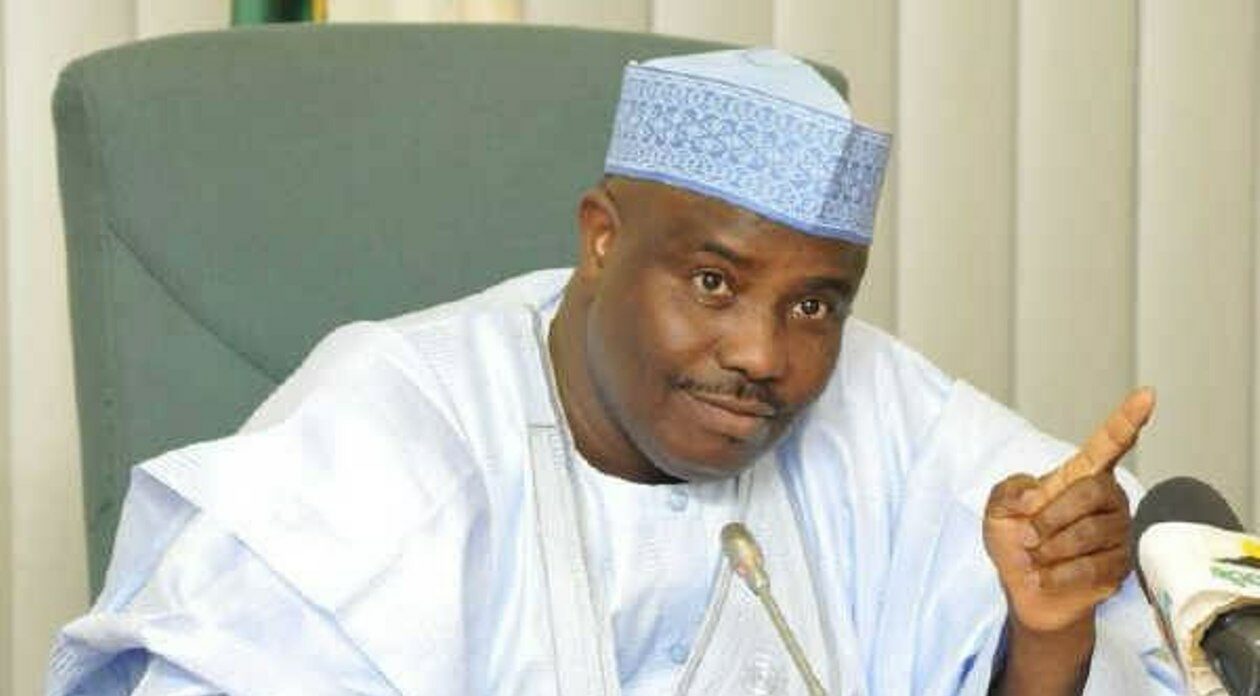
Tambuwal
By Obi Nwakanma
Mr. Aminu Tambuwal, governor of Sokoto state wants to be president of Nigeria. That aspiration is entirely his right as a citizen of Nigeria. It is a right guaranteed to any Nigerian citizen above the age of 35, with the requisite minimum education, to aspire to the highest political office in Nigeria. Aminu Tambuwal is a Nigerian.
He also belongs to a political party – the Peoples Democratic Party (PDP). The interesting thing about the PDP is that since its founding in 1998, it has claimed to stand on a certain, clear principle of rotation of its presidential candidates during election cycles. This principle was the basis that threw up Obasanjo. It threw up Yar Ardua. It threw up the candidacy in the last election of the former Vice-President, Atiku Abubakar.
It in fact out threw out Goodluck Jonathan, on account that he flouted, as sitting president, the necessity of that contrivance, and thus rather than agree to the one term following his succession of the late Yar Ardua, chose to run for a second term in disregard, some claim, of the party’s agreements and principles.
This grundnorm of the party last week, came under severe attack by Aminu Tambuwal who declared his interest in seeking the presidential ticket of the PDP. For Tambuwal’s ambition, this principle should no longer be tenable. His party should, he said, worry more about “who could win elections rather than rotation of the presidency.” Tambuwal’s rather interesting claim presumes of course that he, or the likes of Mr. Atiku Abubakar, and Dr. Saraki, who have defied, or are in the move to defy party principles, are the ones that can win nation-wide elections in Nigeria. That claim flies in the face of facts and reality.
But it is important to go to the very rhizome of Tambuwal’s claim. Does Aminu Tambuwal have what it takes to win the presidency of Nigeria? What gives him the gumption to assume unwarrantedly that he makes that cut and not others outside of the zones whose turn now, according to the PDP’s zoning principles are up to produce the candidate for president? Well, here is what is interesting: in his national political life, having been Speaker of the Federal House of Representatives, Aminu Tambuwal was the product of the PDP zoning formula. In 2015, he was one of the party men, including Saraki and Atiku Abubakar, who left the party, formed a broad coalition that resulted in the formation of the APC that raised a “candidate of the North” – Mr. Muhammadu Buhari – to push Jonathan out of the Aso Rock Villa on account that the PDP had flouted its zoning principles.
He returned to the PDP after helping to oust a PDP president. Aside from the fact that it is easy to call to question his loyalty to this party on which he now wants to ride to the presidency, it is also easy to show how much bullshit is in his claims about those who can in elections. First, Tambuwal’s performance as governor of Sokoto State does not show any extraordinarily remarkable difference that could commend him to the Nigerian presidency.
If any measures are taken, Aminu Tambuwal is a mediocre governor of a backward state in Nigeria. Secondly, Tambuwal comes from a minority ethnic group in Nigeria – the Fulani – which if truth be told, does have an exaggerated hold on Nigerian politics, up to the point of exclusion. But the presidency of Muhammadu Buhari has awakened that tribal fact to Nigerians who hitherto did not bother too much about these facts.
Thirdly, there is no region of Nigeria which can win the presidency with votes from just one region. Tambuwal is not a national figure of significance. He is not a juggernaut of politics. He is just a presumptuous provincial lawyer; a bumkin from some remote dustbowl of the North, who presumes a certain ordained right to rule – given his assumption that he comes from that group which can “win elections.” Happily, Dr. Iyorchia Ayu clarified this issue about zoning last week.
The party’s zoning formula remains. And we can leave it at that. The point though is, politicians engaged in poli-talk, must use discernment and logic. Tambuwal’s talk was class A hokum. Fact is, there’s not even a coherent “North” which was the underlying source of Tambuwal’s self-projection. Elections are won by strategy and by appeal. It is true that one of the great ironies of democracy is that even idiots have a right to vote. But Nigerians, north and south, are not idiots. Increasingly, bread and butter issues will determine election results. Who can put the cereal on the table? Who can create jobs? Reduce crime. Secure the nation? Create policies for effective public utilities like electricity, water, etc. In time, such issues as Nigeria’s foreign policies; military spending, technology partnerships, the National economy etc, which are determined by the Federal government will increasingly shape the debates on who shall occupy federal offices. I should even support Tambuwal, that in future, as we educate more Nigerians, and create more politically informed citizenry, such a question as zoning of the President or any national office ought to be dispensed with. Competence in statecraft should be the real test. But until then, and hopefully on the completion of the zoning cycle, the principle of zoning seems to be the best call in the current situation of Nigeria. Nation-building is an inclusive process.
UMAHI’S BURDEN…
David Umahi says he is sleeping soundly, even after the Federal High Court declared that he is no longer the governor of Ebonyi State. He is sleeping soundly, he said, because he is not bothered by such a declaration of the court. For Umahi, the judgment of the Federal court is irrelevant, since he obtained an earlier judgement in his favor from a state High court.
The problem for Umahi however is, wrong as it is, elections, even gubernatorial and municipal elections, are federal mandates. There are, as a result, issues of jurisdiction pertaining to which courts can declare the validity of elections. Election laws are quite silent on the role of state courts, it seems, pari-passu, Federal courts. And with state high courts, allegedly open to transactions and pressures, their independence is often in question.
What the honourable Justice of the Federal High Court clearly did was to assert the superiority of the Federal High Court on state election matters. The judgement stands, until it is determined by appeal. But this is all too technical for many a layman. What is fact is that by the declarations of the court, David Umahi is no longer the governor of Ebonyi State. He stands, as at now, a pretender to the office, until a police constable, acting on the orders of the court, escorts him out of the office of the Governor. The INEC has given excuses about why it is yet to reissue the certificate to the PDP candidate. It is immaterial. It is not physical possession of the certificate by INEC that makes the governor, it is the enforceable declaration of the court.
As long as the court’s judgement is still in force, and there has been no appellate restrictions to that judgment, the PDP can obtain the orders of the same court to compel the Commissioner of Police for Ebonyi State, to enforce its judgement and evict Mr. Umahi out of the Governor’s Lodge since he has ceased, until any further determination, to be the governor of Ebonyi, especially also as the court has denied his application for a stay of execution of the order. In any case, Umahi is not very bright about these questions of the constitution. Frequently, he has been known to give orders, and issue commands to institutions of state as though he was running a military tools shop.
He probably still does not understand the basic legal issues involved in this judgment, which is why his first statements presumed to place his non-existent powers above the power of the court. He has no idea and he has not, I suspect, often given the right sorts of legal counsel, either by his own Legal Adviser, or by the Attorney-General of the state, who ought to be more neutral. Last week, Umahi challenged Mr. Nyesom Wike to a public debate, in light of Wike’ claim that he is behind Umahi’s troubles. Umahi did not stop there: he made the rather extraordinary claim that he became a billionaire at 25.
Many Nigerians have taken that claim with a pinch of salt. From where did Umahi get those billions, given that he probably left ASUTECH, Enugu’s Engineering School at 22 at the very least, did National Service at 23, and probably started work or business at 24, and it takes more than a year to make a billion. Not even Dangote, who has been given monopolies from the military era, was a billionaire in a year. Umahi needs to clarify this.
Disclaimer
Comments expressed here do not reflect the opinions of Vanguard newspapers or any employee thereof.