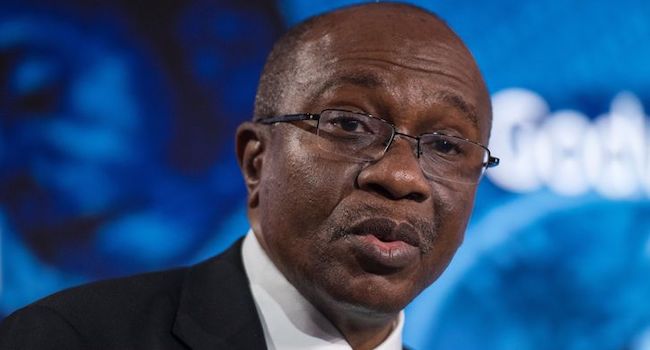
Godwin Emefiele
By Obas Esiedesa, Abuja
With Federal Government set to eliminate most subsidies in the electricity sector by January 1, 2022, experts have held that the government could leverage on the N1.5 trillion intervention funds provided by the Central Bank of Nigeria (CBN) to boost the finances of the industry.
The removal of the power subsidy estimated at about N1 trillion was expected to drastically raise electricity from the New Year.
Special Adviser to President Muhammadu Buhari on Infrastructure, Ahmad Zakari had disclosed at the 12th edition of PwC Nigeria’s Annual Power and Utilities Roundtable, that the nation needs to optimise the potentials in the power sector through a cost-reflective tariff regime.
In about eight years, CBN would have spent over N1.5 trillion to keep the nation’s power sector afloat.
READ ALSO: CBN and importance of development financing
The CBN alongside the Federal Government had initiated the interventions to avert the collapse of the 2013 electricity privatisation exercise.
Reacting to government’s plan, the experts who largely agreed that in the long run, a cost reflective tariff remained the best solution to the challenges faced by the sector, they stated that the CBN funds have ensured that subsidies could be phased out gradually.
An energy lawyer, Osagie Agbonlahor, stated that government ministries, agencies and security formations must begin to pay their bills to boost revenue in the sector.
He queried: “How many army, police, air force, navy barracks that the residents pay electricity rates at all? How many government ministries, army, air force, navy offices pay for electricity consumption? Who has ever had the courage to drive to the barracks to remove wires as they would to ordinary Nigerians. For how long have this been going on in this country. Take away these huge leakages and you will see that the ordinary Nigerians have actually been sustaining and subsidizing the consumption of these fat cows.
Agbonlahor said the last time government broached the idea of deducting the huge outstanding bill on electricity consumed by the barracks and government offices was during the time of the former president Obasanjo era.
Stating that the development has remained elusive since then, he noted that “until we start to do the right things, we are just going to be beating round the bush.”
He asked government to do a forensic audit of N1 trillion subsidies to check where the so called subsidy is coming from.
On his part, the former President and Chairman of Council of Chartered Institute of Bankers of Nigeria (CIBN), Prof. Segun Ajibola said the strongest argument in favour of subsidy is the need for government to protect the welfare of the people by underwriting some of their basic household and infrastructure needs.
He noted however that the argument about removal of electricity subsidy, if any, is not the most fundamental to Nigeria at the moment.
“Rather, the inability to supply the electricity needs of Nigerians, in the right quality and quantities. If supply deficit could be remedied, the cost of electricity and energy generally would be cheaper to Nigerian households firms and even government compared with the cost of alternative sources of power to them,” he stated.
Also speaking, energy expert, Eseosa Lloyd Onaghinon, stated that the energy sector must be rid of inefficiencies, which is usually passed on to consumers, adding that there is about 40 per cent inefficient loses between transmission and distribution.
“If we do not address such losses that occur, we might as well get into a trap where it’s an unending discussion of subsidy though it is actually continuous inefficiencies covered up as subsidies,” Onaghinon added.
Disclaimer
Comments expressed here do not reflect the opinions of Vanguard newspapers or any employee thereof.