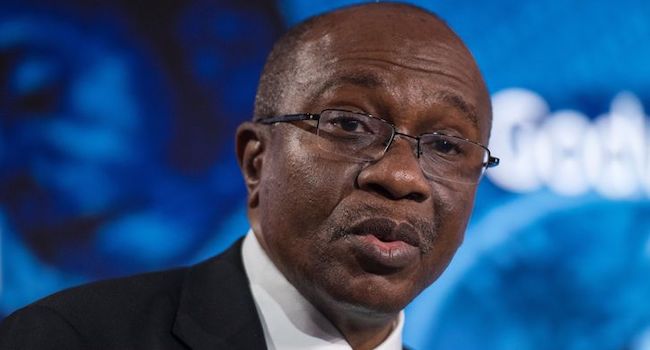
Godwin Emefiele
.
By Ibrahim Hassan-Wuyo
The Central Bank of Nigeria ( CBN) has explained the operational benefits of its newly introduced eNaira to the public and scolded commercial banks in Nigeria for not doing much to educate the citizens about the eNaira platform.
Officials of the CBN took turns in Kaduna on Wednesday to lecture youth corps members, hundreds of students from tertiary institutions across the state and other members of the public on ” onboarding of stakeholders on the eNaira platform, calling on the students to develop entrepreneurial skills even while in school.
Head, Development Finance Department of the CBN, Aminu Muhammad, an Assistant Director, said financial institutions that are under the purview of the CBN are supposed to play these critical roles in growing the economy.
Speaking at the CBN Fair which was held in Kaduna and also featured real-time the Kano version of the Fair simultaneously, Aminu Muhammad said the commercial banks were not effective on issues relating to the eNaira.
” They are lagging behind and that’s why the CBN is coming in to intervene,” he said.
According to him, “For example, the information asymmetry, like what we saw when they were talking about the eNaira in Kano.”
When those at the event were asked about the eNaira, there was no response unlike in Kaduna where many signified knowing about the platform.
He said Kaduna people had that awareness, earlier unlike in Kano, which is because of information asymmetry.
According to him, all the banks knew about e Naira but members of the public do not know.
He said some people, probably might be hearing it for the first time, adding that there is an imbalance of information as regards the eNaira, and that is why the CBN has come out to sensitise the public, give people the opportunity to come in so as to block that information asymmetry.
He said another reason for their intervention was because there is a lack of appropriate financing products and services in the banks.
He recalled that before they started intervening in the agricultural sector, a sector that has so many risks, the banks were forced to lend a certain percentage to agriculture because they don’t want to go there.
“The banks don’t want to develop products that will be talking to agriculture. Even with the percentages given to them and enforcing it, they are still not doing it.”
He said if an examiner goes to the banks and check, they have a way of doing it.” You will see the books, you will see the name of the borrower but at the end of the day, the money will not really go to agriculture.
So that is the reason why CBN is intervening by bringing out products appropriate for Nigerians.”
He said another reason was the lack of useable collateral, saying almost 90 % of those in micro, small and medium enterprises do not have collateral to offer to the banks as security.
“When the banks are in operation to make profits, they would not want to give loans that are not collateralized.”
He said in fact the CBN would even penalise them for that.
“So must of the interventions that we have under the CBN, the collateral requirement is minimal, in some cases even none.”
He said the smallholder farmer doesn’t require any collateral to access the intervention from CBN.
He, however, decried the bank’s apathy to lend to certain critical sectors of the economy, e.g agriculture because of the high risk, something that is not within their control.
” You go to the farm, put the seeds, put on the fertilisers, put on the chemicals, at the end of the day, if the rains didn’t come, what do you harvest? Nothing. That is 100 per cent lost.”
” That is why the banks do not like to go to such type of sectors.
Some of the micro and small enterprises, the banks don’t like to go there because they will be dealing with a lot of people, by the time they are lending, by the time they are lending small amounts their banking halls will be crowded and they will be forced to employ a lot of staff and overhead cost will be high. They don’t want to do that and that’s why the CBN is intervening,” he said.
Disclaimer
Comments expressed here do not reflect the opinions of Vanguard newspapers or any employee thereof.