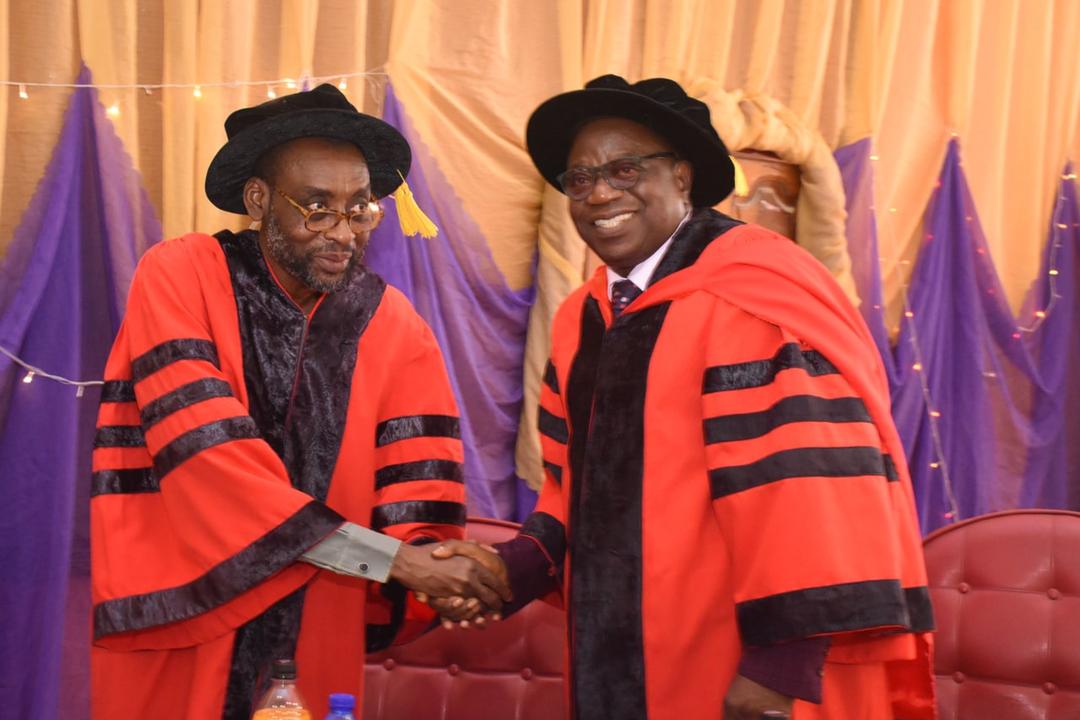
L- R- The Guest lecturer, Prof Francis Egbokhare and the AAUA Vice Chancellor, Prof Olugbenga Ige during the institutions 10th and 11th Convocation @ Akungba- Akoko, Ondo state
.
— We need renewed curricula for sustainable dev.
—– Laments glut of graduates
Dayo Johnson Akure
A Renowned Professor of Linguistics and African Languages, Francis Egbokhare, has lamented that the nations National Policy on Education is a piece of paper produced to satisfy all righteousness.
Egbokhare said this while delivering the 10th and 11th Convocation Ceremony lecture of Adekunle Ajasin University, Akungba Akoko, entitled, Nature of State, National Ideology and the Modelling of Higher Education for Sustainable Development”.
According to him” The reality today is that the National Policy on Education is a piece of paper produced to satisfy all righteousness.
“The most depressing aspect of it is that it has been crafted without a sense of ideological clarity and therefore, the policy does not transcend the semantic interpretation that it affords.
“Second, both the producers and operators bear the burden of colonial infrastructure, having passed through a colonial education system with a fixated view of what education means and how it should be modelled.”
” lt was not correct to always believe that Nigerian graduates were not employable, but there has been a glut of graduates in the system which has caused the collapse of choice while searching for a job.
“Once there is a glut, there is a collapse of choice in job search and demand.
“This radically alters the factors involved in employability. In order for us to understand our perspective on the issue of employability, we need to consider four related issues.
” These are absorptive capacity of the Nigerian economy, the lack of a culture of quality, employment practice that is not supportive of excellence and the incidence of graduate glut due to prolonged unemployment crisis.”
The guest lecturer, therefore, recommended “an effective and sustainable model that must respond to the nature of state and national priorities across all parameters such as curricula, programmes, administration, regulatory regimes, and have philosophical and ideological clarity.
He equally emphasised “the need for all stakeholders in the nation’s education sector to begin remodelling of the existing curricula of the nation’s universities such that they are rooted in the realities of the people and be formulated into national philosophy and ideology for sustainable development.
“An education philosophy that is not ideologically grounded in terms rootedness in the realities of the people, their conceptualisation of society, their aspirations, no matter how well crafted, is just a piece of paper.
“Simply defining a philosophy based on some academic understanding of the purpose of education and on the basis of a conceptual framework based on foreign experience will only lead to dependency and enslavement.”
He however condemned the prevailing establishment of many universities as competitors instead of being collaborators to solve societal problems, adding that if Nigeria could have the right model of universities that would be generated from its national ideology, the nation would have more returns on investment.
” The failure of any education system started from the conceptualization of its philosophy and the ideology that framed it, stressing that, It is not enough to establish expensive laboratories, modernize the classroom, create entrepreneurship programmes, develop critical thinking tools and establish autonomous leadership opportunities in the education system.
“Without philosophical and ideological clarity, the education system simply ignores authentic social and cultural systems, the real needs of the individual and the collective.”
Earlier, the Vice-Chancellor, Prof. Olugbenga Ige, in his welcome address explained that the choice of the title for the Convocation Lecture was informed by the need to seek a better approach to addressing the challenges identified with the nexus between the dynamic nature of our society and our educational philosophy.
Prof Ige emphasized that the way in which students were trained should be geared towards making them more socially responsible, critical and sensitive towards sustainability issues.
Disclaimer
Comments expressed here do not reflect the opinions of Vanguard newspapers or any employee thereof.