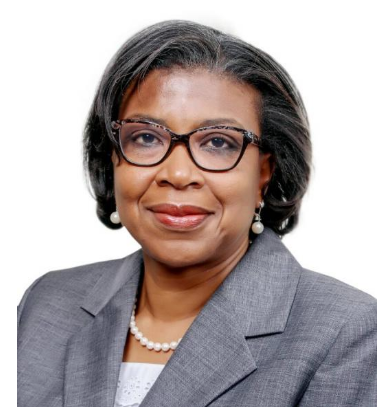
Director-General DMO Ms. Patience Oniha
Emma Ujah – Abuja
The Director-General (D-G) of the Debt Management Office (DMO) Ms Patience Oniha, has suggested a new push at raising revenue, in order to reduce new borrowings.
The suggestion was one of several she presented at the interactive session on the 2022-2024 Medium Term Expenditure Framework (MTEF) and Fiscal Responsibility Paper (FSP) at the National Assembly (NASS) on Wednesday.
She noted that in the DMO’s opinion, the borrowing in the Medium-Term Expenditure Framework (MTEF) 2022-2024 was high and that as such the government needed to accelerate revenue significantly to be able to service the debt.
Ms Oniha said that the public debt stock has “been growing because of New Borrowings in the annual Budgets and New Borrowings approved under the Medium Term External Borrowing Plan, both of which are duly approved as provided for in the DMO Act and the Fiscal Responsibility Act.”
She said, therefore, “what are the DMO’s recommendations? Our first recommendation is that we must do a lot more about revenues.
“What will increased revenues do for Nigeria? It will reduce the level of new borrowings and the Debt Service-to-Revenue ratio.
ALSO READ: Breaking: Mass failure in 2021 UTME
“The other option is, to continue borrowing at our current levels of Debt Service which we do not recommend because the Public Debt could become unsustainable.”
DG Oniha advised that the federal government should only borrow for priority projects that could generate revenue and that the government should leverage private capital through Public-Private Partnerships (PPP) arrangements to finance capital projects.
Her words, “Our second recommendation is that we should borrow only for priority projects and for revenue-generating projects.
“Our third recommendation is that, in addition to increasing revenues, we can achieve a reduction in New Borrowings by actively using Public-Private Partnerships (PPP) arrangements to finance capital projects.”
She noted that the recently approved tolling policy of the federal government would create an avenue for revenue.
“This is one way to generate revenue. If we want to borrow to develop the economy, let us keep a sharper focus on generating revenues so that we do not spend all our revenues on Debt Service or even borrow to service debt,” Ms Oniha said.
The DMO boss noted that borrowing was high when Nigeria went into recession and that it was based on the Economic Growth and Recovery Plan (EGRP) with the goal to bring the economy out of recession.
According to her, the level of borrowings started trending downward, then in 2020, when the budget was revised because of the socio-economic implications of COVID-19, the borrowings shot up, by about double.
She recalled that the new borrowings in the first 2020 budget was about N1.6 trillion but that in the revised budget it rose to about N4.6 trillion.
The DG said, “Our position is that from Medium to long-term, it is not advisable to fund the government with borrowings, it has to be through available revenues then borrowing can be for special purposes.
“Therefore, as Debt Managers, we are concerned with activities that will generate revenues that we can use to service the debt.
“If we look at the rate of other countries, we will see that their debt-to-GDP is much higher than Nigeria. We were 21.6 per cent as of December 2020, while countries like the USA and UK have much higher ratios and, in some cases, more than 80 per cent.
“But when you get to their Debt Service-to-Revenue ratios, it is 10 per cent, at most 15 per cent. This means that our numbers are not adding up because of low revenue generation.
“The issued recommendation from the DMO, therefore, is that we should begin to focus on revenues. Recently, under the Medium-Term Debt Strategy 2020-2023, the Debt-to-GDP ratio was raised to 40 per cent from 25 per cent.
“The purpose was to accommodate the increasing Borrowings as well as the promissory notes that have been approved by Federal Executive Council (FEC) and the National Assembly (NASS) but does not mean we must get to that 40 per cent limit if we have not made significant improvement in revenue.
“As the Honorable Minister of State for Budget and National Planning said during his presentation, between January to June 2021, the Debt Service-to-Revenue was about 34 per cent.
“In reality, the actual ratio is higher which is not good for any country. When we say there is a revenue problem, there is a revenue problem.”
Disclaimer
Comments expressed here do not reflect the opinions of Vanguard newspapers or any employee thereof.