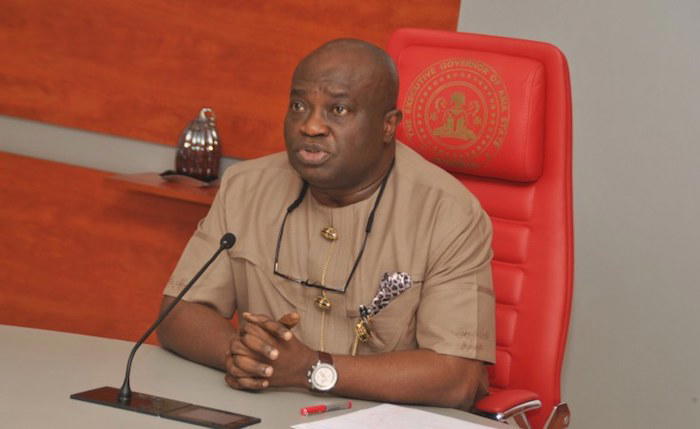
Governor Okezie Ikpeazu
By Dirisu Yakubu – Abuja
Governors Okezie Ikpeazu and Yahaya Bello of Abia and Kogi states respectively, Monday, disagreed on the variant of constitution the country needs to realize her potentials among the comity of nation. The two political giants who took turns to speak at The Osasu Show, TOS, while agreeing that the country has fared less than the world expected of her, however differed on what constituted the people’s constitution.
The state of the nation with emphasis on ‘The People’s Constitution’ was the focus of the TOS symposium, yesterday in Abuja, the nation’s capital. Now in its fifth edition, TOS is a forum which brings together stakeholders from the public, private and development sectors to discuss issues on nation building and sustainable development.
In his keynote address, Governor Ikpeazu came short of blaming the sad trajectory of the Nigerian nation on what he called the defects of the 1999 constitution both in draft and content. According to him, amendment to a set of laws that did not truly emanate from the collective will of the people is not what the country needs to grow and take her place in the sun.
READ ALSO: Runsewe heads Kogi’s Advisory Committee on culture & tourism
He said, “Judging from the reality of the fact that in a few years time, crude oil will no longer be important, in which case, a country like Nigeria should begin to look for alternative sources of livelihood and revenue; can the present constitution guarantees that we can tap fully into our diversity in the area of agriculture? If this is true, which crop is our chief crop or crops for export in Nigeria? Are we going to look at mining? If the answer is yes, do we have the operational framework to do mining according to best global practice? Why do we have many children out of school today than we had ten or fifteen years ago? Why has it become difficult to find statesmen, rather what we see is the preponderance or tribesmen and religious enthusiasts? Why have the citizens of this country suddenly lost interest and faith in government and political leadership at all levels? Why are we struggling with separatists and bandits for the soul and attention of our youths? This social dislocation is what has brought about palpable tension in recent times which has unfortunately manifested in many issues and protests raging from EndSARS, banditry, separatist agitations, industrial disharmony including the emergence of unknown gunmen.”
The governor also premised the lack of social cohesion in the country to the near absence of people-rooted constitution saying “if you reflect on where we have found ourselves as a country, you will be lured into many thoughts of disappointment. People complain of the state of infrastructure, power, water, education and access by the vulnerable member of the society to Medicare. Others complain of a lack of functional system from local government through to the states and to the federal government. Others see a complete disconnect in the policies at the federal, state and the local government levels. We have every reason to worry about our trajectory and the destination that lie ahead.”
According to him, “the dysfunctional state of the Nigerian nation has widened the gap between the rich and the poor and has left government in a situation where people see government as a catalyst that promotes their misery rather than as source of solution to their problems. There is an emergence of a vicious cycle, having two varied important groups at both end of the spectrum: The political class and the masses. The political class has over time benefited from patronage of gullible lot through public perception and express demand from pittance instead of dividends of democracy. Because of this scenario, the political class respond through primitive accumulation of wealth which leads to lack of basic amenities. Sometimes, these poor people glorify people who have no business in the task of governance.”
Driving home his point, the Abia governor continued: “If you look at the state of events in our country today, you will find a nexus between the constitution, the way we look at it and the problems that have bedevilled us as a country. The challenge we have today is to look at how we can remobilize Nigerians to move forward because we have lost trust and faith in the people we seem to be leading. What it means is that despite the fact that constitution of any country is supreme, above the constitution is the superior power of the people. This place a big question mark on the strategies we are deploying to amend the constitution, the 1999 constitution. We seem to have put the same set of people in the fore to give us a new constitution which from my opinion amounts to putting a new wine in an old skin. As we move toward drafting or amending our constitution, who are the people of Nigeria? The first phrase in the constitution, ‘We the people” has been described as a lie because at no point did we as a people come together to agree on a constitution and whatever is erected on a lie cannot stand and will not be sustainable. Ours is a constitution that was foisted on us by the exiting military at that time,” he added.
Ikpeazu’s argument which elicited thunderous rounds of applause did not however go down well with his Kogi state counterpart, Yahaya Bello who argued that constitutions across the world are work in progress rather than the finished article from the onset.
Represented by Moses Okezie, Director General, Research and Development and speech writer to the governor, Yahaya Bello called for patience, noting that amendments to the existing 1999 constitution would suffice in the interim.
“The 1999 constitution was enacted by Decree No. 24 inaugurating Nigerian 4th Republic, restoring democratic rule to Nigeria. Given our socio-political realities as a nation, I think calls for us to dump the present constitution wholesale and make a new one from scratch are not very realistic at this time. Constitutional democracy is not a naturally occurring system of governance. It is always preceded by authoritarian ways or means by which societies have previously been organised. When the forces of progress and modern governance finally make democracy inevitable in a polity, the weaken authoritarian institutions usually find themselves overseen the process of their own overthrow usually via the making and promulgation of the constitution. This is the story of most nations and their constitutions,” he maintained.
He argued that there would always be issues with foundational constitutions such as that of 1960 and transitional ones such as that of 1999, stressing that what is of paramount importance is the unity and will to make a nation work, regardless of challenges.
Also speaking, former Attorney General of the Federation and Minister of Justice, Mohammed Bello Adoke, called for the devolution of powers to federating states even as he argued that community policing is ripe to take firm root in Nigeria given the challenges of security in the past few years.
The Osasu Show Symposium is a brain child of Osasu Igbinedion, is an award winning broadcast journalist and TV host
Disclaimer
Comments expressed here do not reflect the opinions of Vanguard newspapers or any employee thereof.