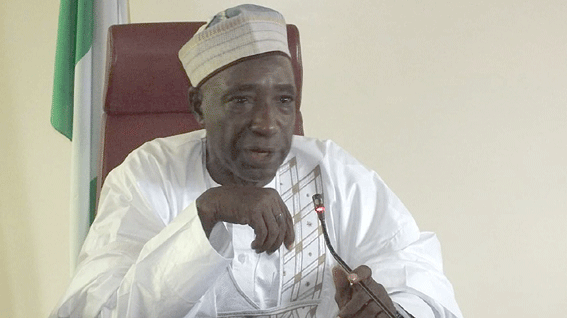
Mohammed Nanono
By Gabriel Ewepu – Abuja
The Federal Government, Thursday, expressed concern over challenges bedeviling fish production in the country.
This was stated in a keynote address delivered by Minister of Agriculture and Rural Development, Mohammad Nanono, at the ‘National Dialogue on Transformation and Future of Aquatic Food Systems in Nigeria’.
Nanono also acknowledged and pointed out the important role of fish in food and nutrition security, being a good source of protein for the human diet containing essential amino acids required by humans in the right quantities which are usually lacking in most national staple foods. “Fish, therefore, remains a valuable nutritional supplement and a virile candidate for addressing food and nutrition security in Nigeria.”
He also commended organizers of the dialogue and said the programme is taking into cognizance the current drive towards increasing domestic fish production to reduce importation of frozen fish into the country, which development of the nation’s fisheries and aquaculture sector is highly critical at this time.
He added that the outcome of the dialogue will feed into the development of a consolidated country report.
READ ALSO: A’Ibom fishermen storm NHRC office, demand justice in case against oil firm
He said: “Despite the potential impacts of the fisheries and aquaculture resources, the sector is however confronted with numerous challenges including the high cost of inputs, use of unimproved breeds in aquaculture, need for improved access to finance, and many others that will still be deliberated upon today, which is affecting the fisheries and aquaculture sector.
“The aim of the dialogue is, therefore, to deepen our understanding of these challenges while also proffering noteworthy recommendations that would leverage aquatic food systems capacity to contribute to the attainment of SDGs in Nigeria in the coming years.”
Meanwhile, the Minister maintained that the Buhari-led government is seriously committed to all sub-sectors of agriculture, and currently makes effort to boost all value-chains towards becoming efficient and productive with the aim of being self-sufficient.
“The vision of Mr. President is to grow Nigeria’s Agricultural Sector to achieve a hunger-free Nigeria through Agriculture that drives income growth, accelerates achievements of food and nutritional security, generates employment, and transforms Nigeria into a leading player in global food/fish market to create wealth for millions of practitioners.
“It is therefore important to mention that the Federal Ministry of Agriculture under the present Administration is pursuing a holistic approach to the development of Fisheries and Aquaculture Sub-Sector through the diversification programme of Mr President along the value chain process.
“The Ministry of Agriculture and Rural Development is therefore willing to engage and partner with all stakeholders for the development of the sector for economic development, wealth and job creation as well as food and nutrition security”, he said.
However, in an address of welcome, the Permanent Secretary, Federal Ministry of Agriculture and Rural Development, Dr Ernest Umakhihe, pointed out that fish production deficit stands at about 2.5 million tonnes, hence importation of the commodity continues, which has drained foreign exchange.
Umakhihe said, “Fish is one of the cheapest and predominant sources of animal protein in Nigeria. It accounts for about 50 per cent of total animal protein consumed in Nigeria with per caput consumption of 17.5 Kg /person/year.
“In this regard, the total demand for fish is 3.6 million tonnes annually while Nigeria is producing 1.1million tons from all sources (Aquaculture, artisanal and Industrial sectors) leaving a deficit of about 2.5 million tons to be supplemented by importation.”
He also highlighted some efforts made by the Ministry to boost the nation’s fisheries sub-sector, “The Ministry has played key role in addressing aquatic food systems in Nigeria notably amongst are: Backward integration policy of Government to encourage fish importers to go into commercial aquaculture (pond and cage culture) of fish and shrimp farming, Establishment of fish farm clusters nationwide, Establishment of fish feed mills in each of the six geo-political zones of the country; Lake enhancement programmes for stock assessment and stocking of water bodies nationwide to increase their productivity.
“Capacity building of farmers, extension workers, women and youth with the provision of starter packs for job and wealth creation, food and nutrition security; Establishment of cottage fish farms in Unity Secondary schools for entrepreneurship development, school feeding programme, targeted at the increase in protein intake to reduce malnutrition among students; Issuance of Letters of assurance to investors to go into deep sea fisheries exploitation for Tuna and Tuna –like fishes and other pelagic fish species for local consumption and export to the international market.
“Diversification of fish species to provide alternative fish candidates for aquaculture and wide preference for our teeming Nigerians.
“Aquaculture certification and the production systems for local consumption and export to international markets.”
Speaking on the way forward to tackle challenges in the fisheries sub-sector, National President of Fish Association of Nigeria and also Regional Vice President for Fisheries and Aquaculture ECOWAS, Dr Adegoke Agbabiaka, advised the Federal Government to liaise with the private sector across the states to facilitate and coordinate its programmes for effective results.
However, Agbabiaka pointed out that there are no funds to execute some of these projects and programmes in the sub-sector.
Disclaimer
Comments expressed here do not reflect the opinions of Vanguard newspapers or any employee thereof.