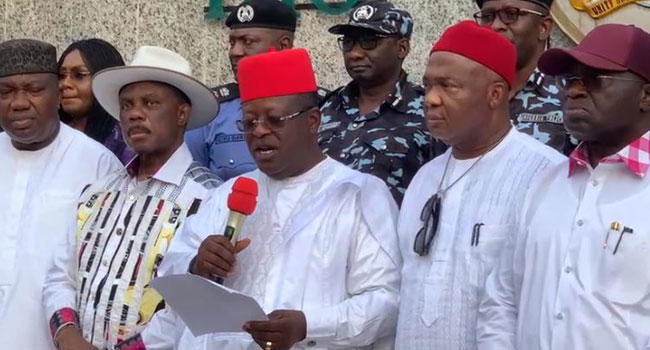
• Governors are excessively greedy, operate as emperors — Onyike
• Show of power, expansionist tendencies of the govs — Bishop Onuoha
• FG should be blamed — Abia monarch
• Lawmakers not interested in making the Local system work
• Govs, not chairmen, stifling devt in LGAs — former Abia commissioner
• Only full autonomy will solve the problems — Abia NULGE president
• We need a constitution that returns power to the people — Osuagwu
• State electoral commissions should be scrapped — Isiguzor
By Anayo Okoli, Vincent Ujumadu, Chidi Nkwopara, Chinonso Alozie, Ugochukwu Alaribe, Chinedu Adonu
& Steve Oko
The Local Government is the branch of government closest to the people. Rural development ought to revolve around it. But this supposed closest system to the people, particularly the rural masses, is indeed very far from them.
The people hardly know what goes on in their councils in terms of programs and projects that benefit them.
In fact, in most cases, there are no projects at all, let alone the ones impacting the rural people. Worse still, even the council chairmen, elected and appointed, don’t stay in their council areas. This is worse in councils in rural areas.
They all reside in the cities and visit their councils at their convenience. This is why they don’t know the problems of their people.
The 1976 local government reform that created the third-tier of government was aptly aimed at bringing democracy and good governance closer to the grassroots. It aptly made provision for the election of councilors and chairmen who are people well known in their communities and who can be easily accessed by the people to know the needs of the various communities.
But with the military incursion into governance, the local government system was dismantled like other democratic structures, leading to the collapse of the system. Military leaders began to appoint council officials who in turn owed allegiance only to those who appointed them, rather than to the people they were meant to serve.
The 1999 Constitution which ushered in the present democratic dispensation though granted a sort of autonomy to the local government councils, but the governors never allowed the autonomy to function. They hijacked council funds from Abuja, appropriate them as they deem fit and released pittance to the council leaders. The governors exploited the state/local government joint allocation policy, which gave the state governors the power to control local government funds.
This policy has rendered the local government system ineffective as the governors control the funds and decide what goes to the local governments.
In some states, the governors pay a stipulated amount to the caretaker committee after such chairmen had signed their full monthly allocation, which they then hand over to their governors. This, perhaps, is why most governors have refused to conduct local government elections which would enable the elected chairmen to access their allocations directly from Abuja.
In Anambra State, for instance, the last local government election was conducted towards the end of the second tenure of former Governor Peter Obi, over seven years ago. At the end of the tenure of those elected chairmen and councilors; the present administration in the state has not conducted another local government election.
The opposition political parties in the state have been clamoring for the conduct of local government election in the state but officials of the state government insist that there is a court injunction stopping the conduct of the exercise. As it is, no meaningful development is taking place at the grassroot level. Even Internally Generated Revenue hitherto collected by local governments has virtually collapsed as the state government officials control the system.
Concerned by the Anambra situation, human rights activist, Mr. Osita Obi has vowed to stop the November 6 governorship election in the state if the government fails to conduct local government election before the governorship poll.
According to Obi, “how can they be planning to conduct governorship election while denying those who want to contest election at the local government level their aspirations? I want to be a councillor and it will be improper for someone to force me to subsume my aspiration while he is pursuing his. It is not possible. If there is no local government election, there will be no governorship election in November.”
Chief Abi Onyike, a former Information Commissioner in Ebonyi State who is the spokesman of Igbo elite group, Alaigbo Development Foundation, ADF, blamed the rot in the local government system on the excessive greed of the state governors and their totalitarian control of governance in their states.
Onyike said: “Nigeria is parading the most dangerous set of hardened characters that operate as emperors in their states. They are not only corrupt, they have swallowed their state resources to acquire properties in Dubai, China, New York, London, Spain and the South of France, not to talk of Maitama/Asokoro in Abuja and Victoria Island, Lekki and Banana Island in Lagos.
“Because of the governors’ strangulating hold on the councils, the local governments are not autonomous, so they cannot assert their independence. The local governments are part and parcel of the states. The whole idea of making the Councils the third tier of government has been defeated as the people in the rural areas are not benefiting from the system.
“The Council Chairmen do not feel safe to reside in the Council areas because they operate as agents of the governors in the looting of council resources, using the dubious joint accounts system. The governors give them pittance which is not enough to run the council administration. So the council chairmen are always hiding in order not to come face to face with the people of the council area who are the legitimate sovereign owners of the resources being looted by the governors and their surrogates.
“The only way to have a functional local government is to go back to regional autonomy so that the local councils in the regions can be properly financed for genuine development,” Onyike advocated.
The fiery and outspoken cleric, Archbishop Anthony J. V. Obinna of Catholic Archdiocese of Owerri, blamed the rot in the local council system on greed.
Archbishop Obinna is of the opinion that some measure of development would have been taking place in the rural areas to curtail the mad rush to the cities if the local government system is allowed to function.
“I blame the situation on palpable greed. The grab, grab mentality is on the high side. If we have less greedy people at the helm of affairs, things will change for the better. I do not know what needs to be said that some of us have not said, but will those in the corridors of power listen?”
READ ALSO: Commission dismisses reports linking Ayade to shut Table Tennis hall
For the Anglican Archbishop of Owerri Ecclesiastical Province, Dr. David Onuoha: “Most local government headquarters look completely desolate. Workers hardly come to their offices for varying reasons, including, but not limited to nonpayment of their monthly emoluments and allowances.
“How can the local government system work when the governors are not ready to let them be? How can the place function effectively when the governors remain strongly attracted to the monthly statutory allocations from the Federal Government? How can the place operate well when the lawmakers are not interested in making the councils to function?
“The local government councils will remain dead until our lawmakers wake up from their slumber and invoke the principle of oversight function. The place will come back to life when the lawmakers refuse to be tied to the apron strings of the executive arm of government.”
A politician, who pleaded anonymity for fear of being accused of anti-party speech, expressed serious worry about the rot in the system.
His words: “My brother, what do you want me to say? I cannot tell you that I am not aware of the nonfunctional status of the local governments in the state. They are all comatose and may remain so, until a God-fearing executive arm of government mounts the stage.
“It is sad that most local council headquarters have been overtaken by weeds. This should not be the case if we really want to develop the nooks and crannies of the state.
“I am a member of the ruling party, but currently, it does not appear that the current Hope Uzodimma administration is keen on conducting local government polls soonest, or removing his hands from the local government monthly allocations.
“Appointment of interim management administrators has been in vogue over the years and that is what we still have on ground today. So, nothing has changed.”
A local government worker, who simply identified herself as Mama Cordelia, lamented that things have degenerated from bad to worse in the local government system.
According to her: “We do not know why the Local Government Service Commission was created by statute, if they are not allowed to function. There is also the pension unit that is not allowed to function. Salaries are not paid. Many are owed. A disillusioned staff cannot give his/her best in service. Honestly, our morale is very low, but we shall keep praying and hoping that one day, a Daniel will come to judgment.”.
A legal practitioner and former Commissioner for Environment, Abia State, Mr. Okechukwu Osuoha, advocates the abolition of joint state and local government accounts, saying it is a major impediment against development at the local government level.
Osuoha, who had also served as a transition Committee Chairman of Isuikwuato Council, accused governors of tampering with councils’ funds under the guise of joint account.
Osuoha argued that until the councils begin to enjoy financial autonomy and independence from unnecessary interference by state governors, development in council areas would remain a mirage.
He said that many council chairmen are poised to develop their council areas but could not achieve much as states starve them of their allocation from the federation account.
The former commissioner also strongly advocated that council elections be conducted by the Independent National Electoral Commission, INEC, instead of state electoral commissions. This, according to him, will help to reduce manipulation of the exercise by governors.
He also advocated the abolition of the use of Transition Committee to run the affairs as members of the Committee do only the bidding of the governors who appointed them. He argued that compelling council chairmen to reside at a particular location would change nothing if they are not given free access to their council funds.
“No meaningful development should be expected at the LGAs until councils have financial autonomy. As far as governors are tampering with council funds, the chairmen can’t do any magic.
“It is only when councils start getting their funds directly from the federation account that chairmen can be independent enough to tackle the challenges of their areas without external influences,” Osuoha said.
Also, the Chairman, Abia State Elders Consultative Forum, Archbishop Princewill Ariwodo, blamed the near absence of development in council areas on undue interference by state governors.
He said that the greed of state governors has denied council unfettered access to council funds which would enable them embark on developmental projects at the rural level.
The cleric regretted that governors have so caged the local government system that it had become difficult for the opposition party to win a council poll in any state.
Ariwodo also questioned the quality of occupants of chairmanship seats at the councils, saying that many of them are not capable of driving any development initiatives.
“The council chairmen we have nowadays are not the type of seasoned men that occupied such office in the past. It is only when seasoned men occupy that office that governors will respect them. But unfortunately, governors control who comes in and who goes out, and that is why there is bastardisation of the system today,” Ariwodo said.
In his contribution, a former Chairman, Umuahia North Council of Traditional Rulers, and the traditional ruler of Oriendu autonomous community, Eze Philip Ajomuiwe, blamed the failure of the system on the Federal Government.
The monarch argued that if the Federal Government was determined to free the third tier of government from the captivity of governors, it would have made the necessary changes in the constitution.
For the President of the Abia State chapter of the Nigerian Union of Local Government Employees, NULGE, Comrade Ikechi Nwaigwe, the solution lies in granting full autonomy to the 774 LGAs in the country.
He, however, disagrees with the assertion that local government system is not working, but said it is not working at full capacity.
“I don’t agree with the assertion that the local government system is not working. It is working, but not at full capacity. If you compare the performance of the current local government system and that of 1999-2003, the latter worked better. The only problem of the local government is full autonomy. Grant full autonomy to the local government, the problems of the local government will be over.
“They will have the capacity to execute their real functions as the tier of government closest to the people. It is only when autonomy is granted to the local government that they will have the capacity to deliver the dividends of democracy to the grassroots. Again, people will be able to truly assess the performance of the local governments in Nigeria. The problem of the local government system is funding which can only be solved through granting of autonomy,” the NULGE leader said.
According to him, granting full autonomy to the local governments would also scrap the state governments from JAAC as well as JAAC from the Constitution.
“The governors have not hijacked the LGs, what they have done is through the position of JAAC which is contained in the 1999 Constitution, as amended. The application of JAAC is affecting the financial and administrative autonomy of the local governments.
“What we are asking for is that the local governments should be granted full autonomy. When full autonomy is granted, it will jettison JAAC from the Constitution. It will also remove the state governments from JAAC. It will strip the governors of the power to appoint members of the State Independent Electoral Commission, SIEC. If the autonomy is granted and the INEC conducts local government polls, then you will see that full autonomy can bring development to the local governments,” Nwaigwe said.
Nwaigwe also noted that the problems of the local government system have increased because citizens hardly ask questions about the activities of the local government.
“The awareness is high now about the functions of the local government. The people should ask questions, the people should seek, call and demand action. The problems of the local governments have increased because people hardly ask questions about the activities in their local governments. The people need to know their rights and make demands from the local governments.
“If local governments are allowed total access to the fund from federal allocation, Internally Generated Revenue and subvention from the state, the narrative will change for good. You know there is an existing law that mandates the state government to give a certain percentage of the IGR from state BIR to the local governments.”
The NULGE boss also supports that local government chairmen reside in their council areas in order to be close to the people and know their needs.
“The LG chairmen have guest houses in their areas where they live throughout the duration of their tenure. These guest houses are still there till date. But majority of them do not make use of them and only visit their local government areas when monthly allocations are received and disappear till the next allocation.
“This could be for the reason of insecurity. But a local government chairman will put in more efforts to protect his people when he lives in the area. However, I am aware the local government chairmen know the problems of their people. Most of them are also worried about the problems. Everyone must join hands to make the local governments more functional and autonomous. The time to do it is now.”
The former Chairman of Ohanaeze Ndigbo in lmo State, Professor Chidi Osuagwu, is of the view that for the local government system to be functional, there is need for a new constitution to return sovereignty to the people at the local government level.
“You know since 1976, it was modeled on Northern feudalism. So, what has happened is that gradually, the Igbo man learns it and overdoes it. Imagine some feudal minded people who call themselves stakeholders; they form cabals and take power; they are given certain number of local government areas as their booty; as their own share. This is what is going on.
“They do whatever they like with it. What I see in the issue is not to look at local government in isolation but to recognise that we are running a failed system alienated from the people; this is what is manifesting.
“We need a new constitution that will allow the people to determine who governs them and once it happens, the people will pick somebody amongst them. As of now, all these people who emerged, some of us do not know how it happened.
“So, the solution is to get a new constitution, return sovereignty to the people to allow them manage themselves,“ Osuagwu said.
For Goodluck Ibem, the President-General of Coalition of South-East Youth Leaders, the noble objective for which the councils were created has been defeated. He blamed the creation of SIEC as part of the cause of the failure of the system as the commissions never conducted credible elections.
“We cannot address the current security situation without first and foremost addressing the local government council malfunctions. Unless we bring the local government council back to the people, we will not achieve a lasting solution and peace in the country. The local government council remains the key to solving security issues among other things,” Ibem said.
He called for the scrapping of the SIECs, integrating their staff into INEC and allowing INEC to conduct council elections.
Mazi Okechukwu Isiguzoro, a prominent Igbo youth leader, wants a total overhaul of the local government system in Nigeria and grant the councils full financial autonomy; adding that INEC should be saddled with the responsibility of conducting council elections.
According to Isiguzoro, the major setbacks for the community development in the council areas are not because the chairmen and councillors do not reside in their local constituencies, the main problem is the continuous rape on council funds meant for rural development.
A political analyst, Hon. Emeka Jonah attributed the failure of local government system to undue political interference or lack of autonomy.
“Local government has failed in effective service delivery at the grassroots due to a number of factors. Some of these factors are lack of funds, corruption, undue political interference, lack of autonomy, lack of qualified professional staff, leadership problem, poor work attitude, among others.
“There is high degree of external influence in local government affairs by the higher levels of government, particularly the state governments. The governors are fond of controlling their financial allocation, taxes, counterpart funding and failure to conduct council elections.
“The state governors merely conduct council election just to justify their prospective enterprise managers through SIEC. The state governors ensure that the people to occupy council elective positions are men and women proven to be submissive to them,” Jonah said.
He also called for amendment of the 1999 Constitution, saying that it created confusion by empowering state governments to conduct LG elections and mandates the NASS to provide legal backing to allow local government work as third tier of government without being controlled.
“When examined closely, the contradiction in section 7(1) of 1999 Constitution which empowers the state government through state assemblies to create local government council and the same constitution mandates the NASS to provide legal backing to the LG through Section 8. This is where the federal and state governments flex muscles over existence and running of the LG as a tier of government.
“Due to the loophole created by 1999 Constitution, governors control all the activities of the LGAs, especially financial transactions.
The councils can’t execute any project without approval from the state governor. Sections 7(1) and 8 of the 1999 Constitution as amended, should be amended to provide for more viable local government system”, he said.
Jonah called also advocates council chairmen residing in the council areas, saying that “the refusal of the council chairmen to reside in their locality is enough to impeach them”.
Disclaimer
Comments expressed here do not reflect the opinions of Vanguard newspapers or any employee thereof.