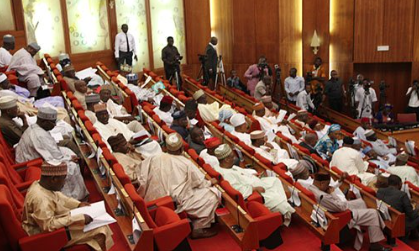
National Assembly
By Sola Ebiseni
Former Deputy President of the Senate, Ike Ekweremadu, aptly captured the mood of the nation with his verdict of loss of legitimacy on the Buhari Government. Contributing to a debate on a motion by Senator Musa Sanni on the security situation in Niger State and the nation generally, Ekweremadu submitted, and rightly too, that “any Government that is impossible of securing the lives of the people has lost legitimacy.
We have made beautiful suggestions and have had retreats on insecurity. Unfortunately, the recommendations haven’t been implemented. We need to do something about this and very fast too. If we need to shutdown Niger State or the Senate in order to find solutions, let us do that.”
Senator Musa was only stating, in greater detail, the earlier alert by Governor Sanni Bello that Boko Haram had taken over 50 communities in the State which is just about two hours to Abuja the seat of power.
The senator lamented that terrorists have mounted their flags in the area, killed several people, kidnapped women, forcefully took wives from their husbands and the people of about 50 communities wallowing helplessly under the sovereign authorities of Boko Haram terrorists who have also sacked and taken over three military camps in the area.
The gory story of Niger state is not different from the experience of Nigerians in many parts of the country, perhaps even a child’s play compared with the situation in the North-Eastern zone, which is virtually under terrorists control except the State capitals. In their various contributions, there was nothing the Senators said or could have said that was new to Nigerians, not even the tears dimension to theatrical debates now seemingly perfected by Kogi West Senators. It is also not new and neither were Nigerians surprised that after the grandiloquent speeches, the resolution was the usual visit of the principal officers to the President to ask and get expected answers to usual questions.
ALSO READ: Terror Attacks: PDP expresses solidarity with Gov Ortom, Benue people
Nigerians undoubtedly had reasonable causes for their choice of Major General (rtd) Muhammadu Buhari in the 2015 elections, confident thereby of the instant end to the irritant Boko Haram terrorist activities in the North-Eastern corner of the country where he was once a Military Governor. Nigerians were reminded of how Buhari was not only a veteran of wars including the Nigerian civil war; how as the General Officer Commanding the 3rd Infantry Division 1981 to 1983, General Buhari had not only dealt with the Maitasine religious uprising which started on a scale higher than the Boko Haram and how Buhari furiously quelled the insurgency and pushed into the territory of Chad before President Shehu Shagari had to call him to order. The majority of Nigerian voters who were either infant or not born when such incidents occurred, were told of how the no-nonsense Buhari as Military Head of State had zero tolerance for corruption.
Unfortunately, not only has Boko Haram festered intractably under Buhari, terrorist herdsmen, bandits, and kidnappers have brought the nation to its knees. Farmers have lost their farms and ancestral means of livelihoods to armed land seekers in the name of herdsmen, wives, and daughters raped before their husbands, fathers, and brothers; the people could no longer travel even within their states for fear of being kidnapped either for death or ransom or both.
Boko Haram and it is allied terrorist groups have achieved their objectives of making western education a taboo as parents and educational institutions, particularly in the north, are better advised to close schools, of all categories, to save the students and their instructors from mass kidnapping and death. Governance has collapsed at the centre leaving only the confused, vexed and irritating voice of Garba Shehu, the loquacious and abusive Special Assistant to the President on Media.
Rather than listen to voices of reason all over the country, for the restructuring of the country in line with the agreed true federalism principles of its founding fathers, Buhari and his cohorts would prefer to delude themselves that the unity of the federation is non-negotiable and not dissoluble in its corporate existence. The possibility of dissolubility of the federation now stares everyone in the face that the President has no choice but to seek external assistance, having subjected the gallant Nigerian military to needless civil wars which have virtually rendered it weary and prostrate. The reality of the grave situation we are in today is aptly demonstrated in Governors now openly calling for the intervention of mercenaries in our multiple and asymmetric warfare.
Not even during the Nigerian civil war, was its corporate existence as threatened as it is presently. Even at its infancy, in 1967, Nigeria was able to weather the storm of its civil war without recourse to external assistance. We have heard it said several times that no nation survives two civil wars, a statement meant to caution Nigerians from allowing the country to slide into another civil war. The situation the country is maybe such that not a single shot may be fired to dismember the federation, but that is a matter for another day.
The Legislature occupies the most unique and pride of place. It is the voice and force of the people. It is the symbol of democracy, thus its dissolution is the prime target of any illegal takeover of Government. It is the only arm wherein all the actors must parade the people’s franchise. It is primus inter pares, the first estate of the realm. At critical times in the life of a nation, the Parliament is looked up to and expected to demonstrate the needed courage to safe democracy and the polity.
ALSO READ: STATE OF THE NATION: Southern governors in emergency meeting
The National Assembly had every opportunity to rise to the occasion to safe this country and steer it away from the path of disintegration. It did in 2010 by invoking the doctrine of necessity to invest the then Vice President Goodluck Jonathan with full Presidential powers in the long absence of President Umar Yaradua who had refused to transmit powers to his Deputy in accordance with the provisions of the constitution mandating him in that behalf.
The Buhari administration was ushered in with agitation for the restructuring of the country. The government had the reports of the 2014 National Conference which had earlier been submitted to the National Assembly by the Jonathan administration. The ruling APC also set up the El-Rufai True Federalism Committee which reports on restructuring was virtually a copy of the confab resolutions. The prevailing herders/farmers clash was then only assuming a terrorist dimension gaining ascendancy in territorial conquest under Buhari whose government’s body language eloquently testifies condonation if not outright complicity. The refusal to heed the calls for restructuring have watered the seed of ethnic self-determination.
India, a federation and former British colony like Nigeria, was faced with nationality questions shortly after its Independence in 1947. By 1953, Prime Minister Jawaharlal Nehru appointed the Fazal Ali Commission for the creation of states on linguistic lines which report in 1955 recommended the reorganisation of India’s states and enacted by parliament. In the Republic of Benin, Nigeria’s small western neighbour, in 1990, under the elected government of President Mathew Kerekou, commissioned a National Conference. The desperate state of the nation was such that the Conference declared itself sovereign, suspended the vexed constitution, shut the Parliament like Ekwere Madu seems to be suggesting now. The recommendations birthed a new constitution of the people which has since endured.
History will not be kind to the present Assembly if it continues to be an onlooker and pretend to be helpless in the face of legislative capacity to provide leadership and redemption. Those who made restructuring impossible now have possible disintegration to contend with. Restructuring is fast losing its attraction; re-negotiation of the terms of Nigeria’s corporate existence may be the middle way out between restructuring and disintegration. Call it a choice between the northern 1953 Araba agenda and Ojukwu’s Aburi of 1967.
Disclaimer
Comments expressed here do not reflect the opinions of Vanguard newspapers or any employee thereof.