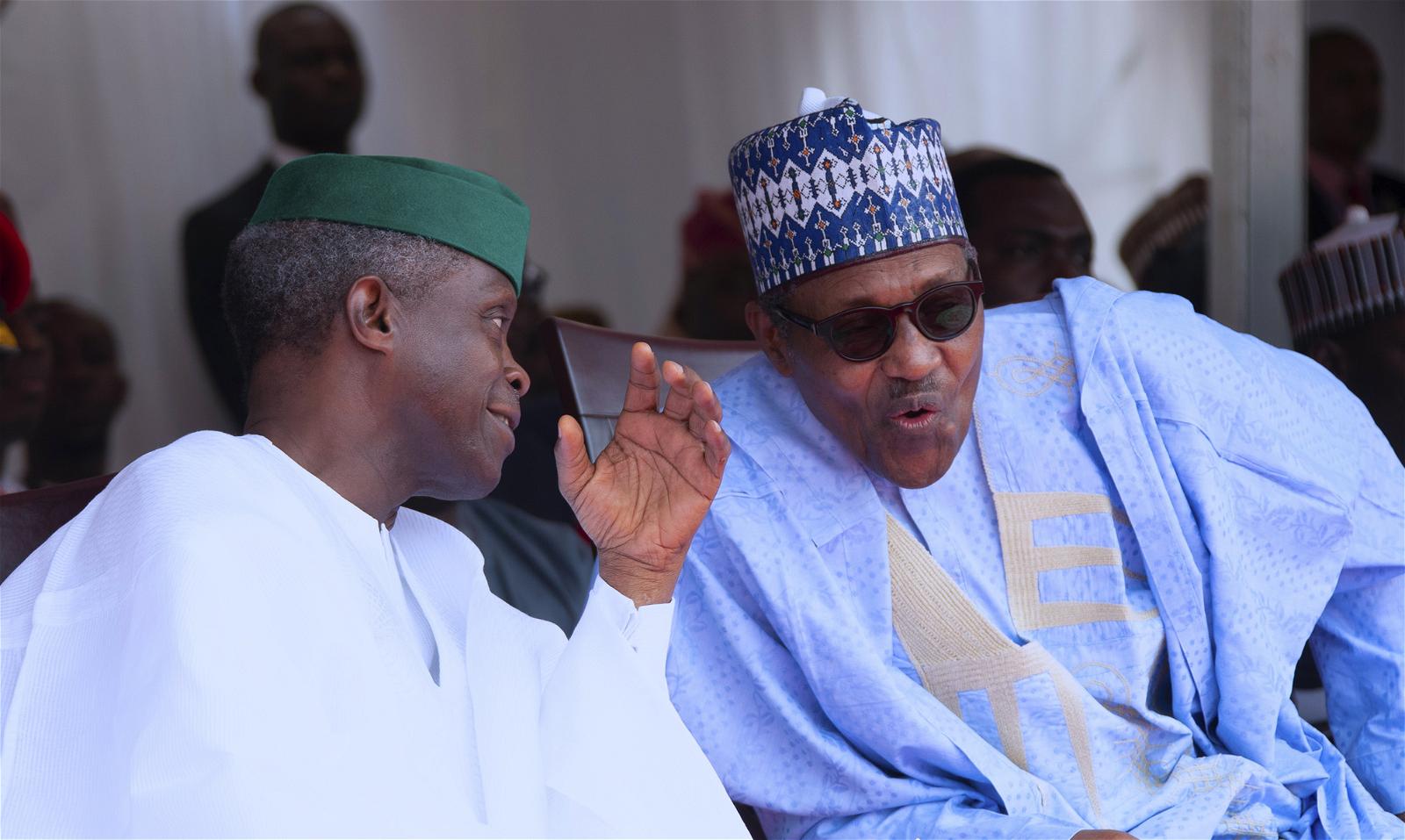
President Buhari and Prof. Osinbajo at the independence anniversary celebration in Abuja
The Buhari Administration’s goal of electrifying Nigeria’s underserved communities is gaining momentum regardless of the lean resources the administration is battling with. From improving the country’s distribution capacity, the administration is now expanding access via off-grid solutions including solar power connections.
With the Economic Sustainability Plan (ESP), including programmes on renewable energy, agriculture, improving access to credit and direct cash transfers, among others, there is a greater acceleration towards a more inclusive economy and potential for growth is widening.
The flagship initiative to connect electricity to about 25 million Nigerians whose communities are off the grid kick-started in Jangefe, Jigawa State on Friday, April 9, 2021 by the Vice President, Prof. Yemi Osinbajo, SAN. It is a watershed in the enunciation of the vision of President Muhammadu Buhari, which can also be regarded as a bold and ambitious initiative to provide all Nigerians with cleaner and cheap energy.
It is interesting to note that the Niger Delta Power Holding Company (NDPHC) is among those agencies driving the process of actualizing this initiative as well as serves as a catalyst in the process of connecting communities across the country. Another critical Agency involved is the Rural Electrification Agency.
Suffice to state that NDPHC was midwifed from the National Integrated Power Project (NIPP) in August 2005 where the Federal Government incorporated it as a limited liability company to serve as the legal vehicle to hold the NIPP assets using private sector-orientated best business practices.
The advantage that NDPHC brought to the ESP implementation is its experience in delivering solar power in some States already even before the advent of the ESP. At the Jangefe flag-off, the Managing Director and Chief Executive Officer of the Niger Delta Power Holding Company, Mr. Chiedu Joseph Ugbo highlighted that the company had already provided 20,000 units of solar home systems to households across the country.
He said “those 20,000 are working as we speak and then the government asked us to do another five million solar connections that will include solar home systems and mini-grid, off-grid solutions.”
Mr. Ugbo added that the launch of 100,000 solar home systems was “the second phase of the NDPHC’s beyond the grid project.”
Shedding more light on the initiative, the Executive Director, Generation, NDPHC, Engr. Kassim Abdullahi also said about 1000 units would be deployed in the Jangefe community as the pilot programme while noting that the Jangefe event was an important milestone in President Buhari’s administration in ensuring all Nigerians have access to electricity.
Chaired by the VP himself as Chairman of the board and besides Ugbo and Abdullahi, the NDPHC machine is oiled by a renewed team of directors including tested hands like Alhaji Babayo Shehu, among others.
Assuring Nigerians that the scheme will be extended to communities, Prof. Osinbajo said at the launch of the Jangefe scheme that “the rollout will continue across the six geopolitical zones in Edo, Lagos, Adamawa, Anambra, Kebbi and Plateau. Other Solar companies are also in the pipeline for the Solar Power facility to continue the march to five million connections during the life of this administration.
President Muhammadu Buhari, according to the Vice President, “had emphasized that we could no longer rely solely the grid if we were to electrify the whole country. Which meant that we had to develop an effective strategy for decentralizing power supply. Two obvious things to do were, first to think of implementing more off-grid solutions and to use renewable energy especially solar power.”
Vice President Osinbajo highlighted that the Covid-19 pandemic which devastated countries of the world had turned out to be an opportunity for Nigerians to think out of the box.
According to him, “another challenge turned opportunity was Covid-19 and our response to the economic fallouts of the pandemic – the Economic Sustainability Plan. A fundamental rationale for the plan was to retain existing jobs and create new jobs. A mass solar programme seemed like a real chance to kill several birds with one stone; electrify the country and in the process, create thousands of jobs form solar assembly and manufacturing plants to installers, payment system operators, and maintenance of solar system once installed.
“The Solar Power Naija programme which is designed by the Rural Electrification Agency is an ambitious initiative that aims to create five million connections through a 140 billion Naira financing programme that will support private developers to provide power for five million households, which means providing electricity for up to 25 million Nigerians.”
From the foregoing, the Buhari administration is on course by joining the rest of the world in providing a clean and peaceful atmosphere by generating energy that produces no greenhouse gas emissions from fossil fuels and reduces some types of air pollution.
Secondly, the country has been depending on grid electricity which has not been adequate and coupled with many challenges. The administration’s diversifying energy supply and reducing dependence on imported fuel, is an audacious step in the right direction which every citizen is encouraged to support.
What is more, the yearning of the administration from inception, for creating economic development and providing more jobs to Nigerians has finally been envisaged as the ESP’s Solar Power initiative is flagged-off. Nigerians would be engaged in manufacturing, installation and servicing in that sector.
Disclaimer
Comments expressed here do not reflect the opinions of Vanguard newspapers or any employee thereof.