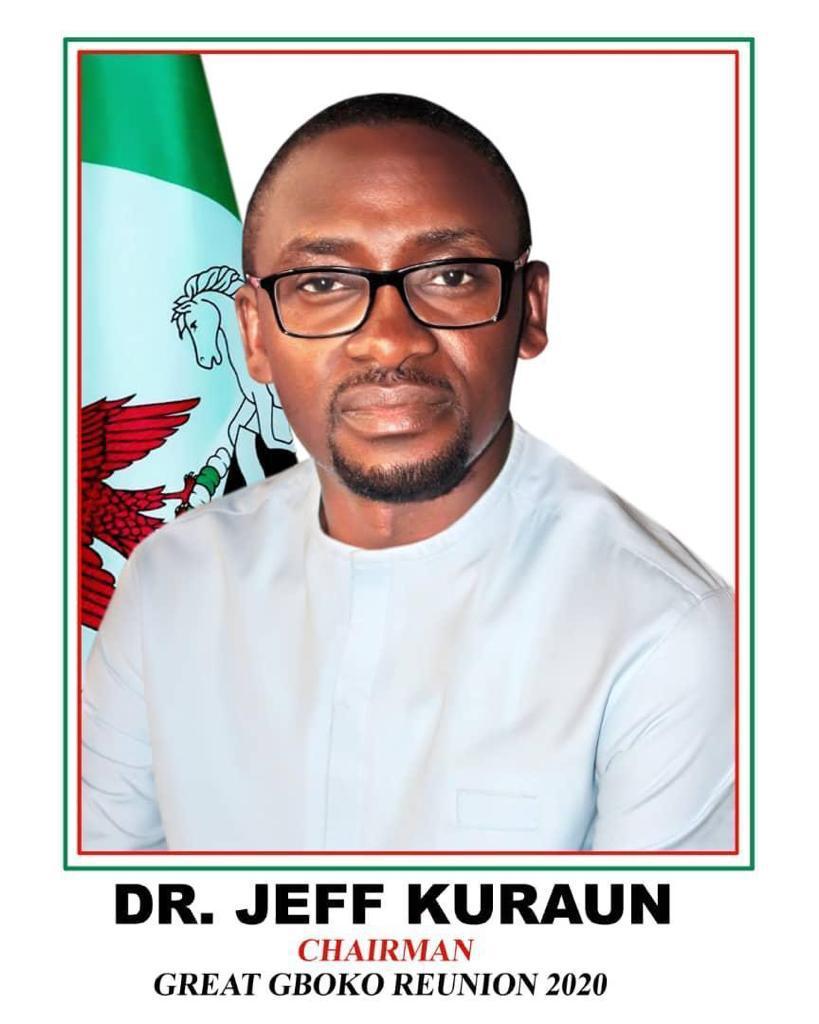
Jeffrey Kuraun has over 20 years post qualification experience in the upstream oil and gas industry and mining and holding senior technical positions in the business, related industry combined.
Prior to his current service in the public sector, he worked in the private sector in Nigerian oil and gas service companies, as Senior Seismologist at United Geophysical and subsequently as Business Development Manager both at ANS Energy Services and Standards & Baldwin.
He holds a Bachelor of Science (BSc) Honours degree in Geology & Mining from the University of Jos, Nigeria and a Master of Science (MSc) degree in Field & Well Management (Engineering) now known as Petroleum Production Engineering from the Robert Gordon University, Aberdeen, Scotland, United Kingdom. He is an active member of notable professional bodies like the Nigerian Association of Petroleum Explorationists (NAPE), Society of Petroleum Engineers (SPE) and
American Association of Petroleum Geologists (AAPG). He won the 1st position prize in the prestigious Nigerian Mining and Geoscience Society (NMGS)/Mobil Producing Nigeria Unlimited (MPNU) Award for a BSc thesis in Geoscience in Nigerian universities. He also holds a Master Class Certificate in Business Administration from London Graduate School and an Honourary Doctorate Degree in Business Management, Specializing in Oil and Gas from Commonwealth
University. He is a Fellow of the Institute of Management Consultants of Nigeria. He has served in several technical committees and participated in many professional pieces of training, seminars and workshops locally and abroad.
As his contribution to educational development, Kuraun served as an external examiner with the West African Examinations Council (WAEC) and participated in both National and International subject panel meetings for curriculum development, item writing and moderation workshops, and review of the West African Senior Secondary Certificate of Education (WASSCE) syllabus for the subject of Mining.
Q: May we hear your advice on how to reform Benue?
A: I want my people, the people of Benue state to be encouraged in spite of the challenges we have faced. We from Benue are regarded as great fearless people, great people, great men and women, we are farmers, we are proud to be called Benue, we are experiencing a lot of challenges in the past, particularly security challenges. Let us pick our pieces and gather ourselves together, take our Benue, gather our Benue, don’t run down your state, don’t go somewhere and talk down on your governor or your leaders. We have been brought up to respect our elders even when you find your elder doing the wrong thing, which in your opinion you think is wrong, there should be a manner of approach.
Also read: Grundtvig Intl Secondary Schl wins Presidential award, as overall best private Schl in Nigeria
One thing I have observed on social media to my amazement is the way that we attack one another particularly the way we talk down on elders or leaders, that is not us, that is not the way we were brought up. We were brought up to respect people, so we shouldn’t disrespect our leaders, our elders.
If you see them doing something wrong, there are so many ways of approaching them instead of pulling them down or running them down or insulting them or talking to them on social media with no regard.
Let us keep doing what are doing, luckily we have relative peace, we should ensure that we do the right thing knowing that the only state we have in Benue, we should be proud. Anywhere we go let’s talk about Benue, let us project our state in a positive way and that is what I hope to do when I assume leadership of the State in 2023.
I will give Benue, a sincere and through leadership never seen before. I have the capacity to put Benue on the global stage.
Q: We u understand that you volunteered as an external examiner with the West Africa examination council (WAEC). You also participated in national and international subjects panels meetings for curriculum development and review the syllabus for the subject of mining. How eventful was your participation in those assignments?
A: I was contacted by WAEC, and they told me someone had nominated you to be part of those that will help us develop one of the skill subjects. I had no idea what he was talking about but I was eager because I wanted to see how I could contribute to educational development, having failed to resume as a graduate assistant, I felt it was an opportunity for me to contribute to educational development, so I jumped at the opportunity.
When I got to the first meeting, we were told that the federal ministry of education selected about 36 skilled subjects and the idea was to ensure that you don’t need to necessarily proceed to higher education after your secondary school in order to get employment. So they brought these trade subjects for students of secondary school level to study these subjects and when they are outside of school, they should be able to apply what they have learnt. It was a sort of entrepreneurial development, you develop your entrepreneurial skills even without going to university.
So mine was the subject of mining. Mining before I was nominated was not part of the secondary school subjects, so they wanted to introduce mining in secondary school just the same way you have English, Mathematics, Physics, Biology, Chemistry and the rest.
So the federal ministry of education made compulsory mathematics, English, one local language either Hausa, Igbo or Yoruba and one trade subjects which were going to be compulsory for every student.
I participated in the development of the syllabus for the subject of mining and it was pretty new to Nigerian secondary schools and because I studied geology and mining of course that was the reason they felt I could contribute to the development of that subject at that level because we don’t even have indigenous books on mining. We have very advanced mining engineering textbooks.
So we needed to develop something that a student after graduating from secondary school would be able to use to develop his or her skills in mining. And it is not just mining; there is an aspect of mining called Lapidary so it is about the cutting and foresetting of gemstones.
So you don’t necessarily need to have earth moving equipment or quarry or a big place or a huge amount of money for you to be able to participate in that sector. You could just have small toolboxes where you use in cutting and for setting diamonds and some precious stones. That will be your office.
So if someone graduates from secondary school and he understands luckily and be able to use to society as a trade. This has been introduced in secondary schools and I was part of those, even the first time WAEC was going to set questions we were part of those that set the first set of questions, how they should look like.
Of course, this is something that is subject to review. If it was going to be very difficult for them to understand it was going to be reviewed over the years.
Q: About your NGO, The Jeffrey Kuruan Foundation, tell us what it is all about?
A: My motivation in setting up a charity organization came from what Mother Theresa said, that if you cannot feed a hundred then feed one. When I read that I asked a lot of questions. I asked myself how can you contribute to society, how can you make the life of one person better, do you have to be necessarily rich before you could help somebody? No. And what is this help, is help all about money, the answer to me is no.
Sometimes just being nice to somebody or putting a smile on someone’s face asking how are you doing, just showing concern, For me, a smile change somebody’s life because the person will feel somebody understands me, somebody recognises me.
There are lots of people going through very tough times and all they need is someone to say hello to them, for a neighbour to say how are you doing, to genuinely stop and ask how are you doing today. This is a very difficult thing a lot of people find doing.
I asked myself these questions and I said to myself, if I have any job or if I gain any employment, if I am doing any business I must put a percentage of what I earn aside for someone else to benefit from it. And within me, I said if I can’t do that then I am not qualified to work or I am not qualified to do that business.
So it is a personal covenant that I have with my God that I must put something aside from what I earn every day of my life, I would do that until my last breath.
So am very proud of the Jeffrey Kuruan Foundation, we can’t do so much or we can’t do everything but we have just narrowed it down to health, education and economic empowerment.
In the health sector, we organize seminars just to sensitize people to understand the importance of having a healthy life, even sometimes we sponsor speakers who would talk about very important subjects, things that we know about HIV, hepatitis, educate people on them. We donate drugs that we have solicited from pharmaceutical companies, we organize outreaches. We have done some reasonable jobs in Lagos and by the grace of God now that I am working up north here, we want to bring it particularly to Abuja and my own state Benue.
It is a personal conviction, you need to be convinced that you want to do that, it is voluntary, you are not forced to be charitable. More so some people are discouraged, some people have tried to do things like this in the past but they get discouraged, they are not motivated particularly because people lie, people who are not in difficult situations come and lie to you that this is our situation.
When you find out that the little you gave out which was meant to serve a particular purpose did not even get to them you will feel a bit discouraged though. But my advice is that if you genuinely want to help, you shouldn’t bother if someone is not appreciative or if you are called names. Some people might say you don’t even know what to do with what you have.
I am a civil servant, I don’t earn much but I have that covenant and I am not doing so much but at least I have some testimonies, people coming to me to say this is
what you did for me or I have heard from others those we have helped or assisted one way or the other, what they have said about us and it is very motivating, it is very encouraging.
So I would say it is a matter of personal conviction. If you genuinely know that you can be of help to somebody to a neighbour, to a brother or to a sister, don’t b discouraged just keep doing what you are doing because you don’t need to change everybody’s life, you only need to change one or two or three, so that is my position.
Disclaimer
Comments expressed here do not reflect the opinions of Vanguard newspapers or any employee thereof.