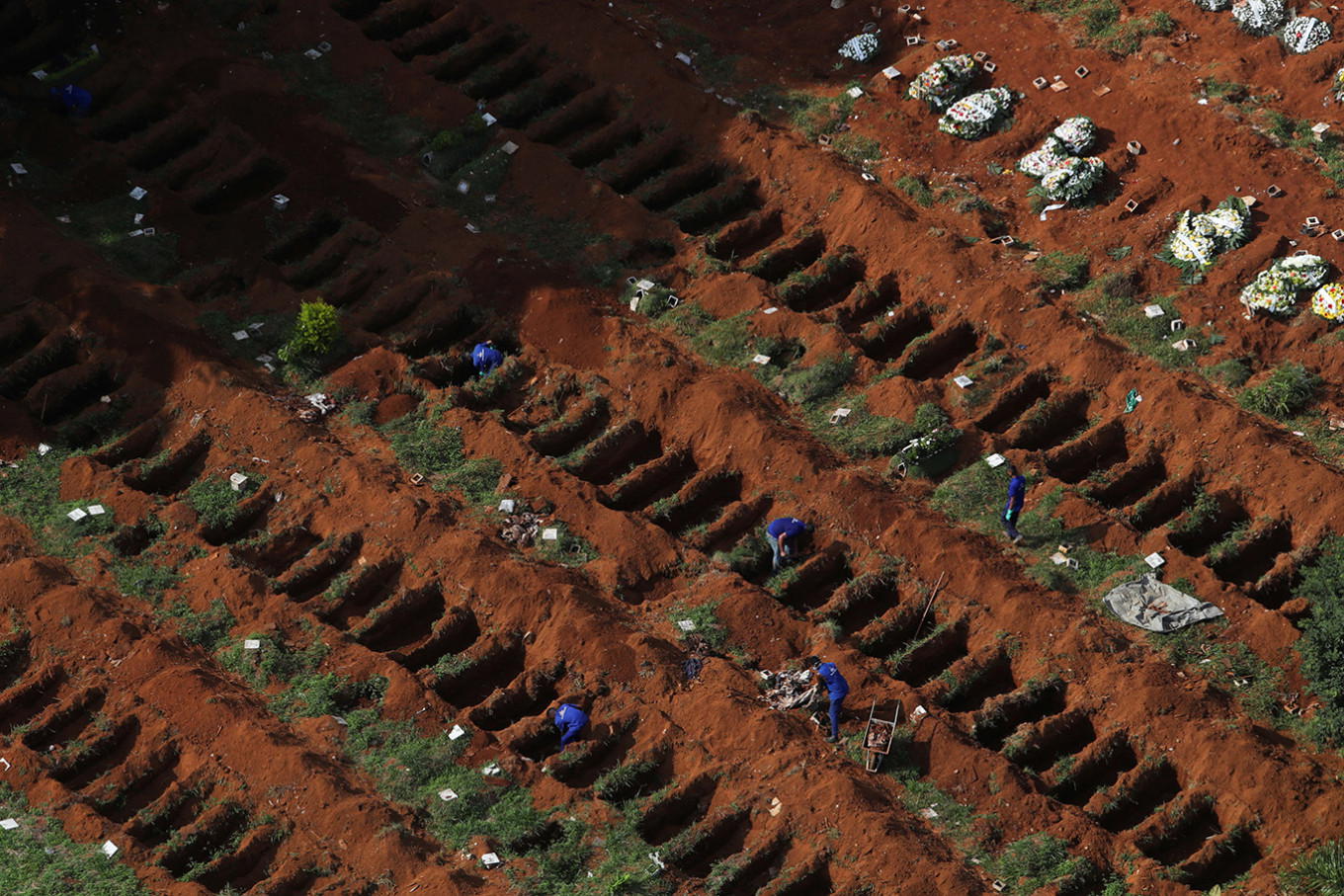
Gravediggers open new graves as the number of dead rose after the COVID-19 outbreak, at Vila Formosa cemetery, Brazil’s biggest cemetery, in Sao Paulo, Brazil, on Thursday, 2020. (REUTERS/Amanda Perobelli )
By Sherriff Ghali Ibrahim,
I write not as an encomium to the Chinese authorities; I write not just because of punditry; I write not to castigate Mr Temisan Amoye’s piece on “COVID-19: CHINA’S COMMUNIST AUTHORITIES HAVE GONE A STEP TOO FAR” which was published by the Vanguard on May 4, 2020, but I write as a sinologist; as one who observes the historiography, politics and socio-economic development of the Peoples Republic of China.
I indeed write to divulge the realities of China’s handling of the COVID-19 outbreak, religious freedom, human rights, Hongkong issue and ultimately the Xinjiang allegations.
It inherently ensues in the culture and tradition of writers, journalists and public affairs analysts to write for remuneration, to opine an opinion and develop prejudices. Whichever one takes, it suffices a rationally thinking reader to understand the direction and message which the writer is taking and trying to deliver.
In my opinion, Mr. Temisan Amoyes’s caption as designated above reflects the idea of one who only studies and read from the internet as he clearly pointed out in the first page of the write-up, without having a critical view of the contending paradigm. It also shows that the writer has been swayed by western media and or fake news, allegations and misinterpretation of the Chinese authorities and what they have achieved especially in their fight against the COVID-19, which the United States has failed to do due to the comical character of their president.
Temisan asserted that “had the Chinese authorities heeded the early warnings, acted responsibly and transparently in their dealings, it would have saved the world hundreds of thousands of lives, social upheaval, trillions of dollars and the mental stress of living through a pandemic.” The action taken by China was not seen by ordinary people who were either parochial in orientation or do not read international news.
ALSO READ: France warns ‘unacceptable’ for Sanofi to give US virus vaccine first
This is largely because, China had fulfilled all righteousness in considering the regulations and requirements of the World Health Organizationin terms of measures to be taken whenever there is an outbreak as such, especially the border exit, health and quarantine measures.This was manifest in the Border Health and Quarantine Law of the People’s Republic of China on Prevention and control of infectious diseases to prevent cross-border transmission.
Of course the Chinese authorities have given early warnings and all necessary information needed in the country and in the international community about the virus. Let me take you to 3rd of January, 2020, when China has been updating the WHO and relevant countries and regions of the epidemic on a regular basis.
Let me take you to January 20, when the NHC issued a notice to classify the novel coronavirus pneumonia as a quarantinable infectious disease according to the Border Health and Quarantine Law of the People’s Republic of China and category-B infectious disease according to the Law of the People’s Republic of China on Prevention and Control of Infectious Diseases, and took preventive and control measures on the level of a category-A infectious disease.
If you did not know, Mr. Temisan, let me educate you, if you knew it but became oblivious let me remind you that on January 23, the city of Wuhan suspended outbound transportation including air and rail. Prior to that, the Chinese customs already took proper measures to manage outbound travelers with symptoms of fever, who were exhorted to suspend their travel plan or transferred to designated medical institutions for diagnosis and treatment.
How more responsible was the Chinese government in dealing with the situation is for you to understand that since January 23, all ports in China have conducted COVID-19 nucleic acid test on each and every outbound suspected case and reported the newly-tested positive cases to the WHO every day so that all countries could assess and study the situation timely.
Apart from the above, Chinese authorities have developed a universal consensus and public mobilization system through: timely release of information, dissemination of knowledge about prevention and control, public opinion guidance and support by mainstream media, and universal participation with social cohesion.
This was complemented with social isolation and traffic control, using city lockdown and transport freeze in hardest-hit areas, differentiated traffic controls in less severe areas, developed tactics to prevent social gathering and cross-infection and used community isolation as basic line of defense.
It was part of being responsible and responsive that the Chinese authorities carried out screening, testing and dynamic monitoring, treatment plans and scientific research, allocation of resources and guaranteed supplies through a drastic command system and strategic policies.
On Xinjiang, lack of basic understanding of the Peoples Republic of China is another lead to its misinterpretation. China is not a communist state as people know of the Stalinist or Marxist structured state. China practices what is known as “socialism with Chinese characteristics,” with a shift from the classical Marxist state system. Socialism with Chinese characteristics envisages that, on its economic fronts, China sticks to a multi-ownership-oriented basic market economic system, with the public ownership in the dominance.
ALSO READ: COVID-19: China’s communist authorities have gone a step too far
On its political fronts, China upholds a system of the People’s Congress, a system of multiparty cooperation and political consultation, and a system of regional ethnic autonomy. And in its cultural fields, China keeps its socialist value system at the core of social trends, while respecting differences and expanding common grounds. These practices have proved that socialism with Chinese characteristics is the only and successful road China must take in building it into a well-off, democratic, civilized and harmonious modern nation.
In the opinion of Temisan, there is no religion in communism, human rights or any interfering ideology. What Temisan should first learn is that China is not such a communist state. In my four years of study in Wuhan, I have had the freedom to worship daily and attended Friday prayers both in Chinese and foreigners’ mosques. Let me deal with the religious rights in China before delving into the Xinjiang issue.China is a country with a great diversity of religious beliefs.
The main religions are Buddhism, Taoism, Islam, Catholicism and Protestantism. Citizens of China may freely choose and express their religious beliefs, and make clear their religious affiliations. According to incomplete statistics, there are over 100 million followers of various religious faiths, more than 85,000 sites for religious activities, some 300,000 clergy and over 3,000 religious organizations throughout China. In addition, there are 74 religious schools and colleges run by religious organizations for training clerical personnel.
Buddhism has a history of 2,000 years in China. Currently China has 13,000-some Buddhist temples and about 200,000 Buddhist monks and nuns. Among them are 120,000 lamas and nuns, more than 1,700 Living Buddhas, and 3,000-some temples of Tibetan Buddhism and nearly 10,000 Bhiksu and senior monks and more than 1,600 temples of Pali Buddhism. Taoism, native to China, has a history of more than 1,700 years. China now has over 1,500 Taoist temples and more than 25,000 Taoist priests and nuns.
Islam was introduced into China in the seventh century. Nowadays in China there are ten national minorities, including the Hui and Uygur, with a total population of 18 million, whose faith is Islam. Their 30,000-odd mosques are served by 40,000 Imams and Akhunds.
Catholicism was introduced into China intermittently in the seventh century, but it had not spread widely until after the Opium War in 1840. At present, China has four million Catholics, 4,000 clergy and more than 4,600 churches and meeting houses. Protestantism was first brought to China in the early 19th century and spread widely after the Opium War.
There are about 10 million Protestants, more than 18,000 clergy, more than 12,000 churches and 25,000-some meeting places throughout China.China has the following national religious organizations: Buddhist Association of China, Taoist Association of China, Islamic Association of China, Chinese Patriotic Catholic Association, Chinese Catholic Bishops’ College, Three-Self Patriotic Movement Committee of the Protestant Churches of China, and China Christian Council.
We live in the times of violent extremism and terrorism which serve as a great threat to human existence ubiquitously. Extremist groups are found across all religious groups in the world such as in Islam, Christianity, Buddhism, Hindu and Jewish religion among others and the world has suffered a great set back due to such trends.
The United States has established detention camps such as Guantanamo bay, where captured terrorists have been persecuted, retributed and even executed with the name of fighting terrorism. All European allies of the United States have joined hands in this fight including Asian and African countries where terrorism has been on the rise.
Nigeria is on the fight against Boko Haram; Afghanistan, the United States and coalition forces against Taliban; the Sahel region against the Islamic State and AQIM among others; Somalia is suffering from the attacks of Al-Shabab, while Uganda has recovered from the activities of the Lord Resistance Army.
Xinjiang is a key battlefield in the fight against terrorism and extremism in China. For some time Xinjiang has been plagued by terrorism and religious extremism, which pose a serious threat to the lives of the people in the region.
Addressing both the symptoms and root causes and integrating preventative measures and a forceful response, Xinjiang has established vocational education and training centers in accordance with the law to prevent the breeding and spread of terrorism and religious extremism, effectively curbing the frequent terrorist incidents and protecting the rights to life, health, and development of the people of all ethnic groups.
On the issue of Hongkong, foreign meddling has faced a sheer fiasco to disintegrate the island from the mainland. The Hongkong protest was gravitated by the proposed amendments to Hong Kong’s extradition law.The amendments were prompted by the gruesome case of a Hong Kong man who was accused of strangling his pregnant girlfriend and stuffing her body in a suitcase while they were in Taiwan in 2018.
The suspect, Chen Tongjia,fled back to Hong Kong. And because Hong Kong doesn’t have a formal extradition treaty with Taiwan, he couldn’t be sent back to face trial. The Hong Kong government seized on this case and used it as the rationale to propose amendments that would allow case-by-case extraditions to countries that lack formal extradition treaties with Hong Kong in order not allow a recurrence of such and to maintain strong rule of law.
The proposed extradition law changes first prompted protests in March and April, and in May, pro-democracy and pro-Beijing lawmakers literally came to blows over the bill on the floor of Hong Kong’s legislature.After the huge protests on June 12, Lam “indefinitely suspended” the bill that would have amended the extradition law.
The protesters made five demands to be considered before making a shift from the protest. They demanded that (1)the extradition bill be withdrawn (2) for leader Carrie Lam to step down (3) an inquiry into police brutality (4) for those who have been arrested to be released, and (5) greater democratic freedoms. What democratic freedom are the protesters looking for better than what they have as a system?
The Chinese system has made its people prosper with increased purchasing power parity, stability, equal opportunities, education, health care, rule of law and a strong defense system. It is apparent that there exists foreign meddling in order to destabilize the Hongkong and its unity with China and pave a way for foreign interference.
China has been able to restrain from intervening using force just like other countries did during their socioeconomic tragedies. For example, on March 10, 2010, a mass crackdown was initiated to thwart a planned peaceful ‘million march’ to be conducted in a South Indian state capital of Hyderabad demanding formation of a new federal unit, more than 100,000 Telangana people were taken into custody by a police force controlled by the coastal ‘Andhra’ elites. During the 2010 G20 summit in Toronto, over 1100 people were confirmed to be arrested over the week due to a protest against the summit.
The major issue that needs to be understood is that, all the protesters’ demands have been fulfilled by Carrie Lam, the Executive leader of Hongkong, only one, which demands for her resignation. Macron did not resign in spite the magnitude of the yellow vest protest.
The implication is that, if china tries to respond in a manner to block the protest, the west will begin to condemn the action of China when the French action was never condemned, foreign meddlers may begin to supply Taiwan with more weapons; coalition might be formed against china to join the trade war, the south China Sea might become another flash point, the Belt and Road might also face some challenges as a result of such.
There is one thing that the meddlers need to consider, which has been pointed out by President Xi Jinping, if I may para-phrase, China is not a pond, but an Ocean; storms can shake the pond, but cannot shake the Ocean. It has reached to the point that two groups have emerged in Hongkong today, the anti-bill and anti-government protesters on one side, and the pro-bill and pro-government demonstrators.
Consequently, the unity of China cannot be compromised and it is apparent that any form of foreign meddling in Hongkong or Taiwan cannot succeed, because as President Xi Jinping argued “China is not a pond, but an ocean” which cannot be easily shaken.
On the issue of human rights, Temisan also posited that “the stability of social order seems to be more important than human lives in the face of a looming health crisis, considering China’s history with SARS.” Let me vehemently make this clear, the right to life is the most fundamental human right, which is confirmed and guaranteed by the UN’s Universal Declaration of Human Rights and the International Bill of Human Rights.
There is no country on earth that protected this universal declaration like China, especially in containing this global health crisis and a pandemic that some countries want to politicize. China has been able to save more lives than the United States, the United Kingdom, France, Italy, Spain and many more countries around the world.
The Chinese government has always taken people’s lives and health as its first priority and has been treating the patients and saving the people at all cost. The country has been going all-out to save every COVID-19 patient, and has launched “blanket search” to ensure that no one is left behind. Besides, it also launched differentiated treatment plans and cares for individual patients in critical and severe conditions.
China’s anti-pandemic efforts fully demonstrated the country’s moral principle of placing people and lives in the first place, as well as the power of the Chinese ethic. Besides, China also participated in global anti-pandemic cooperation with concrete actions and offered assistance as much as possible for countries and regions in need, making an important contribution to the global cause of human right protection.
Under long years of oppression by the “three big mountains” — imperialism, feudalism and bureaucrat-capitalism people in old China did not have any human rights to speak of. Suffering bitterly from this, the Chinese people fought for more than a century, defying death and personal sacrifices and advancing wave upon wave, in an arduous struggle to overthrow the “three big mountains” and gain their human rights.
The Chinese people enjoy political, economic and socio-cultural rights. They enjoy the right to work, religious belief and rights of minority nationalities. The Chinese also enjoy the protection of such rights and active participation in international human rights activities.
It is therefore intellectually absurd to underestimate the responsive ambience of the Chinese authorities in dealing with the COVID-19 pandemic, for China has succeeded in containing the virus at home and has gone international to provide humanitarian assistance to other countries in need.
It is completely an anti-China campaign to believe that China does not protect human rights; it should forfeit sovereignty over Hongkong; it should not rehabilitate people with the extremist mind in Xinjiang or to conceive the idea that there is no religious freedom in China. It is the internal struggle of the CPC which strictly follows democratic values and principles of “socialism with Chinese characteristics” that allows China the position of the world second-largest economy and the progressive momentum is still waxing.
China is not a colonial master; it does not impose its values on any people on earth; it does not claim superiority over others, but it is evident of course, that it is the alternative to the hitherto global system that was not inclusive in nature, but discriminative, oppressive and dehumanizing.
It should be known that China seeks to achieve non-interference in the affairs of sovereign states, mutual benefits, win-win cooperation with partners and ultimately a world of shared future.
Disclaimer
Comments expressed here do not reflect the opinions of Vanguard newspapers or any employee thereof.