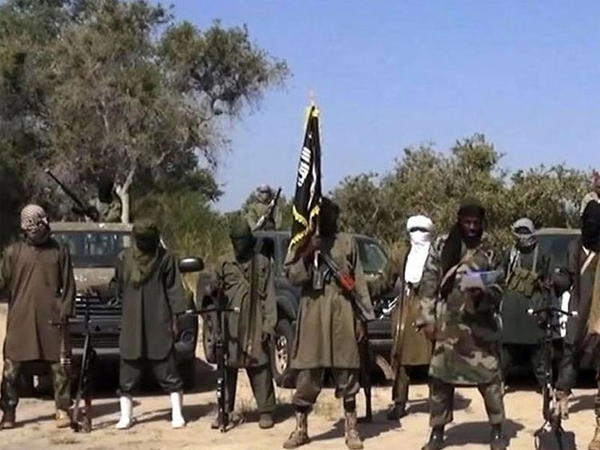
File photo of terrorists
By Ola Balogun
NOT much has changed since then. The white officers have now been replaced by Nigerians, but the bulk of the soldiers still consist of largely illiterate individuals who can neither read and understand army manuals nor be expected to read maps accurately.
This situation is wholly untenable! In the year 2020, we are fast approaching the end of the first quarter of the 21st century, so there can be no justification for having an army that is mostly made up of uneducated folks…More importantly, both the officers and lower ranks of the present Nigerian army are sorely lacking in patriotic zeal, having mostly joined the army for career reasons. The choice of having a purely volunteer army, therefore, has to be examined afresh!
Is that really the best option for Nigeria? Most modern nations (including the U.S., Russia, China and the Western European countries) have traditionally stiffened their armed forces by conscripting young citizens for two or three year periods of military service and training, taking full cognisance of the fact that an individual who is fighting to protect his parents and children is likely to be more highly motivated in the battlefield than one who has merely joined the army to earn a salary.
It is also noteworthy that in many of the most successful nation-states of past eras, availability for military service was a pre-requisite condition for full access to citizenship rights. This was the case in Sparta, Athens, Rome, post-Meiji era Japan, revolutionary era France and Russia, as well as in the United States of America up till the Vietnam war…For very good reason, this also remains so today in Israel, which considers itself to be a nation on a permanent war footing.
Step three: Cutting Boko Haram off from its sources of food and military supplies. It is a time-tested truism that fighting forces that do not have access to food supplies cannot continue fighting for very long…A strategy based on a keen appreciation of this fundamental fact lay at the heart of the overall strategy applied by the British army to defeat the guerilla forces in Malaya in the course of the conflict known as The Malayan Emergency (1948-1960).
t is considered highly significant that Lieutenant-General Sir Harold Briggs, who was appointed Director of Operations of the British forces in Malaya in 1950, vigorously implemented a strategy aimed at isolating the guerillas of the Malayan National Liberation Army, MNLA, from their sources of food.
To achieve this objective, virtually all the civilians resident in the forests were forcibly relocated to strictly guarded fortified villages to prevent the guerillas from securing food supplies, leading to a situation where large numbers of guerillas were arrested or killed whenever they approached the fortified villages in search of food.
ALSO READ: Boko Haram targeting Christians to trigger religious war — Mohammed
This strategy of large-scale forced relocation of civilian populations, which was subsequently applied with varying degrees of success by the British in Kenya and by the French and Americans in Indochina and Vietnam needs to be applied in all combat zones where Boko Haram fighters are located in order to cut them off from food supplies. For instance, all civilians living in and around the notorious Sambisa forest should be forcibly relocated to specially constructed camps situated far away from the combat zones within a strict time limit.
Once the forest has been emptied of civilians, all entrance and exit points should be strictly guarded night and day by heavily armed military units, while an intense bombing campaign should be carried out for the purpose of wiping out all living creatures within the Sambisa forest.This approach would achieve the dual objective of preventing food and military supplies from reaching the Boko Haram fighters while at the same time killing and wounding large numbers of guerillas from the air without exposing the Federal Armed Forces to unnecessary risks.
Step four: Implementing an aggressive strategy of massive military operations against Boko Haram fighting units. The successful pursuit of warfare requires that once an initial advantage has been gained on the battlefield, the opposing forces should not be given any breathing space to regroup and continue the battle. The great Zulu General Shaka (Ushaka Zulu) was renowned for ruthlessly pursuing opposing forces relentlessly until they were totally annihilated. On the battlefield, the Zulu armies never stopped fighting until all the enemy forces had been completely smashed, thus ensuring that no further resistance would be encountered from the defeated enemy.
It would seem that the Federal Forces appear to have unwisely eased pressure on the Boko Haram fighting units two years ago after prematurely declaring victory, thus allowing the Boko Haram insurgents to regroup in secret and begin launching the fresh attacks that we are currently witnessing. Once the Boko Haram forces have been successfully placed on the defensive the Federal Armed Forces must be made to continue attacking them relentlessly from all sides until they are all wiped out.
It is noteworthy that in the course of his exchange of views with members of the House of Representatives Defence Committee on February 19, 2020, the Governor of Borno State called on the Nigerian army to pursue the Boko Haram insurgents vigorously into their enclaves. His statement would seem to suggest that this is not being done at present.
On the contrary, the Nigerian army would appear to have adopted a strategy of concentrating on defending urban enclaves and abandoning the countryside to the guerrilla forces. It is obvious that it this kind of disastrous strategy (which has never worked anywhere in the world!) that was responsible for the recent tragic incident that took place at Auno, when the Boko Haram fighters were left free to massacre dozens of civilians on the outskirts of Maiduguri. As the French and the Americans discovered to their cost in Indochina, it is the height of folly to abandon rural areas to guerrilla forces because the guerrillas can then roam to and fro freely, wreaking havoc in their wake, while the conventional forces sit helplessly guarding urban centres…
Step five: Rehabilitation and resettlement of civilian populations in the battle zones. It is a well-known fact that wars are never conclusively ended if the defeated side are subjected to needless suffering after the end of hostilities. If the side that has been defeated is subjected to unnecessary punishment, an incentive is created for new generations of fighters to take to the field further down the line, thus reigniting the war at some point in the future.
However, the best example of how best to end wars is to be found in the manner in which the Soviet Union and the Western powers helped the defeated German and Japanese populations to rise once more from the ashes of defeat to build prosperous economies, thus cutting the ground from under the feet of any die-hard elements who might have wished to prolong the Second World War through guerrilla activities…
In the case of Boko Haram, not only should pro-active steps be taken to reintegrate the disaffected populations in the combat zones into the national fabric, but the underlying causes that contributed in the first place to the emergence of Boko Haram such as widespread unemployment and the absence of educational and economic infrastructures must be vigorously addressed.
An effort should also be made to prosecute those responsible for the extra-judicial killing of the original Boko Haram leaders such as Mohammed Yussuf, so that justice can be seen to have been done, for without justice, there can be no long-lasting peace in the areas that were overrun by Boko Haram at one time or the other.
Concluded
*Dr. Balogun is a filmmaker, author and musician who currently lives in Lagos
Disclaimer
Comments expressed here do not reflect the opinions of Vanguard newspapers or any employee thereof.