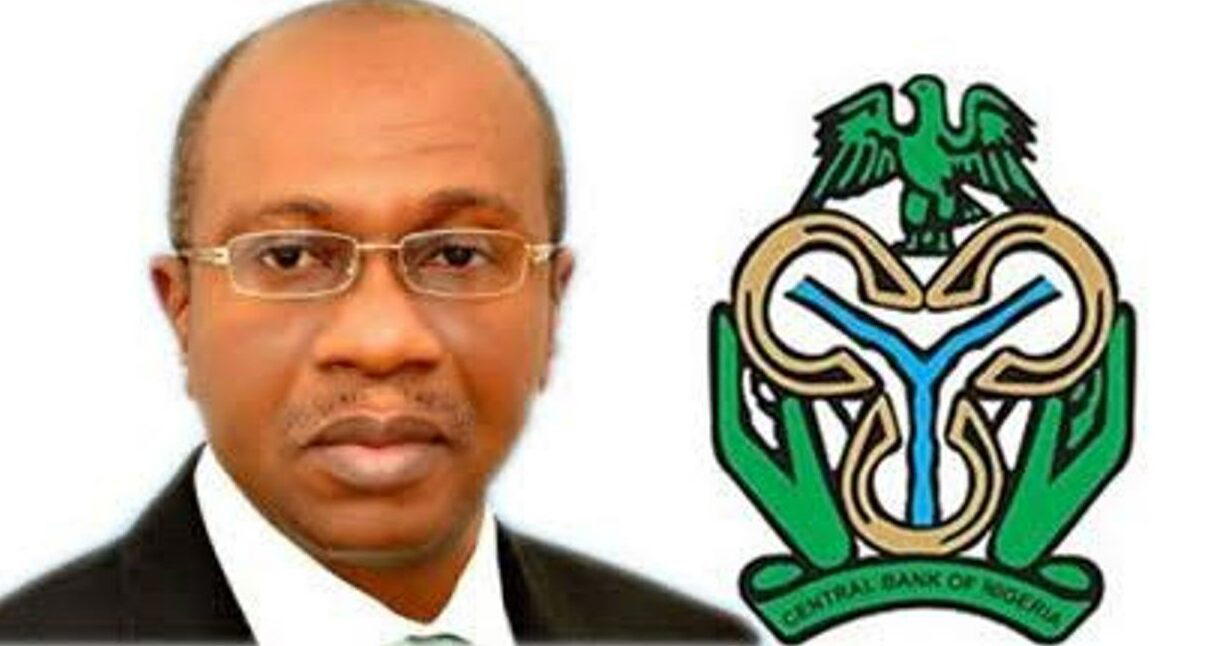
Godwin Emefiele, CBN Governor.
•Moves against currency speculators
•Mulls more real sector intervention
By Emeka Anaeto, Business Editor
THE Central Bank of Nigeria (CBN) may have launched an emergency campaigns ostensibly to rescue the Nigerian economy from the fallouts of the Coronavirus (COVID-19) induced global economic stress.
Coronavirus is basically a bio-health issue but it has come to the center stage of the global economy; it has snowballed into a major economic crises. So a new word has entered the lexicon of know economic jargons, Coronanomics.
For Nigeria, an impressive performance or status in the global profile of the bio-health stands in direct opposite to what we have as Coronanomics. The domestic economy is already on tenterhooks, bleeding on all fronts both public and private sector. As at last count oil revenue which funds the bulk of 2020 budget is heading to a red zone, spiralling every other macroeconomic indices.
READ ALSO:CBN prioritises economic stability with Obiora as the new DG policy directorate
Besides, pressures are mounting on non-oil revenue and 2020 Capital Expenditure (CAPEX); Fiscal deficit is bound to escalate without any known source of funding; Debt service is set to be in crises; GDP growth recorded in 2019 is set for a reversal; Foreign Portfolio Investments are already taking the exit doors; Pressure has come on the foreign exchange market resulting in serious depreciation of the Naira across all the segments of the market; and the nation’s Foreign Reserves is on a speed lane downwards.
Which way out?
Public policy executives led by the Finance Minister, Zainab Ahmed, and the Central Bank of Nigeria, CBN, Governor, Godwin Emefiele, have set out some conversations around answering this question last week. Besides the apex bank has also taken some concrete steps to tackle some downside market developments.
In response to the panic buying and currency speculations the apex bank has taken a position to the effect that it was not contemplating devalueing the Naira and vowed to sanction authorized dealers found to be involved in currency speculation. According to the CBN’s Director, Corporate Communications, Isaac Okorafor, “Market fundamentals do not support Naira devaluation at time.”
He stated: “The Central bank of Nigeria (CBN) wishes to note with displeasure, the rumours and speculative activities of unscrupulous players in the foreign exchange market, borne out of the impression that the CBN is on the verge of devaluing the Naira, and triggering panic in the FX Market.
“These rumours are false, unwarranted and calculated to serve their dubious and selfish ends. We therefore wish to state as follows: We have begun a robust and coordinated investigation in collaboration with the Nigerian Financial Intelligence Unit (NFIU) and related agencies to uncover the unscrupulous persons and FX dealers who are creating this panic, and the full weight of our rules and regulations will be meted out to them, including, but not limited to, being charged for economic sabotage; For nearly four years, the CBN has successfully maintained relative stability in all segments of the foreign exchange market, which has enabled investors, households and other economic agents to plan and to conduct their genuine foreign exchange transactions with relative ease;
“The introduction of several foreign exchange management measures side-by-side with complementary interventions in food production and manufacturing has drastically reduced food importation, which hitherto constituted a large chunk of the pressure on the foreign exchange market; Although the outbreak of the Coronavirus led to global economic slowdown, fall in the price of crude oil, and less inflow of dollars into Nigeria, the associated public health concerns have also led to factory closures in China, substantial drop in imports, widespread travel restrictions around the world, and cancellation of many conferences, sporting events, business travels, and FX orders
“The size of Nigeria’s foreign exchange reserves remains robust and comfortable, given the current realities of Nigeria’s genuine and legitimate FX demand. As such, the CBN remains able and willing to meet all genuine demand for foreign exchange for legitimate transactions;
“For the avoidance of doubt, the CBN is also working with the fiscal authorities to properly and accurately dimension the immediate and expected impacts of the Coronavirus in order to respond comprehensively and at the same time, ensure a sound and stable financial system conducive for job creation and inclusive growth.”
However, major central banks are now enacting looser monetary policies as global equities reverse earlier gains and safe haven assets rally amid investors’ flight to safety. Partly justifying the panic is the reduction in global economic activities as businesses and consumers pull back on consumption and investment.
Commodity prices have not been left out in the downturn as prices of energy, industrial metals, and agricultural commodities succumbed to a COVID-19-induced demand dip. The prices of crude oil, gasoline, natural gas, copper, crude palm oil, and wheat have heavily declined, adversely impacting revenue generation in producing countries.
Impact assessment
Commenting on the impact of the developments analysts at Cardinalstone Capital, a Lagos based investment firm, stated: “As it stands, global crude oil price is now materially lower than Nigeria’s budget benchmark crude price of $57.00/barrel. The impact of COVID-19 on demand outlook and fresh oil price wars, stoked by the failed OPEC resolution on production cut, have also led to material reviews of oil price projections.
“By our estimates, a base case average oil price projection of $42.50/barrel could result in a N726.68 billion loss in projected oil revenue for 2020 even if government successfully meets its oil production target of 2.18mbpd.
“This, alongside a possible reduction in capital expenditure, CAPEX, intensity to 17 percent as against 35 percent in the approved budget, and 90 percent realization of non-oil revenue target could result in a fiscal deficit of N2.73 trillion in 2020 as against N2.2 trillion.”
However, using last weekend’s closing price of Nigeria’s crude oil grade, the Bonny Light, in the international market, at $36/pb, the deficit is way above N3.1 trillion.
Forex pressures
“The fundamental case for the naira is now materially weaker, with twin deficits across current account and fiscal balances combining with higher inflation expectations to bolster the argument for a currency re-pricing. Clearly, Nigeria’s external buffers are lower, with reserves and excess crude accounts now at $36.2 billion and $71.0 million apiece compared to $62.0 billion and $20.0 billion, respectively, before the 2008 global economic crisis. This comes with significantly higher vulnerability to external shocks as foreign portfolio flows into the apex bank’s Open Market Operations (OMO) now constitutes 32.7 percent of reserves amidst, arguably, one of the worst oil market crises since the Gulf war of 1990/1991.
Fixed Income
In the fixed income market, domestic sovereign yields are likely to climb in near term driven by a combination of recent external shocks and prevailing domestic macroeconomic headwinds. The sizeable reduction in Open Market Operation, OMO, maturities (N618 billion on average in Q2’20 and Q3’20 pales in comparison to average OMO inflows of N1.5 trillion since the OMO ban in October 2019), the likelihood of higher fiscal borrowing (as oil revenues shrink), increased pressure/speculation on FX, and heightened credit risk & inflation concerns are likely to place upwards pressure on yields in the short term.
Reflecting on this scenario, the analysts at Cardinalstone said, “For OMO bills, which are exclusively traded by foreign portfolio investors and banks, we see legroom for an uptick in yields as the CBN is likely to re-price rates higher to compensate for the heightened risk.
“In addition to the recent oil price war, the increased probability of a ratings downgrade, following previous revisions from ‘stable’ to ‘negative’, is a key risk to yield outlook.” Already Fitch Ratings has indicated its thinking along this line with increased pressures on the nation’s foreign reserves.
Foreign Portfolio Investors, FPI’s, have largely been on the sell side in recent months, trimming their holdings in OMO bills from $17.7 billion in August 2019 to $12.7 billion in November 2019 as the CBN faces an uphill task of convincing investors to stick as reserves continue to slide.
The CBN has indicated that it was alive to the responsibility of preserving the integrity of the nation’s treasury market. Consequently, Emefiele stated last week: “Central Banks in key markets across the globe have responded by reducing policy rates in order to stimulate growth, while measures are being taken by fiscal authorities to build resilient buffers to contain the spread of the virus.
“The CBN fortunately had already embarked on similar measures which have resulted in significant reduction in lending rates, as part of our efforts to boost growth. Working with the fiscal authorities, we will not hesitate to deploy additional measures to strengthen our buffers and insulate the Nigerian economy from the global headwinds.”
Interventions, devt finance
The CBN has been running several interventionist policies providing access to capital and technical supports for local production of goods. The idea was to save the foreign reserves from import-dependency.
The apex bank appears to be stepping up this action. In his address at last week’s meeting, Emefiele disclosed that the apex bank would fund local drugs production and the establishment of specialist hospitals in the country.
This, he said, would be the bank’s immediate response to the lessons of the impact of the Coronavirus.
His words: “On our part as central bank, what we put on the table is that we will extend our intervention.
“At this time we in Nigeria CBN will now be looking at our Pharmacists and pharmacologists and as say that it is high time they stop dispensing in hospitals. We will now begin to do what they learnt in schools- the formulation of drugs and the development of pharmaceutical industries will now form part of our intervention activities. We will also be looking at the possibility for us to see that we reduce the drain on our foreign exchange where we find that people travel abroad for common medical checks.
We are going to intervene heavily in the health sector to see how we can support the efforts of government to see to it that we develop specialist hospitals and to handle ailments that would have taken our people out of the country and constitute a drain on our FX resources.”
Stock market
The stock market has been reeling under the weight of COVID-19 fallouts with investors losing N1.8 trillion just last week. Commenting on why the market had in the early part of the first quarter 2020 enjoyed rally only to be moderated by prolonged bearish trend, the Chairman of the Association of Securities Dealing Houses of Nigeria (ASHON), Mr Patrick Ezeagu, said: “There were a lot of positive policy pronouncement which influenced investors’ perception, hence the rally.
These are attributable to the policy of the Central Bank of Nigeria (CBN) on Open Market Operation (OMO) Bills, the new national budget cycle, the expectations of members on the outcome of the demutualization of the Nigerian Stock Exchange (NSE) and generally, the traditional optimism following a new year, which was our own January effect.
“The sector of the economy that has been so resilient has been agriculture, which has always been part of our daily lives in which we have a long value chain and levels of participation. These offer a wide range of opportunities for medium to large scale enterprises.”
Disclaimer
Comments expressed here do not reflect the opinions of Vanguard newspapers or any employee thereof.