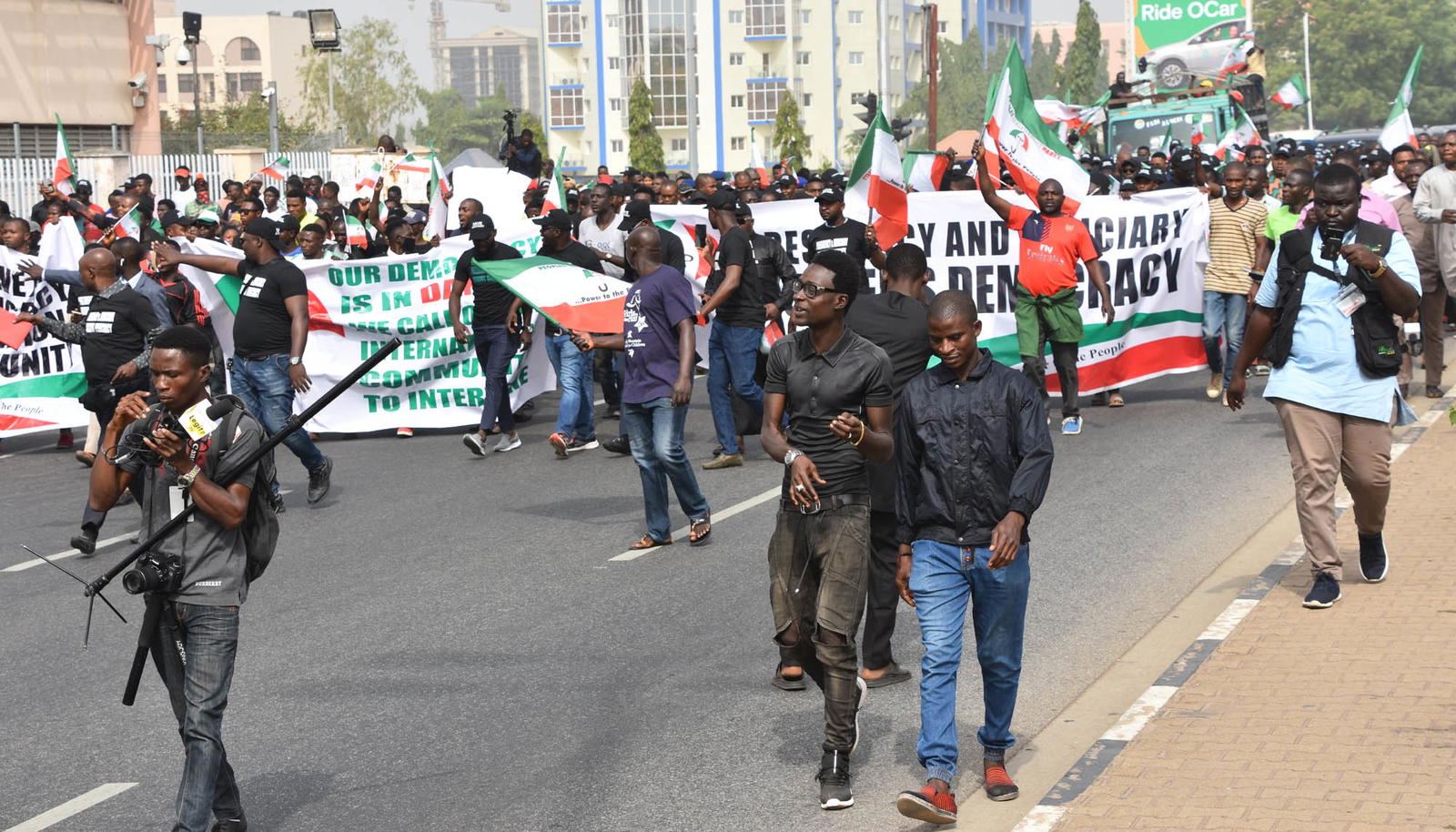
Pic.2. PDP supporters during their protest against recent Supreme Courts Judgment on Imo Governorship Election, which sacked Gov. Emeka Ihedioha and replaced him with Sen. Hope Uzodinma, in Abuja on Monday (20/1/20). 00381/20/1/2020/Anthony Alabi/BJO/NAN
By Obi Nwakanma
It is no longer news that the Supreme Court of Nigeria led by Tanko Muhammad had supervised what must now go down as the most controversial judgement in the history of the judiciary in Nigeria.
Judges, like Justice Mrs Kekere-Ekun, who wrote the so-called lead opinion of the court, and who were thus used to deliver what is nothing but a bare-faced injustice will go down in the history of the court as deserving nothing but what they currently get: the opprobrium of the citizens whom they betrayed by denying them justice. But that is not the most galling thing: it is that this judgement has destroyed the citizens’ confidence in the courts. Its dangerous consequence is that it now leaves more people little option but to resort to self-help rather than to the courts in matters of justice.
In a nation whose courts can no longer guarantee justice, anarchy reigns. It will soon come to pass that condemnation by a court in Nigeria will be a badge of honour rather than reproof against crime because the judges themselves will be seen as the real offenders. That is the danger to which this judgement puts the courts in Nigeria.
A judge can be fallible and may deliver fallible justice, as the honourable Justice Chukwudifu Oputa once averred, because judges, after all, are human and are not infallible. But a judge who betrays his calling by delivering partisan justice betrays God, nation, and conscience.
So, what should an aggrieved people who find themselves betrayed by the highest court of the land, and without further recourse, to a court for justice do? This is the question. And this is exactly the situation with the voters in Imo State, majority of whose votes the Supreme Court willfully and brazenly cast aside.
READ ALSO: Imo defectors to lose their seats, says PDP chieftain
There is a theory of just action. Where a citizenry feel no longer covered by the protection of true and efficacious justice, they have a right to organise and seek alternative justice. Until justice is done completely they must not rest. They have a right to disobey any laws or rules, or orders or injunctions issued or emanating from a court, or a government which they feel does not represent or reflect their truest interest.
A free and organised people, in other words, have an obligation to disobey a court where the ruling of such a court is questionable under the conditions of natural law.
The import of this is that the majority of the voters or the electorate of Imo State have both the right and the obligation under the full rights of their citizenship to disobey the Supreme Court, where they discern that such a declaration of the court is unjust, or inconsistent with their common interest that are protected under the constitution, namely, their rights to suffrage.
Thus, in my estimation, Imo people must not allow Hope Uzodinma to be imposed on them, or to govern for even a day if indeed, he was not elected by them. But if on the other hand, Hope Uzodinma represents the true repository of their mandate, then they must rally and support his government and his election as effected and as established by the Supreme Court.
But if the Imo people feel that Uzodinma is an impostor sent to govern them against their popular wishes, they owe it to themselves, and to the future generation to make it impossible for him,
Supreme Court or no Supreme Court, to govern in Imo State. They must make it clear by denying him the very grounds on which he can stand in Imo State. Imo people will not be the first to send an impostor governor running.
The people of Ondo sent Akin Omoboriowo running from Akure to Lagos in 1983. Imo people must send back Hope Uzodinma to the Supreme Court in Abuja and defy every order of government until their mandate is restored.
They cannot do this merely with street campaigns and talk. Street campaigns and talk are only part of it, but such tactics alone are no longer effective in forcing the hands of oppressive orders.
In the past week, there have been various marches on the streets in Owerri, and solidarity street marches to protest this Supreme Court judgment in Abuja, Lagos, and some neighbouring Eastern states. Such street marches are okay for show. But they do not change anything as we know it because they no longer threaten those against whom the protesters march.
You may march all you can, but they will disperse protesters with a battery of gun-toting police, or get some soldiers from the barracks to shoot into the air and dispatch strong arms against the public protests. There are two forms of protests: one is a street march, that is largely theatre, and the other is a defiance campaign. That is the real McCoy.
Its goal is often to defy and force the oppressive order to its knees. It locks down all avenues of citizens participation in civic life and brings down governments by confronting it with its own methods.
The most important tool of every government is the power of coercion. Popular governments can get away with it. But an unpopular government alienates people the more it deploys coercion.
Just last week, Hope Uzodinma announced that he will bring down the full weight of the law on anybody who continues to protest in Imo as a result of the Supreme Court ruling that imposed him on Imo. “God made me governor,” he said. But this is a lie from hell! God did not make him governor.
A partisan court violated the will of the people in the most inexplicable ruling and imposed him willy-nilly on Imo State. If his mandate is truly the mandate of the people, the protests should quickly fizzle out. But if his is an unpopular government or an impostor government, he most certainly has set the stage for a sustained defiance campaign.
Sustained defiance campaign
For a defiance campaign to work, however, it means that the people themselves must be properly organised, and be prepared. They must gird their loins and must be ready to meet the government’s capacity for violence measure for measure. They must not just yap about injustice, they must act to restore justice to themselves.
They must not stop only on street marches, they must organise directed campaigns to hit this government at its most vulnerable: they must become tax resisters, and refuse to pay taxes to the government, including forced taxes. If the government tax collector comes to them they must drive them away until such a time when the government of their choice is restored.
They must organise frequent closures, sit-ins, stand-ups, break-ins, and make the streets empty, ensuring no movement of people, no opening of shops or markets; that nobody in fact opens the gates of government ministries. They must deploy guerrilla tactics.
They must openly defy the laws of the state until the jails are so full, there will be no more space for civil offenders. They must be prepared to suffer pain for a little moment until their electoral rights – the most important right of their citizenship – is restored.
The first act must be for a citizens committee to go to a state high court and secure an order of mandamus restraining Hope Uzodinma from assuming or entering the office of the governor to Imo State.
Thereafter, at least one million citizens must invade and occupy the State House in Owerri, and stay there until a judicial review restores the mandate of the people. They must store water, dry food packs, and volunteer doctors must be on standby in case of emergencies.
They must show no fear of the police or the military even when they come with their guns or threaten violence. The police nor the military can afford to massacre citizens in open protest at this age when such an image might go viral globally.
Besides, the people themselves must not think themselves powerless before threats of violence. Such a threat might work against individuals or small groups. But against the mass of the people, it is an empty threat.
First, because the combined forces of the Police and military are not as many as the citizens of the city of Owerri alone, not to talk of Imo in general. The government does not have the numbers to contain any citizen uprising.
Secondly, if these agents of government do not refuse any orders, no matter where it is issued, to shoot citizens engaged only in “civil disobedience”, the citizens themselves reserve the right to defend themselves and respond, because such public agents would no longer be legitimate institutions of authority.
I already hear voices from the usual quarters telling Imo citizens to “leave this matter to God,” and I as a conscientious citizen say, “Heck, No!”
This is not a matter between God and the people. They also say, “well, the Supreme Court has said…” and I say: “Well, in arriving at this judgment, the Supreme Court has already delegitimised its own authority and is no longer the court of ultimate justice.” And aggrieved people are not obligated to believe or trust in its judgment.
It is imperative that this wrong is made right. The National Judicial Council, must as a matter of urgency, bring Justice Tanko Muhammad and the six other justices before it, and sanction them, otherwise, the legitimacy of the Supreme Court of Nigeria will be in jeopardy.
Disclaimer
Comments expressed here do not reflect the opinions of Vanguard newspapers or any employee thereof.