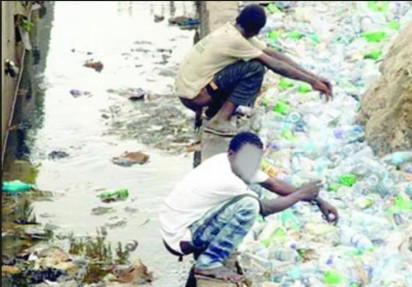
File: Open-Defecation
Many Nigerians believe that the move by the Ministry of Water Resources to rejig and deliver the Wash Action Plan, as part of efforts to solve the problem of open defecation, is an idea for the right time.
Osun Assembly puts budget consideration of 2 ministries on hold
There have been efforts to put an end to the persistent problem of open defecation in Nigeria. According to analysts, the flag-off of the Clean Nigeria: use the toilet campaign on the 19th of November 2019 at the Eagle Square in Abuja heralded a new direction towards solving the problem.
The journey to ensure that Nigeria attains open defecation free status was fine-tuned in Stockholm Sweden between August 25th – 31st during the World Water week when Nigeria signed a Memorandum of Understanding between the Ministry of Water Resources and ActionAid on water sanitation and Hygiene, easily referred to as WASH programme.
Indeed, the launch of the national action plan for the revitalisation of the WASH sector couldn’t have been effective without the declaration of ‘state of emergency’ on the 8th of November, 2019 with the aim of establishing a renewed Federal – State partnership towards credible pursuit of the sustainable development goals (SDGs) and ensuring that the federal government effectively guides and supports states investments and reform efforts.
In order to ensure transparent implementation of the national action plan, a coordination office has been set up with meetings held with development partners and International Research Institutes who have pledged support for the programme in the area of funding, governance, sanitation, monitoring and evaluation and capacity building.
With the guidelines established and distributed in a technical assistance programme to the 36 states and the FCT only 11 states have so far responded and declared a state of emergency. These include: Ondo, Ekiti, Osun, Taraba, Delta, Ebonyi, Bauchi, Plateau, Jigawa, Katsina and Benue states even as the seat of power FCT has yet to make any significant move towards the project.
The whole idea could be a hogwash and go the way of similar programmes instituted in the past, if adequate water supply for urban areas are not pursued with renewed vigor by the federal government if the existing water supply chain is relied upon.
However, Sulaiman Adamu the minister of Water Resources when taken on the issue that the programme could be a colossal failure without adequate water supply, assured that with plans to commission additional eight water supply projects before the new year, bringing the number to 21 major water supply projects completed and commissioned even as Kwara had two commissioned on the 14th of November this year, there is no going back on the WASH plan.
It is interesting to note however that the novel initiative came about as a result of the failure of the country to meet the much-hyped Millennium Development Goals (MDGs) and the need to improve the water supply and sanitation situation in the rural areas caused the Ministry to embark on the robust project.
Since the launch of the programme in 2018 and to date, 29 states have signed the PEWASH protocol, leaving seven states and the FCT to endorse and buy into the programme.
Out of the 29, only 11 state have made open declarations and following seriously the finer details of the programme.
Adamu who was returned as the minister of Water Resources after the elections this year, called on the remaining states to key into the programme. According to him, “I therefore urge the remaining seven states and the FCT to endorse the PEWASH protocol and the other states to prepare and partner with the Ministry so as to benefit from federal government support, in line with the partnership protocol.
“It is pertinent to note that henceforth federal government will only complement states that have shown and expressed commitment in the WASH sector.” Although President Buhari reechoed this protocol and seriousness in 2018 when it was launched, the signing of the Executive Order 09 has given it more bite.
This much Adamu re-emphasised, while confirming that PEWASH “is being piloted in Kano and Ogun states, and so far over N1.6 billion has been invested to deliver 537 hand pumps, 111, solar powered Borehole schemes in Kano and 101 Solar motorised schemes in Ogun State which were either constructed, upgraded or rehabilitated.
“Ondo State Rural Water Supply Agency was also supported for the rehabilitation of 1000 hand pump boreholes across the state.”
River blindness affects fertility —Prof. Jennifer Tyndall
The success of the programme and the gains hinge strongly on the full commitment of states to provide their counterpart funding contribution timely and sufficiently and states making adequate provision for the programme in their respective annual budgets which more often than not neglect the water sector to the detriment of the populace.
It is also a fact that UNICEF and the National Bureau of Statistics conducted the Water Sanitation and Hygiene- National Outcome Routine Mapping (WASHNORM) using the National Integrated Survey of Households (NISH) 2014-2019 covering a total of 1,640 Enumerated Areas across the country assessed the status of WASH services and results from the users perspective of service levels, access, participation and satisfaction sustainability.
The WASH- NORM is actually designed to collect statistically sound and verifiable estimates on WASH services level, accessibility and dependability, using key outcome indicators to determine the situation of families, households with respect to WASH services. Again, the WASH-NORM, Adamu confirmed, “serves as a reference dashboard for systematic monitoring of progress towards attainment of key sector goals and targets; provides routine updates on progress of key sector outcome indicators and institutes government -led evidence generation, knowledge management and sector learning. WASH NORM 11 is under preparation and this will further incorporate water quality and water utilities mapping.’’
Interestingly, while many states are still dumb on Water Quality, Sanitation and hygiene, the issuance of the Executive Order 009 by President Buhari, tagged “The Open Defecation – Free Nigeria by 2025 and other related matters Order” could as well spur the states and corporate bodies to action.
This Order mandates the Water Resources Ministry to coordinate all activities towards ensuring an open defecation free Nigeria by 2025 through the National Clean Nigeria Secretariat, and directs all MDAs to join the campaign.
It also mandates the secretariat to ensure that all public places have accessible toilets within their premises and enforce compliance. Besides, Order 009 also calls for legislation against open defecation by both federal and state legislatures.
But so far only 15 out of 774 local government areas of the country in Cross River Bauchi, Jigawa, Benue and Osun states including very many other communities have achieved Open defecation Free (ODF) status.
Expectedly, 106 sanitation and hygiene facilities had been constructed in the North East, North Central and South West zones while domesticating the production of hydrogen sulphide vials at the National water quality reference laboratory.
The country has also developed and submitted the Country Report on Global Analysis and Assessments of Sanitation and Drinking Water (GLASS) to the World Health organisation while the Water Resources minister took the Open Defecation Free programme to the University of Abuja where he delivered the first lecture tagged ‘Stopping Open Defecation’. He used the opportunity to inform the university community that Open Defecation Free Nigeria is a must.

File: Open-Defecation
According to Adamu, “In keeping faith with the mission of the Ministry which is to be the vehicle of the nation’s integrated water resources management, contributing optimally to the socio economic activities of the nation through comprehensive planning , facilitating and creating the enabling environment for integrated conservation, development and management of various water uses for the preservation of the quality and quantity of fresh water ecosystem for safe water sanitation, production of sufficient food and employment opportunities for sustainable livelihood, as well as equitable allocation to all Nigerian communities.”
On the focus for 2020, the minister explained that more attention will be paid on the ‘Clean Nigeria: use the Toilet’ campaign in pursuit of the Executive Order 09, Implementation[s1] of the Wash Action Plan and PEWASH programme, completion of inherited projects, enhanced operations of River Basins, accelerated, implementation of the TRIMMING project , support for Transboundary activities and programmes and accelerated implementation of the national irrigation programme (2016 – 2030).
The minister during the chat also explained that more attention will now be focused on the coordination of graduate /Youth empowerment programme in the RBDASs while the Songhai Integrated Model farming schemes have been developed in Anambra Imo RBDA, Upper Niger, Lower Benue and the Benin Owena River Basin Development Authorities.
Portable water: We sank over 800 boreholes in C’River for 2bn naira — UNICEF
The Songhai Model farms serve as training centres for the Graduate Youth Programme and provide job opportunity to teeming Nigerians.
Disclaimer
Comments expressed here do not reflect the opinions of Vanguard newspapers or any employee thereof.