News

October 21, 2019

Flood sacks Lagos, Ogun border residents after heavy downpour

Udemma’s tales of a broken heart By Chukwuma Ajakah Arts and culture journalist, Udemma Chukwuma makes a case for neglected children with her maiden novel, Left with Shadows, which mirrors the plight of millions of youngsters from broken homes, through the pathetic story of Nwakaego, whose dream of attaining a good education is thwarted after her migration to Lagos. Left with Shadows, published by Topseal Communications Ltd (2020) is a 139 paged fiction, embedded with topical socio-cultural issues. The novel is set between the late 80s and present day Southern Nigeria, covering Enugu, where the heroine’s biological parents, Njoku and Ama end their ill-fated marriage-with two children divided between them, a remote village in Abia, where Nwakaego, the female child, is adopted by an elderly couple, and Lagos where the protagonist’s dream turns out to be a mirage. Left with Shadows has a simple plot structure which revolves around Nwakaego, the major character. Nwaka, an innocuous victim of a failed marriage, is raised in a foster home where she fares fairly well until she learns that her own mother had abandoned her as a toddler. The startling revelation throws her into a life of misery. Nwaka develops a low self-esteem and withdraws into the cocoon of loneliness, groping through life without experiencing loving family relationships. Ironically, she begins to derive comfort from pain as revealed in the following excerpt: “Mama beat Nwaka ruthlessly as she refused to tell her where she had been all day, Nwaka took pleasure from the pains she got from Mama’s lashes. It felt real; she wanted something that was real, life was not real to her.” She gets so obsessive about leaving the village that she threatens to commit suicide if anyone tries to stop her: “I will kill myself.” Mama’s ominous response, “Go to Lagos, you will regret it,” is confirmed at the end when Nwaka’s enthusiasm about the city wanes, a haunting nightmare triggered by some unpleasant experiences follows. Aunty Ndubunma reneges on her promise to send Nwaka to school and instead confirms her as “nwa boi”, a domestic slave. Nwaka’s modest desire to be enrolled in a secondary school, where she will learn how to “speak English like city people”, becomes a perfect bait for the antagonist to have her entrapped. The book contains sixteen chapters subtitled as follows: Reality, Unexpected Request, Ready for the City, The Journey, In Go Slow, Every Woman is a Mother to Every Child, The Separation and the Separated, City Life, Rush of Memories, The Truth, A Starved Beast, The Colour of Loneliness and Hope Finally Dashed. The author surmises Nwaka’s precarious disposition in Chapter Fifteen: Nwaka didn’t want to be in Aunty Ndubunma’s house; the place had become like hell. She fought her heartache by herself. She tried to bury what had happened to her, but to bury what had happened to her was like cracking Olumo Rock with her bare hand.” A pervading mood of loneliness and despondency resonates from the prologue to the last chapter of the novel, “Hope Finally Dashed”. The author’s tone reflects the heroine’s dominant attitude as she metamorphoses from an amiable personality to a virtual recluse, embracing loneliness as her only companion: “Loneliness crept into Nwaka’s life. Her world was as lonely as a desert. She felt the sort of loneliness that cannot be described. In her misery, she saw the colour of loneliness…It laid in bed with her at night and accompanied her during the day like her shadow.” The climax of the generated conflict occurs when Aunty Ndubunma’s husband, Uncle Ojo, rapes Nwaka after a bout of alcohol. In reaction to this unfortunate incident, she relapses into a suicidal state fraught with terrifying loneliness, despair and fear. Udemma adopts the third person narrative technique, presenting the story from the point of view of a non-participant observer, with a dose of humour, emotive expressions, flashback, drama, dialogic interactions and engaging narration of events. The language of the novel is relatively simple. The diction features a prevalence of commonly used words, illustrative descriptions, and infusion of indigenous lexical items: “Nigerian English”, “Igbo” and “Yoruba”. The author simplifies the reading task further by crafting each chapter as a short story which can be read independently despite its intricate link with the main plot. The book illustrated by Kolade Oshinowo, also contains a glossary of expressions in vernacular. The protagonist, portrayed as a symbolic character, represents the typical girl child, whose destiny is buffeted with a myriad of problems: alienated from family at age two, unloved by society, betrayed by a trusted aunt, made a school dropout, lured into abandoning her life dreams and raped as a pre-teen. Left with Shadows features characters with diverse traits, including the dregs of the society. The antagonist, Aunty Ndubunma is depicted as a capricious villain with a “hidden agenda”. Just as she pretends to help Nwaka, she tactfully conceals her real motives for assuming her husband’s financial responsibilities at home. From being a role model to the protagonist, her flipside opens to unveil an oppressive self-centered personality who will do anything to get whatever she wants. On being reminded of the promise she had made to Papa before taking Nwaka away from the village, Aunty Ndubunma retorts: “Shut your mouth. Do you think I pick money from the ground, did your father or useless mother give me money to send you to school? I feed you, clothe you and accommodate you. Do you want me to kill myself for you?” The narrator adds that: “Aunty Ndubunma gave Nwaka a look that registered in her heart. The look made Nwaka shiver anytime she wanted to remind Aunty Ndubunma of sending her to school.” The thematic treatment encompasses the following: alienation from family and society, illusions of rural urban migration, vicissitudes of marriage, life from a broken home, neglect and abdication of parental responsibility, unemployment and its consequences as well as moral depravity, characterized by those with amoral values like ritual killers and rapists. As depicted through the iniquitous role of Aunty Ndubunma, unscrupulous guardians take advantage of their unsuspecting wards by exploiting them to satiate their own ulterior motives. The victims are often lured into perpetual servitude with promises that will make them believe that their circumstances will be altered for good. Left with Shadows is dedicated “to every child from a broken home”. Cardinal issues that border on family life and child rights are embedded in the story, thereby making it an interesting read to diverse categories of readers: students, children literature teachers, social workers, parents, caregivers and children’s advocacy groups.

By  Olasunkanmi Akoni, Lagos

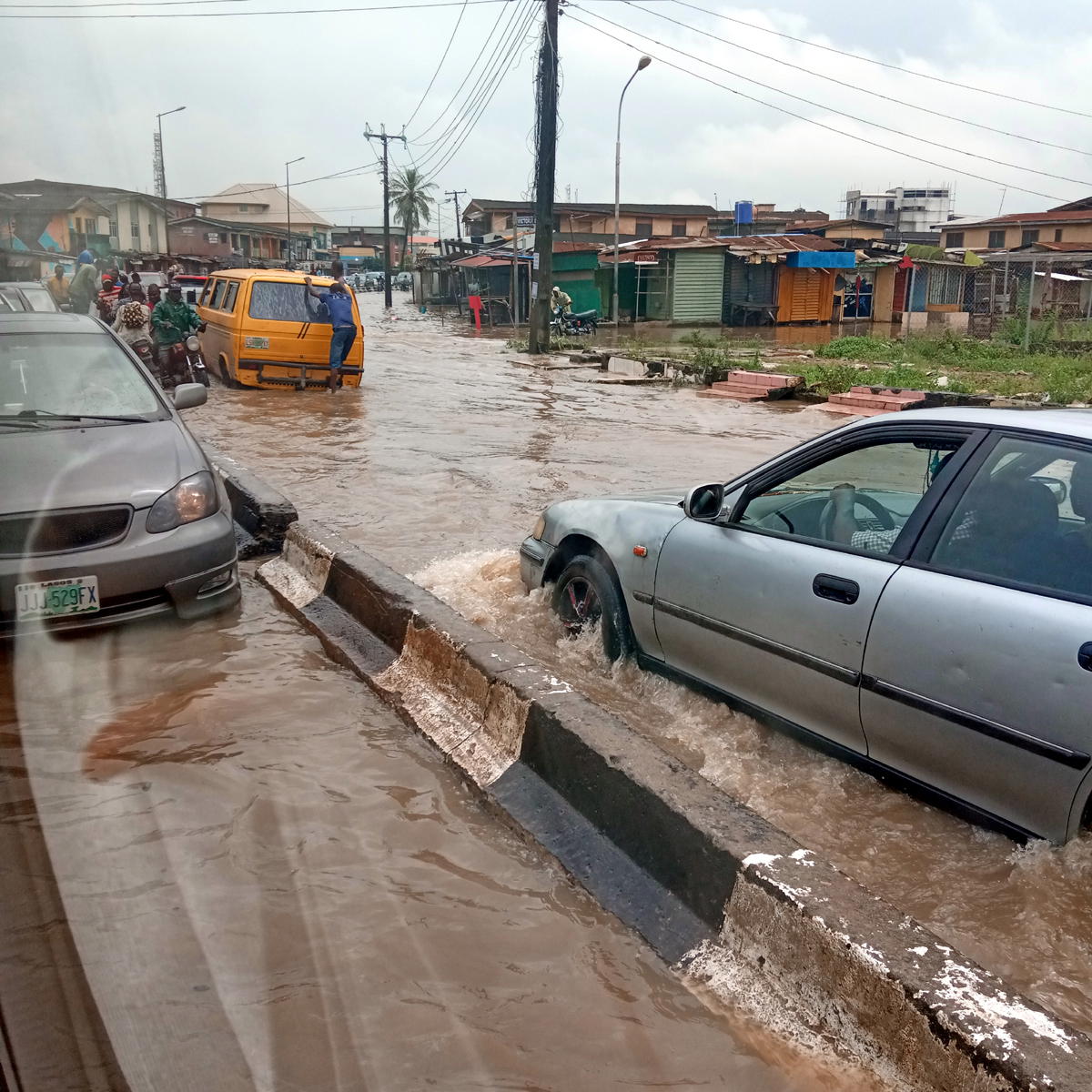
Following torrential rainfall across Lagos State, yesterday, several communities were completely taken over by heavy flood, leaving many residents trapped in their homes.
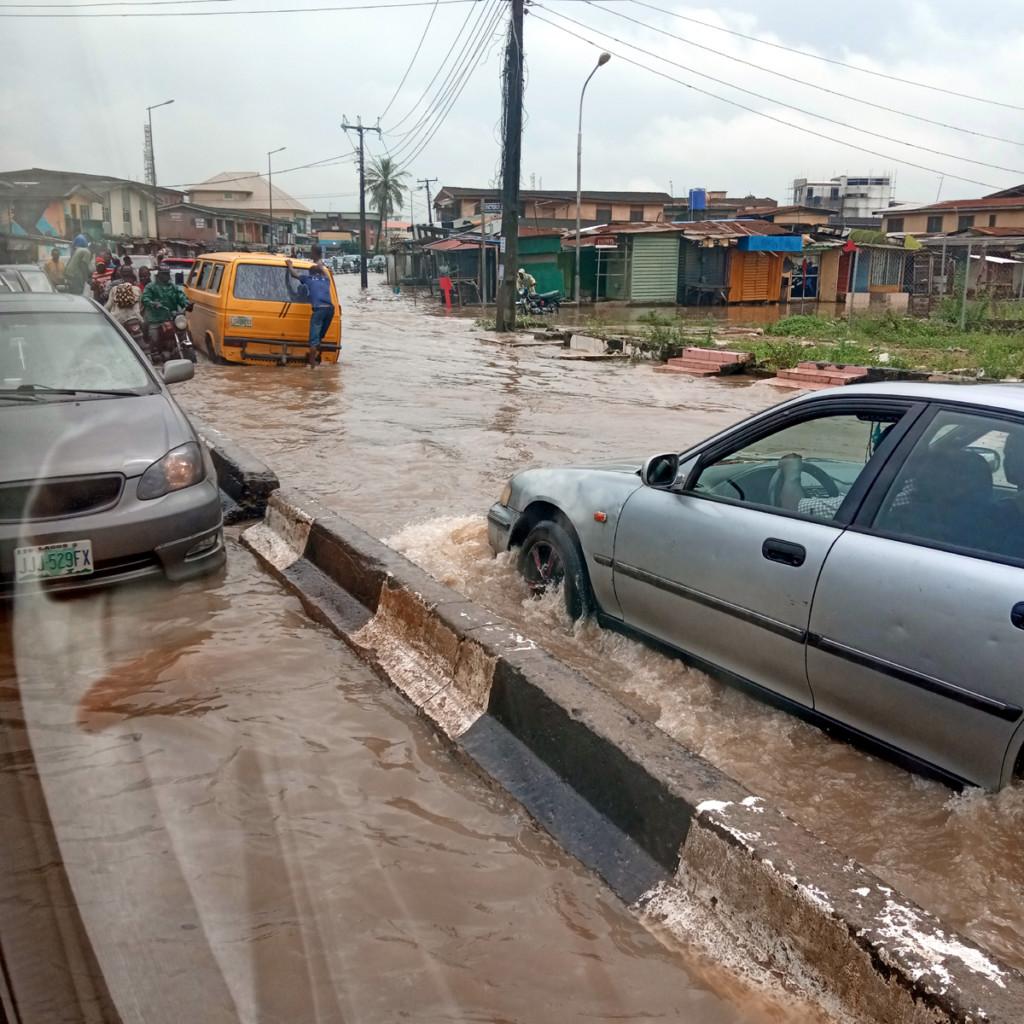
Flood along Ikotun Egbeda road resulting from the heavy downpour on Sunday disrupting flow of traffic. Photo Lamidi Bamidele

The rainfall, which started as early as 2 am, Sunday lasted for several hours into the evening leaving most parts of the state flooded with attendant traffic gridlock on the roads.

A resident of Discovery Estate, Riverview Wing of Opic, Isheri, Lagos-Ogun States border, Adegbola Babatunde, lamented over the inability of his family to move out of their homes which was heavily flooded due to the release of Ogun Dam which has taken over the entire house.

According to Babatunde, “The Dam release from Ogun Dam has taken over the entire Discovery Estate. And the MTR Estate which has a motorable road has refused to open their gates to the people living in the environment to pass through.

“Please, help us appeal to the Ogun State government to open MTR to us so we can evacuate our families out of here.” Other areas which witnessed heavy flooding, included: Ikeja, Agege, Lagos-Abeokuta Expressway, Ikotun-Isolo Road, Oshodi-Apapa Expressway, Lagos-Badagry Expressway, Lagos Island, among others

Vanguard News