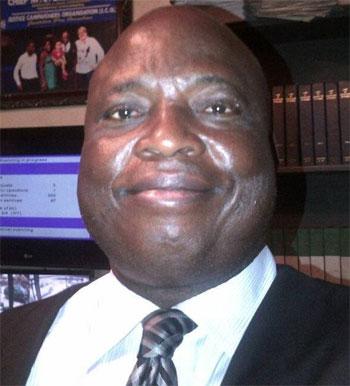
Ekwunoh
By Onozure Dania
Mr Morah Ekwunoh, is a Lagos based lawyer and frontline human rights activist. In this interview, he spoke on expectations of the 9th Assembly, 20 years of democracy in Nigeria and other sundry issues. Excerpt.
The executive of government has continued to disobey court orders despite public outcry. What’s your take on the issue?
The attitude of the executive arm of government towards judgments, orders and rulings from the judiciary, its sister counterpart, is, to say the least, very sad, unfortunate and embarrassing, when viewed from the prism of the civilised and democratic world.
Ekwunoh
EDO ASSEMBLY: Perfecting the old order(Opens in a new browser tab)
It inflicts great laceration of feelings when it is observed that the attitude of picking and choosing which of such judgments, orders and rulings to obey adversely touch and concern affrontations on citizens’ inalienable human rights to, amongst others, personal liberty, freedom of movement, respect for the dignity of human persons and, even, life, as clearly enshrined in the fourth chapter of the Constitution and its counterpart provisions in the African Charter on Human and People’s Rights ( Enforcement and Ratification) Act, to which Nigerian led, as signatory in the comity of African nations, and which Act our courts have pronounced as endowed with greater legal flavours than the Constitution.
Why such brazen disobedience should come from an executive arm of government with hands full in the burner of war against corruption, and against the orders of another equal, opposite and coordinate arm of government, from which the same executive reasonably expects correlative return of respect for its executive actions as carried out and executed within the ambit of the law, shocks to bone-marrow.
How would rate the independence of judiciary under this dispensation?
Principal expectations from the judiciary are of quadruple nature. The first is in the area of recurring decimal inherent in the crusade for financial Independence and autonomy for the judiciary, which, if achieved, will ensure full and unqualified Independence of the judiciary, in all its pitch and substance, and it’s extrication from the executive control and interference, since it’s annual budgetary allocations and estimates will now be directly charged to the Consolidated Revenue Fund, pursuant to the provisions of sections 80, 81 and 84, amongst others, of the Constitution, and the highly appreciable judgements of Honourable Justice Adeniyi Ademola as he then was, and Honourable Justice J.O. Adeyeye, both arising from two litigations activated and set in motion by Dr Olisa Agbakoba, SAN, albeit pro bono public.
A situation where heads of our courts still go to the executive arm of government at federal and state levels, often with caps in hands and on bent knees, for misery titration of their constitutionally entitled and judicially sanctioned funds due and accruing to the judiciary, is, to say the least, antithetical to much- needed Independence of the judiciary.
20 Years of Democracy, whither Nigerian?
A fitting answer to the question of whether Nigeria is moving forward or backwards after 20 years of democracy is that we are neither moving forward nor backwards, but are fixed in a hybrid of conundrum, quandary and quagmire.
Since Cleisthenes’ invention of democracy in the middle of 5th century, and its global acceptance and universality in operations and practices, as a concept of government of the people, by the people, and for the people, Nigerians, nay, Africans are clear strangers to its imports and purports.
The Nigerian Constitution (infra), in its section 14(2) provides “The security and welfare of the people shall be the primary purpose of government” In section 14(3) it also orders thus: “The composition of the Government of the Federation or any of its agencies and conduct of its affairs shall be carried out in such a manner as to reflect the federal character of Nigeria and the need to promote national unity, and also to command national loyalty, thereby ensuring that there shall be no predominance of persons from a few States or from a few ethnic or other sectional groups in that Government or in any of its agencies.
What are your expectations from this government?
Expectations from this government include headlong tackling of insecurity, kidnapping for ransom, herdsmen-farmers conundrum, provision of employment for our teeming youths; severance of the umblical cords of Local Government administration from the State Governors, particularly in the administration of joint State/ Local government accounts through which the masses at the 4th tier of government are suffocated and short-changed by the Governors and political godfathers; amendment of the Constitution and the Electoral Act to protect voters and masses from electoral robbery and brigade associated with last elections and ensure that statutory allocations to Local governments are directly received by them;; improvement in human rights records and obedience to court judgements, orders and rulings.
What are your expectations from the 9th Assembly?
With the inauguration of the 9th Assembly, principal expectations and yearnings from Nigerians, are, no doubts, multidimensional, particularly with the seamlessness accompanying elections of the principal officers thereof, unlike the unfortunate situation which signposted inauguration of the 8th Assembly.
On the front burner of such high expectations is performance and discharge of its constitutionally duty of legislative engineering, with the overriding interests of the variegated segments of the society uppermost in the members’ mind, irrespective of ethnic, religious, political or other differences or cleaverages which riddle the country’ firmament. In this respect, only interests of the famished and, you may add, sequestrated Nigerian masses, should count in their minds.
Thankfully, the seamlessness of the principal officers’ emergence, as earlier stated, when juxtaposed on both the said officers’ joint and several pedigrees, and the ruling party’s active interest and involvement in their evolution, will, no doubts, provide effective manure and impetus towards quick actualisation of this primary goal.
How would you rate President Buhari’s anti-corruption crusade?
No doubts, the government is firing in all cylinders, its war against corruption, which is commendable. However, a lot need to be done, particularly in the area of correcting the impression of its prosecutorial agents’ selectivity where sacred cows represented by the political heavyweights, the super-rich and the haves with strong influence or connections at the corridors of political power, are on the one hand, and the down-trodden, voiceless have-nots and those without political contacts and connections at the corridors of political power, are on the other hand.
Here, for instance, is the existence of paradox inherent in some of their actions, including, but not limited to, the recent transfer, from the EFCC to the Attorney General’s office, of the N25 billion fraud case involving Senator Danjuma Goje at the feverish eve of the 9th Assembly’s inauguration and election of its principal officers, during which the said Goje was a strong contender for the office of Senate President against a government and ruling party’s anointed candidate and eventual winner, Senator Ndume, after which transfer the said Senator Goje withdrew from the race and endorsed his challenger, whereas in another case involving the former Governor of Ekiti State, Ayodele Fayose, was, about the same time, transferred from the court of Honorable Justice Mojisola Olateregun, at the behest of EFCC, over purported allegation of bias, which was done in the manner, at least on the surface, of picking and choosing judges for particular cases.
What is your assessment of human right situation in Nigeria?
Certainly, it is not yet uhuru when it comes to the issues of human rights, in terms of both observations, by government and by activists. In terms of government observation, it is clear that it hasn’t met the expectations of Nigerians when juxtaposed upon constitutional safeguards for accordance of respects to citizens’ fundamental human rights, as captured in Chapter lV of the Constitution (supra).
It will be uhuru for Nigerians when their inalienable human rights are respected, and orders of courts are respected in relation to them, as severally issued in a long chain of cases, including orders for release of the likes of Cool Sambo Dasuki (rtd), the Shi’a leader, Ibrahim El-Zakazaky, and his wife, who are still held and detained despite multiplicity of court orders for their release, including orders from the Economic Community of West African States (ECOWAS) court.
On the flip and correlative side of human rights activism, efforts by such leading lights, led by Dr Olisa Agbakoba SAN, deserve commendable mention for their selfless and pro bono public efforts in advancement of human rights activism in the country. Notwithstanding their efforts under reference, however, Nigerians will be glad to see the return of the era of human rights activism, as pioneered and led by Chief Gani Fawehnmi, Tai Solarin, Dr Beko Ransome-Kuti, all of blessed memories. whose selfless and firebrand activism could be likened to the hurricane that produced the “Arab Spring”of the Middle East fame.
Sadly, as the living veterans in the struggle get bogged by advanced age, dearth of their worthy successors appears to be of great concern at the moment.
This is where the most unfortunate demise of young Bamidele Aturu is still viewed as a mortal arrow in the heart of the human rights community.
Disclaimer
Comments expressed here do not reflect the opinions of Vanguard newspapers or any employee thereof.