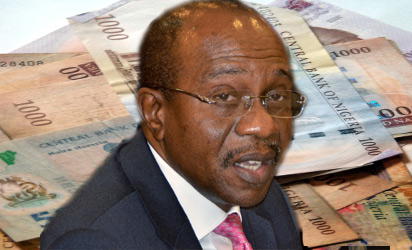
Governor, Central Bank of Nigeria (CBN), Mr Godwin Emefiele
By Babajide Komolafe
The Central Bank of Nigeria (CBN) since 2014 when has ramped up its efforts to use monetary policy to boost enhance job creation and economic growth.
The new impetus was driven by the inaugural speech of Mr. Godwin Emefiele, as CBN Governor, in which he articulated his vision for a people-focussed central bank. This vision according to Emefiele was based on his conviction that central banks of developing countries should go beyond their traditional roles to embrace developmental with the aim of fiscal policies in the quest to enhance employment generation and boost economic growth.
This vision led to the introduction of policy measures like the Anchor Borrowers Programme (ABP), the foreign exchange restrictions on 43 items, and the Investors and Exporters (I&E) window.
Stakeholders’ engagements
The impact of the CBN’s efforts in this regard have been commended by trade unions and Non-Government (NGOs) especially for their job creating impact attracted commendations from
Speaking at a recent stakeholders’ forum organised by the apex bank, they noted that efforts by the central bank had been geared towards promoting the welfare of Nigerians through job creation and increased local productivity, stressing that these policies are visible in the agriculture and textile industries.
Emefiele’s programmes, policies that endeared him to Buhari(Opens in a new browser tab)
They also noted that a bailout fund to states initiated by Emefiele in 2015, played a major role in offsetting backlog of workers’ salary and in reflating the economy.
In addition, they noted that the removal of 43 items from the official forex market also contributed in boosting local production.
During the interactive sessions which took place in Owerri, Imo State, Lagos and others, there were representatives from the National Union of Textile, Garment and Tailoring Workers of Nigeria (NUTGTWN) and other private sector unions affiliated to the Nigeria Labour Congress (NLC).
The organised labour itself, which comprised the NLC, Trade Union Congress (TUC) and United Labour Congress (ULC), all together, had their representatives present.
Speaking, General Secretary of the National Union of Textile Garment and Tailoring Workers of Nigeria (NUTGWTN), Comrade Issa Aremu said the current CBN has done well through its numerous interventions in the various sectors of the economy.
He, however, advised that the country, through CBN should work towards a single-digit inflation rate, saying the CBN should be supported to revive the comatose manufacturing sector of Nigeria.
“I must say that the re-appointment of the CBN Governor for second term is commendable. From the day he assumed office as the governor of CBN, his goal has been to have a monetary policy that will improve production and create jobs.
“For us, you can agree with me that if there are no companies, there will be no workers and if there are no workers there cannot be a union. And if there are no unions, there cannot be leaders of unions that are here.
“So, I think we should partner with CBN as organised labour to realise its objectives especially in the area of development financing. There was a time Nigeria was a workers’ destination for Africans and other nationals.”
Aremu further noted that at a point in country’s history, the country survived on revenues from the non-oil sector, to the extent that it became a dominant exporter of agricultural produce into the global market. Some of these products include cocoa, groundnut, cotton and palm oil.
Nigeria’s focus in agriculture supported the raw material needs of the industrial sector and created employment opportunities for millions of Nigerians, he added.
Aremu stated: “There is availability of local rice in Nigeria. The argument of CBN concerning the 43 items is tenable. Why should we make scarce foreign exchange available for people to import products that we can produce within the country? For us today, that has protected a lot of jobs.
“I think we should commend the CBN and encourage the apex bank to continue in its good job. We have to support CBN because if Nigeria can produce those 43 items locally, our factories will recover. Already, about 2.8million jobs have been created through the CBN ABP interventions. You can imagine if we replicate that in other sectors like Textile and others.
“Emefiele has a way of interacting with stakeholders and taking ideas from such interactions into consideration, so he is a comrade,” Aremu concluded.
Protecting purchasing power
Speaking further, the CBN Governor who recently assumed office for a second term of five years, said the policies of the apex bank in the past five years had been focused on protecting the purchasing power of the poor and vulnerable persons in the country.
According to Emefiele, the apex bank is very comfortable staying on the side of the weak, vulnerable, and poor masses and protecting their purchasing power.
He argued the central bank’s development finance initiatives and foreign exchange intervention are targeted at supporting vulnerable persons in the society.
“Sadly, while most people in this room may be spared the brutal consequences of inflation, the majority of Nigerian masses and fixed income earners are not.
“The poor masses are the ones that bear the brunt of losing purchasing power of the meagre salaries they receive, ever so infrequently.
“Indeed, given the current resistance to pay increased minimum wage of N30,000, one wonders how the fixed income earner would survive the consequences of inflationary pressure arising from the passthrough from exchange rate depreciation being proposed by the naysayers,” he told his audience.
Building a stronger economy
Emefiele said the task of building a stronger economy was far from complete; with the pace of Gross Domestic Product (GDP) growth still very fragile and badly lagging behind population growth rate of 2.7 per cent. He reiterated the fact that the level of credit to the private sector by financial institutions was still very low.
According to the CBN Governor, domestic industries particularly high employment generating sectors like textile and garment sectors have continued to deal with rampant smuggling and dumping of materials through our borders.
“These challenges no doubt call for action by the monetary and fiscal policies through the implementation of policies; the spirit and letter of which must be respected by all,” he added.
He maintained that the bank would continue to defend the naira, saying that the CBN Act demands that the Bank “defend” the naira using the foreign exchange reserves.
“In effect, the CBN would be disobeying the law establishing it, if it sits idly by and allow the naira to be determined wholly by the so-called market forces.
“Second, those who call for floating of the currency betray their wilful ignorance of the effects of significant depreciation, however short-lived, on inflation.
“Several empirical analyses have shown that the pass-through of changes in the exchange rate on consumer prices is almost one-tonne. “This implies that for every percentage point depreciation in the naira, there is almost the same rise in inflation.
“I have also heard a lot of people suggest that all they want is for the CBN to reduce interest rates. In fact, for us at the CBN, achieving a low interest rate regime will give us a great sense of accomplishment.
“Indeed, given our determination to stimulate economic growth, it is obvious that we would want to pursue a policy of moderating interest rates. “Yet, in an environment where inflation recently was a high as 18.72 percent, it would be counter-productive to reduce interest rates because any attempt to ease interest rates under a high inflationary environment will no doubt retard growth.
“While we are delighted that we have been able to fight inflation down to very low double digits, we believe it is still too high for the Nigerian economy. Our goal is to moderate it down to single digits.”
Tackling importation
Speaking at the stakeholders forum held in Lagos on June 22nd, the CBN Director of Corporate Communications, Mr Isaac Okoroafor, the CBN Governor is called a comrade because, “the first day he took office, his vision was titled: ‘a people focused central bank.’
“It means that all the policies from the central bank were to be underpinned and dictated by the welfare of the people.
“Following from that, he initiated the Anchor Borrowers’ Programme which was targeted at the people within the base of the pyramid; the farmers. He looked at millions of Nigerian workers who have been rendered jobless for years because the elite conspired among themselves to be exporting our jobs abroad by massive importation.
“They imported tooth paste, tomato, garri, palm oil, Nigerian print made in China, eggs from South Africa,” Okoroafor said.
“At a time, about 20 million eggs were being imported into the country every day.
“We depended on wheat from Zambia. We imported Fish from Norway. They import toothpick. Aswani market in Lagos used to be the largest textile market in Africa. People from Togo, Mali, Niger, Ghana Sierra Leon and even central Africa used to come there to buy Nigeria prints. Today, Aswani is a shadow of itself,” Okoroafor added.
He explained that all these were imported using Nigeria’s foreign exchange. Inflation which was the greatest enemy of the workers was high and the CBN looked at all these and said ‹why should we keep importing?’”
Disclaimer
Comments expressed here do not reflect the opinions of Vanguard newspapers or any employee thereof.