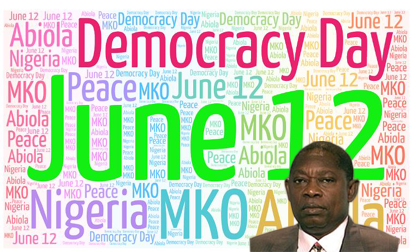
Late MKO Abiola
By Clifford Ndujihe
June 10, 1993: — The Abuja High Court, with Justice Bassey Ikpeme presiding, issues an order restraining NEC from conducting the presidential election.
June 12, 1993: — Presidential election was held in defiance of the court order
Late MKO Abiola
June 14, 1993: NEC publishes results from 15 states on its billboard outside its Abuja headquarters showing that M.K.O Abiola was leading in all regions of the country including Bashir Tofa’s home state, Kano.
June 15, 1993: Another interim Order by an Abuja Court restrains NEC from releasing the results of the presidential elections.
June 16, 1993:— NEC stops the release of the final results of the election
June 23, 1993: — General Ibrahim Badamasi Babangida annulled the election
June 24-29, 1993: — Abiola declared himself president-elect; individuals and groups protest annulment
June 30, 1993: — Campaign for Democracy (CD) an umbrella organization of 40 NGOs/Human Rights Groups, fixed July 5 one-week nationwide protest
August 1, 1993: 30 senators signed a joint motion asking the government to declare the winner of the June 12 election.
August 4, 1993: — Abiola leaves Nigeria unannounced.
August 12, 1993: — Government begins clamp down on activists all over the country.
November 17, 1993: — General Abacha takes over power following the ‘resignation’ of Chief Ernest Shonekan.
May 15, 1994: — Activists and political leaders formed the National Democratic Coalition, NADECO, to press for the revalidation of the June 12, 1993 presidential election
May 23, 1994: National Constitutional Conference elections begin but are massively boycotted by Nigerians heeding NADECO’s boycott call especially in the South-West.
May 31, 1994: Ibrahim Coomasie, Inspector General of Police, declared NADECO illegal
June 11, 1994: — Chief MKO Abiola declared self president at Epetedo, Lagos
June 23, 1994: The Federal Military Government arrests Chief M.K.O Abiola on charges of treason.
July 5, 1994: National Union of Petroleum and Natural Gas Workers (NUPENG) and Petroleum and Natural Gas Senior Staff Association (PENGASSAN) began the longest strike in Nigerian history to protest the annulled presidential elections.
July 8, 1994: Riots break out in the Southwestern states, especially Lagos, Oyo, Ondo, Ogun, as well as Edo State.
August 1, 1994: Abacha meets with the Armed Forces Consultative Assembly to discuss Nigeria’s political problems and their security implications.
August 3, 1994: Nigerian Labour Congress (NLC) calls for a general strike in solidarity with the oil workers.
August 5, 1994: An Abuja High Court presided over by Justice Abdullahi Mustapha grants Abiola a controversial and unsolicited conditional bail.
August 6, 1994: Presiding judge over Abiola’s case withdraws
August 8, 1994: Professor Wole Soyinka, nobel laureate and pro-democracy activist, goes to the Federal High Court in Lagos asking the Court to declare the Abacha government illegal.
August 18, 1994: The Abacha government responds to the workers’ strike by sacking the Executive Council of NUPENG and PENGASSAN, and NLC, closes down three newspapers: the Punch, Concord group (owned by Abiola) and The Guardian. It announces a partial lifting of the ban on politics, allowing individuals to ‘canvass political ideas’ but not to ‘form political parties for now.’
August 19, 1994: Chief Anthony Enahoro, elder-statesman, General Alani Akinrinade, former Chief of Defence Staff, Chief Cornelius Adebayo and other NADECO officials were arrested at Sheraton Hotel and Towers. In Kaduna, Alhaji Balarabe Musa, former Governor of Kaduna State, and others, attending a meeting in his house, were arrested and later released.
August 20, 1994: Chief Frank Kokori, General Secretary of NUPENG is arrested.
August 27, 1994: The military government inaugurates the National Constitutional Conference.
August 31, 1994: A pan-Yoruba Conference holds at Premier Hotel Ibadan. Though divided, it nevertheless manages to ask Yoruba ministers and other appointees in government to resign.
September 4, 1994: Oil workers call off strike.
September 12, 1994: Olu Onagoruwa, a well-known pro-democracy activist, is sacked as Attorney General and Minister of Justice for disowning eight decrees promulgated by the Government.
October 1, 1994: Federal Government arrests and detains Chief Gani Fawehinmi for launching a political party, the National Conscience Party, in Lagos.
November 1994: Professor Soyinka flees into exile
November 28, 1994: Abacha hosts President Nelson Mandela of South Africa who has repeatedly asked for the release of Abiola from detention.
December 6, 1994: The terminal date of the Abacha government is fixed for January 1, 1996 by the Constitutional Conference. Attempts to reverse the decision were overwhelmingly rejected the following day.
December 17, 1994: Abacha releases Chief Enahoro after four months in detention.
February 28, 1995: Brigadier Lawan Gwadabe, the longest serving governor during the Babangida regime, General Obasanjo (rtd), his former deputy, General Musa Yar’Adua, and others arrested over an alleged coup plot against the Abacha government.
May 15, 1995: The National Democratic Coalition (NADECO) emerges as a protest movement for the revalidation of the annulled June 12, 1993 presidential elections,
June 27, 1995: The Constitutional Conference presents final report; recommends multiparty system, rotational presidency, rejects the 1991 census and resolves that the military should hand over on January 1, 1996.
June 30, 1995: A military tribunal under the chairmanship of Major General Aziza pronounces judgement on the March 10, 1995 coup plotters.
February 2, 1996: Alex Ibru, publisher of The Guardian titles and Abacha’s first Minister of Internal Affairs was shot and wounded by gunmen suspected to be hired assassins.
June 4, 1996: — Kudirat Abiola was murdered in Lagos
August 6, 1996: Presiding judge over Abiola’s case withdraws
March 12, 1997: Government charges Chief Enahoro, Chief Falae, Prof. Soyinka, General Akinrinade and others with treason.
December 12, 1997: Government announces a coup plot involving Generals Oladipo Diya Abacha’s deputy; Adisa and Olanrewaju former ministers of Works/Housing and Communications respectively and an array of both military and civilian personnel.
May 1, 1998: United Action for Democracy (UAD) organizes a public protest against the adoption of Abacha as consensus presidential candidate by the five partiesMay 7, 1998: G-34, a multi-ethnic coalition of eminent Nigerians led by Dr. Alex Ekwueme, former vice president, sends a letter to Abacha, adducing eight grounds on which the latter’s adoption as sole presidential candidate by the five political parties breached all relevant laws and urged him to decline the purported nomination.
May 13, 1998: Comrade Ola Oni, a legendary radical lecturer-activist, Bola Ige, Lam Adesina and other activists, arrested over the May Day riots in Ibadan, arraigned before the Chief Magistrate’s Court, Iyaganku, Ibadan.
June 8, 1998: Abacha dies
June 8, 1998: General Abdulsalami Abubakar emerges as the country’s new head of state.
June 9, 1998: Abubakar announces that the socio-political programme of the Abacha Administration will be faithfully pursued in order to transfer power to a democratic government on October 1, 1998
June 15, 1998: Abubakar orders the release of some high profile political detainees: Obasanjo; Dasuki, Bola Ige, Beko Ransome Kuti, Chris Anyanwu, Frank Ovie-Kokori, as well as journalists and pro-democracy activists.
July 2, 1998: Kofi Annan, the UN scribe, on a visit to Abuja reports that Abiola longs for freedom and may have dumped his mandate.
July 7, 1998: Chief M.K.O. Abiola dies ‘apparently of cardiac arrest’ after taking ill during a meeting which Nigerian and United States officials had with him.
July 8-9, 1998: Widespread highway riots break out in response to the news of Abiola’s death;
August 11, 1998: Abubakar inaugurates a 14-member Independent National Electoral Commission (INEC) headed by Justice Ephraim Akpata (rtd) to evolve fresh electoral guidelines and a schedule for party registration and elections within two weeks.
13 August 11, 1998: Government abrogates Decrees 9 and 10 of 1994 which outlaw the executive councils of the NLC, NUPENG and PENGASSAN.
August 25, 1998: INEC announces election timetable: voters registration, October 5-19, 1998; Local Government elections, December 5, 1998; Governorship/State House of Assembly, January 9, 1999; National Assembly elections, February 20, 1999, and Presidential elections, February 27, 1999.
October 9, 1998: Air Commodore Dan Suleiman, Chief John Odigie-Oyegun, Bola Tinubu and other self-exile NADECO chieftains return to Nigeria.
October 19, 1998: INEC gives provisional registration to nine political associations. The associations will have to score 10 % in at least 24 states of the federation and the Federal Capital Territory (FCT) at the council polls to qualify for permanent registration. The parties are: People’s Democratic Movement (PDM), People’s Consultative Forum (PF), All People Congress (APC), Democratic Advance Party (DAP), Movement for Democracy and Justice (MDJ), National Solidarity Movement (NSM), People’s Redemption Party (PRP), Social Progressive Party (SPP) and the United People’s Party (UPP).
December 14, 1998: Constitutional Debate Co-ordinating Committee (CDCC) headed by Justice Niki Tobi submits a draft constitution to government
February 27, 1999: Nigerians vote in presidential elections, Obasanjo wins.
May 29, 1999: Obasanjo sworn-in as president
June 12, 1999 -2014: activists sustain crusade for immortalization of Abiola, recognition of June 12
2018: President Muhammadu Buhari said June 12 next year will be celebrated as democracy day
2019: National Assembly pass bill making June 12 public holiday
June 11, 2019: President Buhari assents bill makin June 12 democracy day and May 29 hand-over/inauguration day.
Disclaimer
Comments expressed here do not reflect the opinions of Vanguard newspapers or any employee thereof.