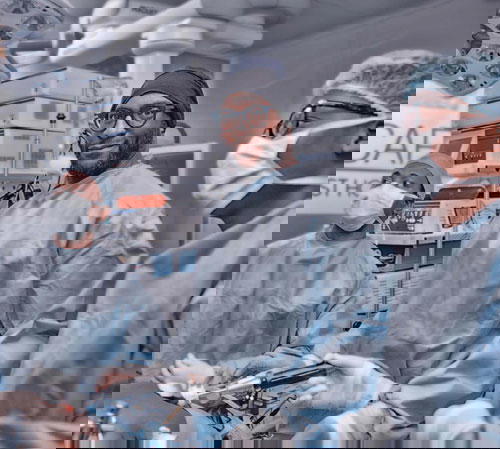
TWENTY one-year-old Ayo was getting a sexual health check up and was stunned to learn he had just one testicle. He was compelled to call his mother to find out where his missing testicle was after the physician, Dr Naomi, confirmed he had only one.
Ayo was being checked as a patient on Channel 4’s show “The Sex Clinic” on E4 when the discovery was made. “‘So I can only feel one testicle…have you only ever had one testicle?” Dr Naomi asked him.
Ayo visited to get an STI test and check his testicles for lumps, according to reports, but what alarmed the doctor was the fact that one of his testicles was missing, while Ayo didn’t seem too concerned, asking: “Should I be worried?”
She explained that if the testicle was still within the body cavity, it could later become cancerous and asked Ayo if he could find out more about his clinical history.
He then phoned his mother to ask if he had been born with only one testicle, or if he’d ever had surgery in early childhood. More baffling was the fact that even Ayo’s mother had no idea why he had just one testicle.
“You’ve always been that way,” she replied.
Naomi, clearly a little baffled by Ayo’s casual attitude, told him : “If you’ve got one testicle, then the question is where’s the other one?”
Ayo replied: “I’m not too sure. I thought it was a less common thing. I’ve been aware of it, I just didn’t think much about it.”
Naomi was keen to establish whether Ayo has had a testicle removed or whether there could still inside his body.
The doctor said: “I find it interesting that this hasn’t come up in a conversation with your mum before.”
She explained: “The danger is if you have an undescended testicle that is somewhere in a body cavity, the risk is if that becomes malignant, we’re not going to pick it up.
“And there’s a higher risk of becoming malignant if it’s in a body cavity because it’s hotter.”
Ayo struggled to remember if he had an operation to remove the testicle as a baby, or whether his parents have ever mentioned the removal in the past.
He was born in Nigeria but has lived in Dublin since he was a toddler.
He said he didn’t remember much of the early years of his life, which may explain why he wasn’t sure whether he had ever had a testicle removed.
Naomi went on to ask him if he could phone his mother to see if she was able to shed any light on the situation.
The doctor told me I only have one testicle, do you know why that is?’ he asked his confused mother.
“Was it removed, or just, like, never found? Was I born with just one testicle or what?”
But Ayo’s mother also seemed unsure about whether his testicle was removed or if he was just born with one.
At first she suggested that the testicle may have been taken away in a hernia operation when he was a toddler, but later she decided he was just born that way.
“I think it was just, you know… you had surgery when you were much younger.” Asking if that was when his testicle was removed, she replied: “No, you had a hernia.”
Ayo probed further. “So they went and chucked my testicle out with my hernia?”
“No they didn’t, I think you just had one,” his mother finally clarified.
Other patients were shocked to hear Ayo’s story, with one girl saying: “Oh my god”. As Ayo explained it was unclear whether his testicle had been removed or was lost, another said: “Oh, wow”.
Naomi suggested Ayo speak to his GP about what the hernia operation might have been, and whether it could have been a removal of a testicle.
“If it’s not clear, I’d suggest having an ultrasound to find out if there is an undescended(cryptorchid) testicle somewhere along the tracks,” she said.
Though a little embarrassed, Ayo is pleased to hear that only having one testicle would not affect his ability to have children or his sexual performance.
At the end of the programme he said: “It doesn’t change anything about my sexual health or my performance in the bedroom. Just live with your one testicle only. Just be yourself.”
Undescended testicles occurs in about 1 in every 25 boys. In most cases no treatment is necessary, as the testicles will usually move down into the scrotum naturally during the first 3 to 6 months of life.
If the testicles haven’t descended by six months, they’re very unlikely to do so and treatment will usually be recommended.
This is because boys with untreated undescended testicles can have fertility problems in later life and an increased risk of developing testicular cancer.
Treatment will usually involve an operation called an orchiopexy or orchidopexy to move the testicles into the correct position inside the scrotum and permanently fix it there. It is is a relatively straightforward operation with a good success rate.
Orchiopexy typically also describes the surgery used to resolve testicular torsion.
A small incision is made in the groin area over the testicle. The doctor will locate the testicle and bring it down into its proper place in the scrotum.
A second incision will be made in the scrotum.
Tiny sutures or stitches that dissolve on their own will be placed under the skin to make sure that the testicle does not pull back up and out of the scrotum.
The incision will be covered by a simple dressing that you will be told when and how to change. When the incision is fully healed, most children have only a small scar from the surgery. The whole surgery takes about an hour.
In unilateral cryptorchidism, the incidence of infertility may be as high as 32 percent and up to 59 percent of men with bilateral cryptorchidism may be infertile despite surgical correction by orchidopexy; records show that 89 percent of untreated undescended testicle patients with bilateral maldescent develop azoospermia (zero sperm count).
Normally, before birth, a baby boy’s testicles are located high in the belly (abdomen). As the baby develops inside the mother, the testicles drop down through an opening in the wall of the belly and pass into the scrotum, the sac of skin that holds the testicles on the outside of the body. In some cases, the testicle may not drop down on its own and may stay high up in the abdomen or groin area.
This condition is called cryptorchidism or undescended testicle.
Orchidopexy is an “elective” surgery, which means that surgery can be scheduled at the parents’ earliest convenience.
Orchidopexy surgery to repair an undescended testicle is important because bringing down the testicle may improve its function and prevent it from being damaged.
An undescended testicle has a higher risk of testicular cancer. Although bringing the testicle down into the scrotum may not remove that risk, it will allow doctors to be able to feel any abnormalities in the testicle on routine physical exams throughout your child’s lifetime.
An undescended testicle may also have a hernia associated with it that will need to be fixed during the same surgery to bring the testicle down.
Sometimes a testicle never formed or lost its blood supply and died before the child was born. In this case, the doctor will explain what parents can expect and do for the child as he grows up.
Disclaimer
Comments expressed here do not reflect the opinions of Vanguard newspapers or any employee thereof.