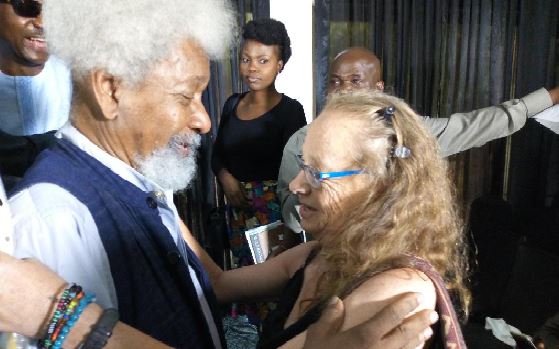
Prof. Wole Soyinka and Yaffer Schuster, Artistic Director of Africa Israeli Stage
By Osa Mbonu,
Arts Editor
I may be dishonest if I claim to be a fan of Professor Wole Soyinka, for the fans of an artist, whether a musician, literary icon, or visual artist are those who love and ‘consume’ the works of the artist. Even as a voracious reader, Soyinka’s works are not my favourites because one, as a writer, he is too high for me. I found his works too difficult for me to understand.

After he won the Nobel Prize in Literature in 1986 and a lot of fuss was made about him, I tried to read some of his books. I guess I must have picked the wrong one – The Interpreters – probably misled by the beauty of the cover. I had to give up and drop the book after putting in quite a great deal of effort. Up till this day, I have never been able to return to The Interpreters. But my late friend and brother, Collins Ebomuche, an unaccomplished poet who taught English and literature in secondary schools, told me that The Interpreters is a very easy work to understand; that it was about the pantheon of gods in Yoruba land. Well, like I said before, I have not made any further effort since then to read Soyinka’s The Interpreters. Maybe if I read the book now, I will be able to understand it, given that I have become older and a more patient reader.
Another reason that denied me the opportunity of becoming Wole Soyinka’s fan was the poetic slant of his writings. Soyinka, in my estimation, is more of a poet and playwright than a prose writer, and I am neither a lover of plays nor a poetry buff. What I love is prose. Although I have written a number of poetic pieces, I have never loved poetry or considered myself a poet. The few poems I have written are short and too simple to be considered as anything great. Take my If I should be a coward as example:
If I should be a coward
When I am in this world
When will I be brave?
When I am in the grave?
But Soyinka, and many other poets are too complex for my simple mind. I have read his Abiku as one of the set poems in my School Certificate/GCE Examinations. In spite of all my addiction to books, till today, I still do not know the contents of his great plays like The Trials of Brother Jero, Death and the Kings’ Horsemen, The Lion and the Jewel, Kongi’s Harvest, and others. However, I am a fan of Soyinka’s radicalism, bravery and activism. I love him because he says the truth and is not afraid of anyone. I also love him for his brilliance and candor.
ALSO READ: After Amaka, Ngozi enters
Only recently, I came across his prison notes, The Man Died, and borrowed it from a friend. I read it in just two days, day and night, using torchlight at night. It turned out to be one of those many books I could not put down once I started reading until I got to the end. The Man Died shook me to the bone marrow. The book bequeathed to me a deeper understanding of who Professor Wole Soyinka is, and I started to look forward to meeting him in real life.
The opportunity came some time last year when I went to cover the launch of his new book, Quis Custodiet Ipsos Custodes? at The Freedom Park, Lagos. It turned out to be a bad day for me because the book launch also turned out to be both a documented and verbal attack of someone else I admire, Dr. Olusegun Obasanjo, who has a lot more in common with Soyinka than with me.
I left the Freedom Park that day with two strong impressions: Obasanjo’s immutable influence in the affairs of Nigeria and Soyinka’s almost obsessive hatred either for Obasanjo or for that seemingly immutable influence. The erudite professor had hinted on the retired General’s huge influence when he said:
“Some people have been going to see Obasanjo, and when they leave, they come to see me in Abeokuta and we discuss. And that is why I am incensed at any attempt to hijack possible movement; and I have seen that attempted hijack take place. At the beginning for instance, the first group that came out was Agbakoba’s Intervention Group in which Oby Ezekwesili was a member. And the next thing I heard; the same terminology that was used before was “Ota”, and I said, what on earth is going on? Why can’t young, new blood be allowed to do this without (Obasanjo)?”
Throughout the event, my camera followed Soyinka. When it finally came to an end, I trudged among the crowd clicking the shutter button of my camera as he stood with one important dignitary after the other. Other guests in the crowd seemed to be people to whom Soyinka was an idol. They milled and swarmed around him like flies, each striving to engage him in conversation or touch him.
Suddenly, I saw one elderly white lady approach him. She came and stood before Soyinka, looking up to him with misty eyes. Soyinka, being a highly sensitive person, must have noticed that he had an uncommon fan before him, for he left every other person and faced the old lady.
ALSO READ: Publishing, reading culture diminishing in Nigeria… Prof Bogoro
Slowly, the arms of the old lady moved up and rested on Soyinka’s shoulders. Soyinka held her shoulders too. A Bible verse (Luke 2: 25-32) flashed through my mind. It was a scene where a man who had been waiting all his life to see Jesus the Messiah before his death finally met him:
“Now there was a man in Jerusalem called Simeon, who was righteous and devout. He was waiting for the consolation of Israel, and the Holy Spirit was on him. It had been revealed to him by the Holy Spirit that he would not die before he had seen the Lord’s Messiah. Moved by the Spirit, he went into the temple courts. When the parents brought in the child Jesus to do for him what the custom of the Law required, Simeon took him in his arms and praised God, saying:
“Sovereign Lord, as you have promised, you may now dismiss your servant in peace. For my eyes have seen your salvation, which you have prepared in the sight of all nations: a light for revelation to the Gentiles, and the glory of your people, Israel.”
They stood like that for what seemed as eternity, communicating beyond the medium of words. I shoved through the little crowd, got closer to them and raised my camera, perfectly framing the blissful old lady and Kongi on the LCD screen of my camera. Then my shutters clicked severally in multiple shots. I reviewed my shots and realised that I had taken an award-winning shot with half the head of Jahman Anikulapo and a certain young lady’s full view at the background. The look on the lady’s face was non-descript – she was subtly eyeing the old lady as one who was jealous.
From behind, someone slapped my back so heavily in an expensive joke, shouting “Prof” into my ear. I angrily whirled round to discover it was an old acquaintance from another media house. “My friend you are distracting me. Can’t you see I am working?” I told him furiously.
He ignored my furiousness and snatched the camera out of my hand. When he saw the picture he whistled and said: “Oh my God! Please send this picture to me.”
As I looked up again, the old lady was gone, leaving Soyinka to attend to some other guests. I searched around the hall but couldn’t find her. I had wanted to approach her to get her name for captioning my award- winning picture but she was gone. I got angry with the friend who had slapped my back at that particular time and distracted me from seeing when the old lady was about to disentangle from Soyinka.
I decided to search further at a different wing of the hall. Someone held me again from behind. “Have you sent the picture to my e-mail?” I turned round, it was the same journalist friend who had made me miss the old lady.
“Get off my back!” I hissed at him, roughly shoving him away. He saw the flames leaping out of my eyes and scurried away.
We met again in an inner room where Soyinka had retired to rest after autographing many copies of his books for many people. A few of us, including Henry Akubuiro of The Sun, were looking for the Nobel Laureate to autograph our own copies of his new book. Jahman Anikulapo, former editor of Sunday Guardian took us to the inner room. We put our books before Soyinka to write our names and append his signature on the opening pages of the books.
“What name should I write?” the Prof. asked the first person.
“My name is …” The owner of the name had to spell the names for him. Soyinka laboriously wrote it and signed the book. “People should bear simple names,” he said.
It was Henry Akubuiro’s turn. “Henry Akubuiro,” Henry told him, spelling the surname for him. He wrote the name, making a face that seemed to suggest that Henry’s name was fairly easy.
When it got to my turn I said “Osa Amadi.” He first looked into my face. I felt he was teasing my white beards as a male lion would tease the scanty hairs around the neck of a female lion. “Simple name; yea,” he muttered, wrote ‘To Osa Amadi’ and emblazoned his signature, which is as complex as his style, under my name.
I bent down beside him and tried to take a selfie with him but he protested. “No, no, no. This picture, picture of a thing….At least I have autographed the books for you guys. That should do.”
We apologised and left the Prof. alone. He looked tired. I wondered what it would be like for one to be mobbed by crowds of people wherever one goes.
Disclaimer
Comments expressed here do not reflect the opinions of Vanguard newspapers or any employee thereof.