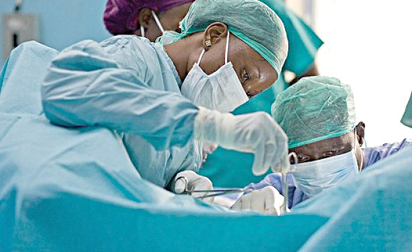
File image
By Taoheed Ajao
Conceived as a citadel of medical education to offer services of specialized facilities for medical training and research, the University of Medical Sciences, the first in Nigeria, located on Laje Road, in Ondo, was founded by Ondo State government on the 22nd of April, 2015.

File: Doctors
The university has not only lived up to its uniqueness in the application of modern techniques in the teaching of medicine, it has also blazed the trail in institutionalizing intellectual discourses that have attracted the participation of high profile personalities on various aspects of the country’s national development.
The university has classified its discourses into three main categories: 1) the Distinguished Guest Lecture series; 2) the Founders’ Day Lecture series; 3) the Annual Public Lectureseries, with each one of the three series specifically designed to address issues of human impact relevance. To continue to disseminate information from academia to the community on varied national and topical issues, especially as they relate to health matters and as a way of promoting town-and-gown relationship, the university has instituted the Distinguished Guest Lecture series.
Nagging wife cannot keep husband for long – Bukky Ogunnote
The series was started in 2016 in efforts to strongly position the university to lead the pathway for addressing the major health and educational challenges facing the country.
Although there have been four lectures delivered so far in this series, the very first Distinguished Guest Lecture titled: “We Reap What We Sow”, was given by Emeritus Professor of Obstetrics & Gynaecology and former Vice Chancellor of the University of Port Harcourt, Prof. Kelsey A. Harrison on Wed. 15th of June, 2016.
His lecture was on the appallingly high maternal mortality in much of sub-Saharan Africa and the compelling need for safe motherhood practices. His submission was that the unpleasant statistics on infant and maternal mortality were a function of poor obstetric care. The poor obstetric care in the words of Prof. Harrison, “is in turn, one result of the chaotic socioeconomic and political systems, which is the major underlying disease that has to be treated.” In order words, a chaotic socioeconomic system reinforces negative health indices hence, the title of the lecture: We Reap What We Sow.
The second Distinguished Guest Lecture was given by Prof. Joseph Balogun, Professor of Physiotherapy, from Chicago State University on “The Case for a Paradigm Shift in Education of Healthcare Professionals in Nigeria” on the 15th of May, 2017.
Prof. Balogun discovered the existence of some curricular dysfunctions in Health Sciences education in Nigeria and made renovations and suggestions to be implemented in the training of healthcare professionals. He advocated for service learning, commitments to primary healthcare and a return to what he called the “Ife legacy” — a first degree in the Health Sciences requirement prior to medical education, wh ich became a mainstream paradigm later embraced by the NUC in 2016.
Resident doctors worry over high maternal mortality rate
The third Distinguished Guest lecture, “The Future of Health and the Promise of Primary Healthcare” by Prof. Mohammed Ali Pate,former Minister of State for Health and global Public Health expert, on the 19th of Oct. 2017, dwelled on critical issues relating to primary care and how these can enhance the development of primary healthcare and its eventual consolidation to ensure universal access to quality care for all.
His Excellency Nasir el-Rufai’s lecture: “ Transforming Nigeria’s Educational System: Looking back and looking forward” on the 30th of April, 2018, was the fourth Distinguished Guest lecture. It was majorly on rebranding the educational sector for better impact and efficiency from the perspective of political administration.
Supported with evidential statistics on the progress of his educational reforms in Kaduna State, Governor el-Rufai showed how he anchored his reform programme on the prioritization of human capital and the democratization of access to educational opportunities.
While the first three lectures in this series dealt with issues of healthcare delivery, for wider intellectual scope and a more eclectic selection of themes, the fourth one was on repositioning the educational sector for optimal performance from the perspective of political governance.
The Annual Founders’ Day Lecture series was instituted to commemorate the founding of the university around the first week in every December, since the 8th of December was actuallythe date approval from the NUC to commence academic programs was given in 2015. This Founders’ Day Lecture series, according to the Vice Chancellor, Prof. Friday Okonofua, “…was conceived in 2016 to give opportunity to reflect on the achievements and challenges experienced by the University during the preceding year, and to provide impetus for accelerated action to do things better in the following year in order to meet the laudable mission and vision of the school”.
The very first Founders’ Day Lecture tagged “The University of Our Dream” was delivered by Prof. Adamu Rasheed, the Executive Secretary of the National Universities Commission, on Thur. 9th of December, 2016. “Secrets of Founding” was the theme of the second Annual Founders’ Day lecture delivered by Aare Afe Babalola, Founder and Chancellor of Afe BabalolaUniversity, Ado Ekiti on the 7th of December, 2017.
Orphan emerges Caleb University best graduating student
The third Annual Founders’ Day Lecture, titled “Ethics, Law and Medicine as Foundation for National Development” by frontline lawyer Chief Wole Olanipekun, SAN, was delivered on the 6th of December 2018.
While the first two Annual Founders’ Day Lectures centered on the best ways of giving the tertiary institutions sound and judicious funding platforms and repositioning both the students, and academic staff for maximum educational impact, the third lecture by Chief WoleOlanipekun SAN, dwelt on how the interplay of good ethics, rule of law and healthy habits can redound positively to society’sdevelop ment and professional satisfaction.
The Public Lecture Series provides a forum for intellectual treatises on any area of interest to the university or society at large. It is also a platform for expositions on germane issues of national importance which even surround ing communities somehow share in their microscopic replications.
The first Annual Public Lecture titled “Some Efficacious Nigerian anti-cancer Herbal Remedies” was delivered on the 31st of August, 2017 by Emeritus Professor of Chemistry, Prof. Joseph I. Okogun. The second Annual Public Lecture, “New Universities as New Opportunities to Reform Nigeria’s Tertiary Educational System” was delivered on March, 20, 2018, by Prof. Oladapo Walker, professor of Pharmacology.
While the first lecture in this series canvassed better harnessing of the unique potentials of the medicinal powers of herbs and roots and the revolutionary application and academic standardization of the acquired knowledge to provide an alternate and sometimes, complementing paradigm of cure to orthodox medicine, the second told of the unexplored possibilities of modelling the newly created tertiary institutions after recognized global universities which excel in both 21st-century cutting-edge knowledge and unbelievable attraction for research grants.
Engineers blame lack of maintenance design for infrastructural collapse
Thus far, in the three year-history of the university, nine lectures have been delivered by nine outstanding Nigerians whose elucidation of the themes of their lectures, has helped in raising the bar of intellectual inquiry and promoted the deepening of communication between the intelligentsia and the public at large.
The lectures have also become inspirational and motivational for the staff and students and have been the university’s contribution to the advancement of matured dialogue in the search for a better Nigeria.
Disclaimer
Comments expressed here do not reflect the opinions of Vanguard newspapers or any employee thereof.