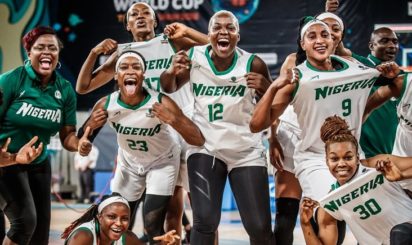
Nigerias D’Tigress
Nigeria is one of those postcolonial states in the world whose predicament has generated a significantly vibrant academic literature. Nigeria’s postcolonial realities have been the subject of many theories and intellectual frameworks. Scholars like Billy Dudley, Claude Ake, RotimiSuberu, BayoAdekanye, Richard Joseph, ToyinFalola, the late KunleAmuwo, Wale Adebanwi, and so many others have generated reflection points and theories that, for them, enables us to come to terms with the postcolonial realities that keep defeating the aspirations of Nigerians.

Women stand by candidates they believe in all the way, so politicians do a lot to gain their confidence. I thank Nigerian women who put their confidence in me and voted for me in 2015; …seeing this gathering. I am confident that the confidence is still there.” — Pres. @MBuhari
For example, Professor Adekanye, for example, provides us with a civil-militaryfundamental lens with which to examine and interrogate the relationship between the military and the civilian elements in any postcolonial state as means to understanding how such a state could ever hope to achieve development. This was a necessary perspective given Nigeria’s long history of military intervention in politics. And it becomes all the more a relevant theory given the trajectory of democratic dispensation in Nigeria since 1999 especially the dominant hold that Diarchy or elites with military background is wielding on the polity and its dynamics.
But one of the most significant theoretical interventions that enable us to see clearly the behavior of the Nigerian political elite is Richard Joseph’s theory of prebendalism. This theory morphs into the patrimonial understanding of Africa’s politics to highlight how the Nigerian political elites, especially in the Second Republic, perceived the state as a personal fiefdom that allow them (a) to perpetuate themselves in political offices and maintain political statuses against the expressed wishes and aspirations of the electorates that elected them into offices in the first place, and (b) decimate the offices they hold by turning it into a place for personal aggrandizement, and the maintenance of a clientelist network of hangers on.
The implication is then that those who hold the rein of power in the state deploy critical state institutions and structures for exploitative rather than developmental and democratic objectives. We therefore arrive conveniently at the conclusion of Acemoglu and Robinson, in Why Nations Fail, that the difference between the poverty and the prosperity of nations is the difference between the politics they play with their structures and institutions.
While prosperous nations have built inclusive institutions that undermine the prebendal tendencies of their leaders, poor nations allow their leaders to deploy their structures for extractive purposes and personal aggrandizement.
One of the lessons that political theory impressed on my intellectual arsenal is that there are many alternatives that could assist in interrogating a problem. Nigeria’s postcolonial project of nation building is often seen in the light of fundamental political and socioeconomic variables—ethnicity, political power, party politics, economic development, and so on. There is no reason why another alternative should not be proposed. There are two significant narratives that have been central to my analysis of the Nigerian predicament.
On the one hand, I have explored the role of generational capital in getting us to where we are and getting us out of it. On the other hand, I have been fascinated with the relationship between heroism, patriotism and national development. What roles do the heroes of a nation have to play in pushing it towards its national goals and objectives? How does a nation harness the heroic capital it is endowed with to further its national development? Is a hero always patriotic? Or is heroism inherently unpatriotic?
This is a dimension that has hardly received any significant treatment in the political discourses on Nigeria. And this is for good reasons too. Nigeria’s political woes and development impasse are usually taken to be beyond individual capacities to encompass fundamental political, social and economic variables. The search for the Nigerian hero or heroine, or the place of heroism in the remaking of the Nigerian society or state, is hardly considered one of such fundamental variables. And, what is even worse, heroism is all about individual Nigerians.
Yet, I think it is high time we started analyzing the roles that heroes and heroines can play in remaking Nigeria. For me, it is high time we began to reassess the variables that enable us to rethink what Nigeria is and what it needs to do to become what it urgent need to become.
The good side of heroism as a theoretical understanding of Nigeria’s national project is that unlike prebendalism, it is more of a positive analysis of how we can get out of where we are. I am not ready to oppose the heroic to the prebendal, or see the idea of national heroism as an alternative framework that is better than the existing understanding of the Nigerian state and its predicaments. This is because there is no one theory that has the capacity to explain Nigeria’s problems and fashion a way out of it.
On the contrary, we can only better understand what ails Nigeria if we continually achieve theoretical and practical constructs that assist us in arriving at solutions that could reorient our understanding. The theory of the heroic in Nigeria’s historical trajectory therefore becomes a means by which we can articulate the contributions, or the lack of it, of those we can call significant individuals—Nigerians—to the directionand development of the Nigerian state and society.
In a recent interview with the German newspaper, Der Spiegel, Emmanuel Macron, the French President, raised issues about what he called at different points in the interview, “political heroism” and “democratic heroism.” The summary of his submission, indeed the title of the interview, is “We need to develop political heroism.” According to him, “We need to develop a kind of political heroism. I don’t mean that I want to play the hero. But we need to be amenable once again to creating grand narratives.” The context in which Macron was talking gives us an insight into what he meant by “political heroism.”
https://newlive.vanguardngr.com/2018/12/un-catalogues-unimaginable-horrors-faced-by-nigerians-in-libya/
First, the interview commenced with the German philosopher Hegel’s statement about Napoleon Bonaparte as embodying “the world spirit on horseback.” Hegel’s sense is that the great men who steer the course of history only do so not for individual reason, but for a greater cause which in itself is larger than the individuals.
A hero is not someone who could scales walls or dodges bullets. He is definitely not Spiderman, and she is not Superwoman. It is in this sense that Macron insisted he is no hero. Heroes and heroines are normal humans with the foibles and weaknesses of an average human being. But they are distinguished by the sense of the extraordinary. According to Arthur Ashe, “True heroism is remarkably sober, very undramatic. It is not the urge to surpass all others at whatever cost, but the urge to serve others at whatever cost.” In Macron’s case, it is serving France and moving it forward. That is a simple definition of heroism that could be attached to every act of political heroism across the world. In Nigeria, to be politically heroic is to be distinguished by the optimism of belief in the possibility of a Nigerian future. A Nigerian hero would be one, academic, intellectual, politician, scholar, business person, anyone, who refuses to give up on the culmination of the Nigerian national project in an eventually united and prosperous nation “bound in freedom, peace and unity.”
To achieve analytical utility, we need to further restrict the circumference of heroism. There is no doubt that across the over 190 million Nigerian, there are heroes and heroines everywhere, from Sokoto to Calabar, and from Yola to Lagos. There are millions of Nigerians who are, in their own little corners of the Nigerian society, bracing up to the herculean challenges of standing up for Nigeria and trying to rehabilitate her postcolonial realities.
There are many diehard Nigerians who remain optimistic that Nigeria deserves national existence and progress. The sum of their collective heroism would certainly make for a serious empirical research on the impact of small efforts on national development in Nigeria. However, a useful starting point for the analysis of heroism within the Nigerian national context would not be collective but political heroism. This would refer to the sociopolitical, economic and cultural efforts of individual Nigerians sufficiently visible to warrant attention from the Nigerian state and from Nigerians. It is critical reflection on the individual and sum total of all these acts of the politically heroic that I am arguing could not only provide a deep insight into the trajectory of Nigeria’s political history but also enable us to see into the possibilities of heroism charting a way out of our political stagnation.
There is no nation that can ever hope to survive without her heroes and heroines. They constitute a significant portion of the entire population, and their relationship with their nations constitute some kind of prophetic assistance that such nations will disregard at very costly consequences. And this also applies to scholarship, especially in Africa.
https://newlive.vanguardngr.com/2018/11/buhari-restates-commitment-for-free-fair-2019-elections/
There is no harm in testing the analytic capacity of political heroism as an intellectual means by which to further understand where Nigeria is coming from and where it hoped to be. Just as a hero or a heroine is distinguished by an overwhelming courage to stand against all odds to perform a heroic act, there is also the need for courageous Nigerian intellectuals and scholars who are not afraid to test the waters. And, for me, the starting point is to first identify those political heroes, and how their heroic acts have influenced or affected Nigeria one way or the other.
Professor Tunji Olaopa Executive Vice-Chairman, Ibadan School of Government &Public Policy.
Disclaimer
Comments expressed here do not reflect the opinions of Vanguard newspapers or any employee thereof.