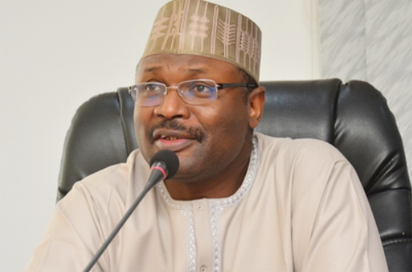
INEC boss, Prof Mahmood Yakubu
By Emmanuel Aziken
The revelation that the Independent National Electoral Commission, INEC has agreed and has indeed, adjusted its costing for the organisation of the 2019 elections to N143 billion down from the N189 billion it earlier canvassed must have gladdened many Nigerians.

INEC boss
By the decision, the commission may have saved the country at least N46 billion. That is the amount that would have if properly channelled could banish poverty in at least two states of the country if properly invested!
However, there is little to praise the commission or its leadership for in this respect. Indeed, the quick surrender of the commission again draws to mind suspicions on the integrity of the commission’s plans towards the conduct of a free and fair election.
Indeed, the commission’s chairman in at least two interactions with this correspondent has espoused the commission’s sincerity and commitment towards the conduct of a free and fair election. Some of his staff, particularly media liaisons, are some of the most convincing, suave and yes, arguably sincere officers in public service.
This is despite question marks arising from the disturbing issue of vote buying that has marked recent elections in Edo, Ondo and recently, Ekiti States.
However, the sums and stories do not add up. First the sums. How the commission was able to within hours shave off N46 billion from its estimated cost is a wonder that is difficult to comprehend. Does it mean that the commission allowed padding in the figures first presented to the National Assembly?
The question is, could the commission have conducted a free and fair election with N143 billion and still submitted a bill of N189 billion?
Even the N143 billion approved to be expended this year is also bound to raise questions given the steep increases in the funding for the election.
The 1999 election, unarguably the freest and fairest of the elections of the Fourth Republic cost the nation a total of N1.5 billion. Subsequently, the figures have continued to rise. In 2003, it was N29 billion, 2007 was N45.5 billion, 2011 cost N122.9 billion while the 2015 cost N108.8 billion.
The reduction in the cost of the election in 2015 was despite the introduction of the card reader. Though some card readers would still be procured to make up for losses and other damages as in Rivers State, the escalation of the cost is bound to worry some.
One reason that has been given for the escalation is the steep devaluation of the naira under the Buhari administration.
The commission nevertheless, needs to propound measures to drastically cut down on its expenses. Increasing cost and introduction of devices have not in any way made elections more acceptable. The fairest election in Nigeria in recent memory was the June 12, 1993 election which did not even involve the use of ballot papers!
Even more challenging for the Prof. Mahmood Yakubu led INEC is its justification for putting the presidential election first. There is no sound basis for putting the presidential election first. Amusingly, the commission has not been able to give any logical reason for starting at the top instead of starting from the bottom.
Does anyone forget that the first elections at the onset of the Fourth Republic started with the local government elections? It was also so in the Third Republic when the military started from the local government level.
The elections that kick-started the Second Republic in 1979 also started from the lowest level and peaked with the presidential. So, why the Yakubu led INEC has insisted despite its proclaimed independence in putting the presidential as the first and by that sparking a bandwagon effect is yet to stand to reason.
Disclaimer
Comments expressed here do not reflect the opinions of Vanguard newspapers or any employee thereof.