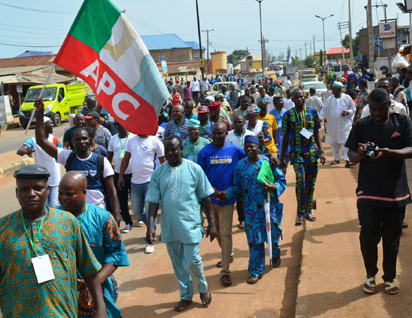
apc
By Paul Odili
In the past two weeks there have been defections from APC to opposition political parties to foreshadow 2019 general election contest. However, these departures are not a deathblow on APC, far from it, if you do a bit more insightful individual, piece by piece analysis. Thunder will not strike twice. APC is in a relatively better shape than PDP of 2014 when it suffered similar departures. There will be no regime/party collapse of APC in 2019. For perspective observers, these defections had long been in the pipeline. Those leaving the party had long made their determination, what was undecided was the timing and with it the political theatre to accompany their leaving. A leaner APC at this time is not entirely such a bad thing.
Actually a leaner APC should inspire those not defecting to recommit to, a stronger and inclusive party, clear direction and even clearer ideology. Also APC to plug the hole left by those leaving the party to contestagainst it in the general election must ensure proper leadership recruitment through free and fair primaries. Such primaries empower the party’s’ rank and file to freely vote their preferredcandidates and equally as well permit them to take ownership of such candidates unhindered.
Happily, Governor Adams Oshiomole as APC chairman is veering in a positive direction of direct primaries. Transparently done direct primary is a boon to APC ahead of 2019. These defections are also triggered by personal ambitions of some of those involved. Moreover, it is unlikely that if you wish to run for the presidency that APC is such a viable platform. The chance of anyone defeating PMB at the primaries is nil. In 2014 the PDP National Assembly intimidated President Jonathan into conceding party tickets to the federal lawmakers against Governors. APC Chairman Oshiomole made the point that the party has no plan to give return ticket to anyone, an offer other parties are ready or have already granted APC decampees. This was a clear signal to those in the National Assembly wishing to return that their chances of wrestling tickets from the Governors is slim, if they are not aligned with state Governors.
The point is that a party of incompatibles is like driving a vehicle with four flat tires, it simply is an impracticable proposition. APC today is a party with clear values which has PMB as the president, leader and certainly flag bearer in 2019 general election. When APC settled for PMB, it knew what it was bargaining for, perhaps some in the alliance that formed APC did not fully internalized this. To assume that PMB will depart from what he represents and believes is a gross miscalculation by those who wish to continue with the old order. PMB is anti-elite. He has deep contempt for the elite; he believes they are unpatriotic and the root cause of national collapse. He is not shy in stating this fact. In comments, speeches and action PMB has shown he is a strong believer in change, he is deeply frustrated with business as usual. He believes the common man has been shortchanged. He believes in retributive justice for those who sabotaged the country.
And so to think that supporting PMB to win office and that on his getting there he will trade away his core beliefs on the altar of political expediency is a mistake on the part of some persons. PMB did not run for office as a politician but as a statesman. Next election was not his overriding concern but the next generation. Nigeria had been run down and needs to be revived by introducing progressive change. PMB type of change demands hard work, discipline, honestyand patriotism. Petro-dollar easy money has had tremendous corrosive effect on Nigerians. Reordering Nigeria, our mentality and values is a process that does not have overnight solution. It tool Moses 40 years to weed out Israelites stuck with Egyptian mindset.
A study done by KGB,soviet secret police posits that it takes at the minimum 15-20 years to reform people’s mindset. To therefore assume any transformative political and socio-economic change is going to be easy, a walk in the park is to live in illusion. Such changes are risky, sometime messy and arecompounded by great anxiety caused by its uncertain nature. Are we sure we will ever get there? The reformer and those who are willing to give change a chance question themselves. Yet the chance of survival, of success is to press ahead with courage and boldness—qualities not often in abundance. And so it is difficult to improve upon the observations of 15th century Italian philosopher NiccoloMachiavelli, who in his famous book, the Prince, articulated the dynamics of change and why it is such a hard thing to do.
He said: “It should be borne in mind that there is nothing more difficult to arrange, more doubtful of success, and more dangerous to carry through than initiating changes. The reformer makes enemies of all those who prospered under the old orderand only lukewarm support is forthcoming from those who would prosper under the new. Their support is lukewarm…partly because men are generally incredulous, never really trusting new things unless they have tested them by experience.”
In three years since the coming into power of President Muhammedu Buhari on the platform of change, every attempt to effect change has produced strong resistance and polarisation. The refusal to continue with business as usual is the heart of the issue. The entitled elite, who do not think the rule applies to them are obviously appalled that PMB is resolute in his struggle. It would be recalled that for years PMB was resisted and scoffed at by the ruling class because of what they thought he was capable of, eventually he assumed office and it has become a self-fulfilling prophecy.
The loudest in this class have waged the most visceral psychological battle to weaken popular support for change. Others wilier have a different stratagem, which includes sponsorship of false flag operation that escalates insecurity. The killings going on in different parts of the north, targeting of priests, poor rural farmers, attack on innocent road users are all part of the game to induce mass hysteria and undermine regime stability. Under this pretext security issues become political.
What we see in Nigeria is a scorch earth stratagem against the government—human lives mean nothing, in so far as it destabilizes government, and prevents the continuation of APC government. Direct accusation without proofs have been hauled at PMB that he is backing Fulani herdsmen kill, conquer and dominate lands not belonging to them. I have not seen a more ridiculous argument. Is there anything in PMB track record that hints at him habouringexpansionist designs? The answer is no. And the practical question is: how can such territories besustained—by armed force or by force of law? The herdsmen/farmers clash is not limited to Nigeria. Ghana is facing similar challenges; its government recently began implementing a cattleranch initiative without hindrance. In Nigeria, the cattle ranch initiative has been stymied by religion and ethnicity, propagated by hate merchants masquerading in religion and ethnic garb. Nothing has been left out.
To a large extent, the nation is caught in between the lukewarm support of those who would benefit: the masses (who are confused by the coordinated howling of the revanchist forces, exploiting the peoples’ most basic fear—fear of death).
The National Assembly led by its current leadership has been the most obstructionists that ever emerged since return of democracy nearly 20 years ago. One question I would like to ask Dr. Bukola Saraki is: as Governor, would you have tolerated a Speaker, who behaved the way you behave? The answer is obvious. Sarakiwon’t.
It is unarguable that in 2015 when PMB came into office, the economy was not thriving. Oil price was falling, no savings was in place as buffer, no infrastructure had been built to sustain economic growth, Nigeria was a net importer of basic needs including food, and diversificationof the economy that was needed to rebalance its structure, create employment and reduce povertyhad not even started. Instead government treasury was leaking massively—government was borrowing money to pay salaries, states governments were in arrears of salaries to government workers and had to be bailed out—unaccounted funds flowed out of the treasury, the military was in flight before Boko Haram. It was a country that was falling apart. It is hard not to describe Nigeria in 2015 as a failed state. However, between that time and today, the administration has stabilised the economy. From available indices economic growth has begun and can only accelerate with time. It is true that security remains a challenge and this is not because of lack of effort.
In all I do believe that change under APC is the change that will finally get this country sorted out. The party under Governor Oshiomole is rapidly reforming and working to strengthen internal party mechanisms. In this connection I am confident that before long a stronger, more disciplined and formidable APC will emerge. Nearer home, I completely endorse the decision of the party leadership concerning Delta state APC chairman, as intractable as the crisis was at a time. The confirmation of Prophet Jones Erue as party chairman was the right step, I believe time to come together is now. The battle ahead is monumental and we cannot compete in disarray.
Paul Odili is APC House of Representatives aspirant for Ndokwa/Ukwuani federal constituency and sent this piece from Delta state
Disclaimer
Comments expressed here do not reflect the opinions of Vanguard newspapers or any employee thereof.