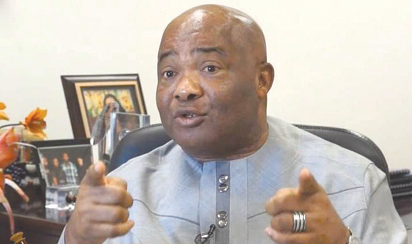
Governor Hope Uzodimma of Imo State
Intellectuals from the South-East were recently challenged to dispassionately analyse the issue at stake in the 2019 elections and come up with a blue print that should guide Ndigbo in arriving at the best Northern candidate to vote for in the election.

•Hope Uzodimma
In formulating the blue print, they should have at the back of their minds, how it should be the sure political road map Ndigbo need to clinch the Nigerian Presidency in 2023.
This was the tall order given to Igbo intellectuals by Senator Hope Uzodimma, Chairman Southern Senators Forum, in his lecture at the University of Nigeria nsukka (UNN) on Monday.
The event was the 14th Eni Njoku memorial lecture where Uzodimma, as guest lecturer, spoke on the topic ‘Intellectuals as Critical Stakeholders in National Development.’
After proving convincingly that no nation can develop without the incisive input of intellectuals, Uzodimma proceeded to applaud Nigerian Intellectuals who, he said, have been ‘up and about’ and doing their best, before specifically charging those from the South-east to come up with ideas on how to permanently re-integrate Ndigbo in Project Nigeria and end their marginalisation which began with the civil war and has lasted till date.
He disclosed that many fora where he delivered lectures, that he had canvassed the well-known view that before the Nigerian Civil War, Ndigbo were the leading lights in the country in academia, industry, the bureaucracy and commerce.
Said he: “We lost that pride of place after the 1966 Coup and it became more manifest from the end of the war. We all know why. We also know that the major set-back we confront in our land today is that Ndigbo have not been able to get to certain exalted positions in the public service, the military and in politics.
“Although an Igbo son, Aguyi Ironsi was the first Major- General of the Army, today Nigeria has three five star Generals, (as you know, this category does not retire from the army) and none is Igbo. How come? You ask? The Civil War.
“Again, although Igbos produced the first President of Ngeria, NnamdiAzikiwe, even if ceremonial. Since 1979, we have had five elected Presidents and no Igbo is among them. Again you ask why? The Civil War! The truth of the matter is that Ndigbo have not been truly re-integrated into project Nigeria since the civil war ended.”
He warned that crying marginalisation to the roof tops will solve no problem because lamentations alone do not solve any problem. The solution lies with clear-headed thoughts on the practical pathway to end our plight so that we can take our rightful positions again in the country.
“Let me make this clear; the plight of our people is truly pathetic. And I do not see any better forum to squarely address it than this august gathering. Many reasons inform my stand. (1) This man standing before you is a full blooded Igbo man (2) As a Senator of the Federal Republic of Nigeria, I should be genuinely concerned on how to end the pathetic plight of our people since the war ended.
(3) The intellectual giant we are celebrating today was also a full blooded Igbo man and one of the first victims of the hate Igbo syndrome by other tribes. This syndrome spread fast after the 1966 coup and counter coup and the civil war, and has become almost institutionalised after the war.
(4) I have seen many egg-heads of Igbo extraction in this event and I think it will do us well to agitate our minds on how we can find a lasting solution to the dilemma.”
He then posed the question: “In the face of the obvious drawbacks we face in almost all facets of society, what should we do? Is it not really intriguing that our younger brothers who were born after the civil war are agitating for Biafra? Does that not tell us that even the post-civil war generation of Ndigbo do not feel accommodated in Nigeria?
“Should we fold our hands as their disillusionment in Project Nigeria deepens by the day? These are general posers I am throwing up for our intellectuals because I am convinced that they have all the answers. I insist that our intellectuals can and should come up with well thought-out ideas on how best to reintegrate Ndigbo into Project Nigeria, where they will have and feel a sense of equity and a level playing ground for all.
“Certainly, option Biafra is no option. We need Nigeria and Nigeria needs us. So we must work it out – how best to co-exist as equal stakeholders.
“Why did Ndigbo do so well in Nigeria before the outbreak of the civil war? The answer ought to be obvious. Nigeria had a true federal structure that provided a level playing field for individual and collective talents to thrive. That is all that Ndigbo need to fulfill their God given destiny; a true federal structure that ensures equity for all. That is also what we mean by restructuring.
“In essence, we should champion the need for the restructuring of Nigeria, a return to the pre-independent and First Republic structure upon which our federal project was rested. We should work relentlessly to actualize the return to the Nigeria that our founding fathers, Nnamdi Azikiwe, Ahmadu Bello, Herbert Macaulay, Obafemi Awolowo, Tafawa Balewa, Dennis Osadebe, etc, agreed to; a Nigeria where power is devolved to the regions as the true federating units.
“A restructured Nigeria will guarantee the South East the sixth State it deserves. It will ensure that Ndigbo have level playing field in Nigeria to take their destiny in their hands. It will naturally and logically end marginalisation in any form or shed. We should push for it until it is actualized.
“In doing this, we must rise with a strong voice to condemn any separatist clamour. We must let our people know that what we need is a balanced Federal Republic which guarantees equity to all, not Biafra.
“One way to do this is to come out as a group to press for restructuring. Our intellectuals should be the leading lights in this direction. They should be able to sensitise and galvanize public opinion to drum up support in the South-East for restructuring. They can do this by holding public seminars, conferences and symposia to advance the logic on restructuring. Make no mistake about it, it is only a restructured Nigeria that can guarantee Ndigbo equity and a pride of place as co-partners.”
For Uzodimma however, the more cogent option beacons. A presidential election is at hand for 2019. As I said earlier, so far, Nigeria has had five elected presidents namely, Shehu Shagari, Olusegun Obasanjo, Shehu Musa Yar’adua, Goodluck Jonathan and Muhamadu Buhari. None was Igbo. What hope does an Igbo have of becoming the President of Nigeria?
What are the chances of an Igbo winning the Presidency in 2019, 2023 or anytime soon. Already the major political parties have zoned the Presidency to the north for 2019. This means we don’t stand any chance of winning the Presidency in 2019. Since we do not stand any chance of winning the Presidency in 2019, what about 2023? My answer is yes, we stand a good chance to win the Presidency in 2023. But we must start now to do the needful. And this is where our intellectuals come in.
I challenge our Igbo intellectuals to come together and analyse the political clock in Nigeria and formulate a way forward for Ndigbo vis-à-vis, our quest for the Presidency in 2023. It is a settled fact that having a Nigerian President of Igbo extraction in 2023 is our sure way of assuaging the battered post civil war psyche of Ndigbo and re-assuring them of their full stake once more in Project Nigeria.
So, I challenge the Igbo intellectuals to chart a road map on how this can be actualized.
Some posers will help in this respect. Which Northern candidate are we sure that if we vote for him must relinquish power in 2023, thus paving way for Nigerian President from the South-East?
What should reason demand, to vote for someone who will do only four years or the one who will do eight years?
As I said earlier, the intellectual is governed by reason not emotion. So, I challenge our Igbo intellectuals to formulate a reason-driven pathway for the South-East in the 2019 elections with their eyes fixed on the Presidency in 2023.
Disclaimer
Comments expressed here do not reflect the opinions of Vanguard newspapers or any employee thereof.