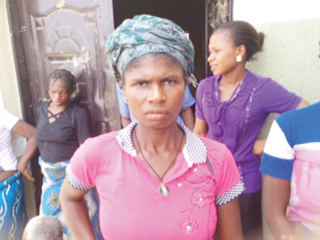
Mrs. Ngur Oryima
Why Nigerians should expect food shortage this year
By Peter Duru, Makurdi
TIME was when Benue State was celebrated as The Food Basket of the Nation and was so recognised in official circles. But not anymore. At least not since some heavily-armed marauding herdsmen invaded farming communities in the state, unleashing terror and destruction in the process. It all started on February 8, 2011 in Gwer West Local Government of Benue State when 19 farmers were reportedly murdered in cold blood and several property, farmland and houses destroyed by the invading militant herdsmen.

Mrs. Ngur Oryima
Since then, hardly a year passed without Benue recording cases of armed herdsmen incursion in the hinterlands. As time went by, the incursion which literally turned Benue villages into theatres of war, spread like wildfire across almost 18 local government areas including Agatu, Apa, Makurdi, Guma, Tarka, Gwer East, Oju, Ohimini, Buruku, Logo, Ukum, Otukpo, Okpokwu, Kwande, Katsina/Ala, and Ado.
Regrettably, the affected local government areas account for the large chunk of food produced and consumed within and outside the state. The implication of this is that residents of these affected areas and communities who are known for their prowess in farming, can no longer engage in large scale food production which they are known for.
The reason being that the marauding herdsmen had since the beginning of the year literally sacked several communities in the state and taken over such areas, rendering the locals homeless and their fertile and arable farmlands turned to ‘grazing reserves’ for millions of cattle.
In the event, over 200,000 original owners of these affected communities who were forced out of their ancestral homes now live a life of despair in eight Internally Displaced Persons, IDP, camps established by the state government to avail them succour. While they live in a state of despondency in these camps, leveraging on the goodwill of the government, organisations and people of goodwill for survival, the farming activities from where they eke their living have been put on hold.
Those who dared to leave the IDP camps to their communities to carry on with their routine life of cultivation of food crop, never made it back alive. They were either shot dead or hacked by the invaders who have now assumed ownership status of the Benue valley. As the days went by, many of the displaced persons, including children who constitute over 60 per cent of the IDPs have lost their lives to illnesses, avoidable killer diseases and unnatural circumstances.
Though the state government and the tribal leaders of the state have persistently called for decisive action on the part of the Federal Government to restore order in the hinterlands of the state by ordering security agencies to chase out the invaders but little has been done in that direction thus far. Even the 45-day military spike operation code-named: Operation Ayem A’Kpatuma inaugurated mid-February by the Chief of Army Staff to restore peace and order in the affected communities, which came to an end in March, achieved little.
Hence, the people are still languishing in the camps, children of school age can no longer attend school and the economy of the state which largely depended on food and cash crop production has gone comatose. The resultant effect is that prices of food stuff which used to be very affordable in the state have all hit the roof and the ordinary man on the street who hitherto enjoyed cheap and affordable food in the state christened The Food Basket of the Nation, can hardly enjoy same at the moment.

Tervershima Terna
Lamenting their ordeal to Vanguard Spotlight, some of the displaced persons expressed worry that aside taking over their farmland for the grazing of cattle, the invaders also destroyed and fed their cows with all the food crop that were due for harvesting before the invasion. For Mrs. Ngur Oryima who said she luckily escaped with her three children, including a two-month old baby from Torkula village early January, when well armed herdsmen stormed her village, she lost all her yam seedlings, all the melon that was due for harvesting in her farm when the invaders marched into the community. “It was on January 2 that herdsmen came to my village shooting sporadically and we had to run for our dear lives. Several persons couldn’t escape alive but I thank God I made it with my children and my husband. Unfortunately, we couldn’t rescue any of our belongings, including all the farm produce we had harvested for sale. All were destroyed and burnt by the armed herdsmen.
“Even my yam seedlings which we intended to plant by February were destroyed and later given to their cows as feed. You know that we are the largest producers of melon or egusi in this part of the country, all was destroyed by them. Today, if you go to the market, you can hardly buy egusi because it now goes for over 10 times the price we used to sell it before the crisis.
“Shea butter is another product that I am into. The trees were all burnt by the intruders. That medicinal plant which we had in abundance in Guma have all been destroyed by the mercenaries. Shea butter production used to be a source of income for majority of us but today, most of the trees have been burnt all because they want to occupy our land. Look at my children, they are looking malnourished because feeding has become a problem. I know one thing for sure, those behind this trauma we are going through will not go unpunished.
“I appreciate Governor Samuel Ortom because he has not abandoned us, he is always coming to give us hope and also assure us that he is working hard to ensure that we all go back home. All we are asking the Federal Government is to use the Army to chase out the people who have occupied our land because we have not wronged anybody,” she said.
Marauding herdsmen
For 18-year-old Tervershima Terna, an IDP from Ter Hinde who claimed he lost both parents few years back, the trauma of living in an IDP camp with his two siblings after losing the home and farmland his parents left behind to enable him take care of his two siblings to marauding herdsmen, had left them helpless. According to him: “Since the death of my parents last year, my two brothers and I have been surviving from our rice farm which is what we do to raise money to pay our school fees.
“But all our farms and houses have been destroyed and all our labour is now in vain. My pain is that we don’t know where to start from whenever we return to our homes because we don’t have anything to fall back on. With the coming of the rains, we are expected to go back to the farms but nobody can do that because it is currently not safe to return to our village which has be taken over by herdsmen.”
On his part, John Ngutor, a farmer who was sacked from his home in Agasha lamented that militant herdsmen had destroyed all Benue was known for. He said: “Benue is known for intensive farming and food production but in the next few years, we might find it hard to feed ourselves because all we had in our food barns and farms have all been destroyed.
“We are now guests at the IDP camps, no farming is going on; all that we were supposed to sell this year were also destroyed by the herdsmen so whether we like it or not, we will suffer food shortages this year. Even at this moment, food prices in Benue State are gradually getting out of the reach of the ordinary man. Rice, yam, cassava, soya bean and guinea corn are already in short supply because most of the communities affected by the crisis are known for massive production of yam, rice and other grains but we have lost all that to the crisis.”
Looming food crisis
“The implication is that we are facing a looming food crisis of unimaginable proportion because even if we go back to our ancestral homes today, it will take us at least another one year to be able to find our footing to be able to go back to our farming activities. So whether we like it or not, the entire country will suffer food shortage because a large chunk of what is eaten in this country comes from Benue State, so the earlier we are able to go back to our ancestral homes, the better for us and the entire country.
“President Muhammadu Buhari must at this time convince us that he has no hand in our sufferings by ordering the military to chase out our killers from our communities and also ensure that the killings are stopped.”
Reacting to the implication of the crisis in the state, the Benue State Commissioner for Agriculture, Mr. James Anbua, said the state had lost over N80 billion worth of food crops to the crisis. “The crisis is already taking its toll on our farming populace; moreover most of the communities affected in the crisis are well known for the massive production of the food we eat here in the state and in other parts of the country.
“The crisis has distorted the life style of our people who dedicate their time and life to food production which is our means of sustenance but the truth is that all that have been distorted and it may take us time to find our footing again and the Nigerian populace will be worst for it because it has become obvious that we might not be able to avoid food shortages in the coming years in the country as a result of the crisis.”
Disclaimer
Comments expressed here do not reflect the opinions of Vanguard newspapers or any employee thereof.